Teardown
Louis Vuitton: a €1,850 gift, and its best reassurance is hidden behind a click
Alexandre Suon · 2026-11-11
Louis Vuitton has built one of the most complete gift journeys in luxury e-commerce: free delivery the same day in Paris, a gift box on every order, a printed message, and advisors on WhatsApp. But on the product page, the two promises a gift buyer needs most, returns until 31 January and a receipt without the price, sit behind closed panels. Issue nº2 of The E-commerce Teardown: the holiday journey screen by screen, and the five tests we would run next.
Executive summary
- The holiday season starts on the first screen. The homepage opens on "Le voyage des fêtes" with a link to the gift selections, and "Cadeaux pour les Fêtes" is the third entry of the menu, right after Women and Men.
- Delivery is promised where the decision is made. Under "Ajouter au panier": free delivery, the same day in Paris, the next working day everywhere else in France.
- Gifting is built into the bag, for free. "Cette commande est un cadeau" adds a printed message of up to six lines, a recycled paper bag is one tick away, and every order ships in the signature box.
- A person is never more than a click away. "Contacter un conseiller" sits under the button, the phone number tops the bag and the checkout, and the gifting panel offers WhatsApp, Apple Messages and Messenger.
- The two strongest gift promises are hidden. Returns extended to 31 January and the price-free receipt only appear inside closed panels on the product page. The receipt is never mentioned in the bag or at checkout.
- Gift browsing has no budget. The gift hub shows no prices at all, the gift listing shows its first price about three screens down, and the filters offer no price range.
Section 1 · Homepage and menu
The holiday season starts on the first screen
The homepage opens on a film, "Le voyage des fêtes", with a single link: "Découvrir les sélections cadeaux". In the menu, "Cadeaux pour les Fêtes" comes third, before bags, fragrance and jewellery. For a brand whose catalogue runs from a €220 make-up palette to trunks, putting gifts first in November is a clear choice.
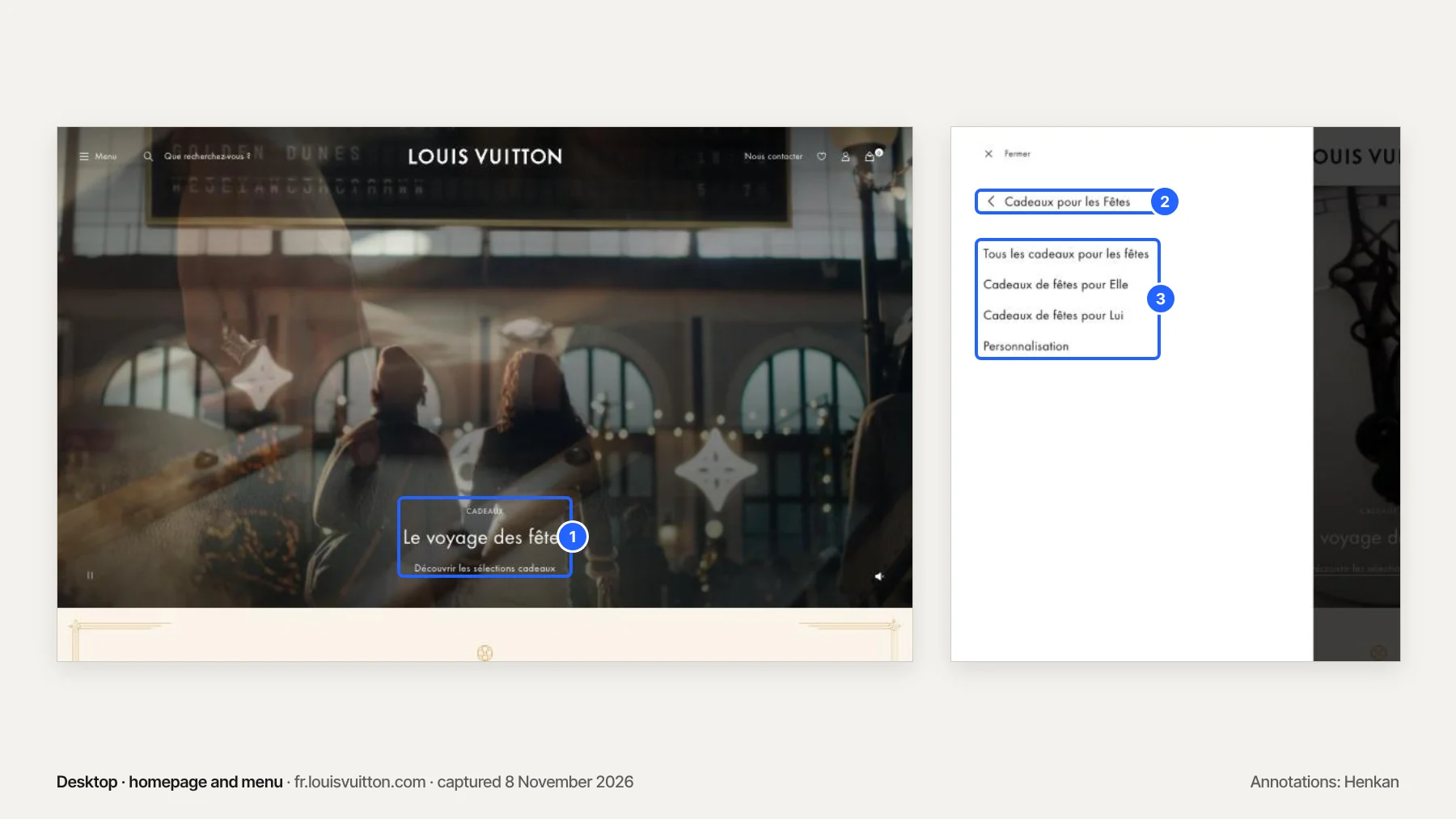
The four entries split gifts by recipient: for her, for him, personalisation. That matches how people start, but not how they decide. Most gift buyers arrive with a budget in mind, and nothing in the menu speaks to it.
Section 2 · Gift hub
The gift hub is a magazine with no prices
"Tous les cadeaux pour les fêtes" leads to an editorial page: a film, two gift guides (for her, for him), category blocks and the Maison's services. It is about 10,000 pixels tall on a laptop screen, and it shows no price at all. Every product decision is pushed to the next page.
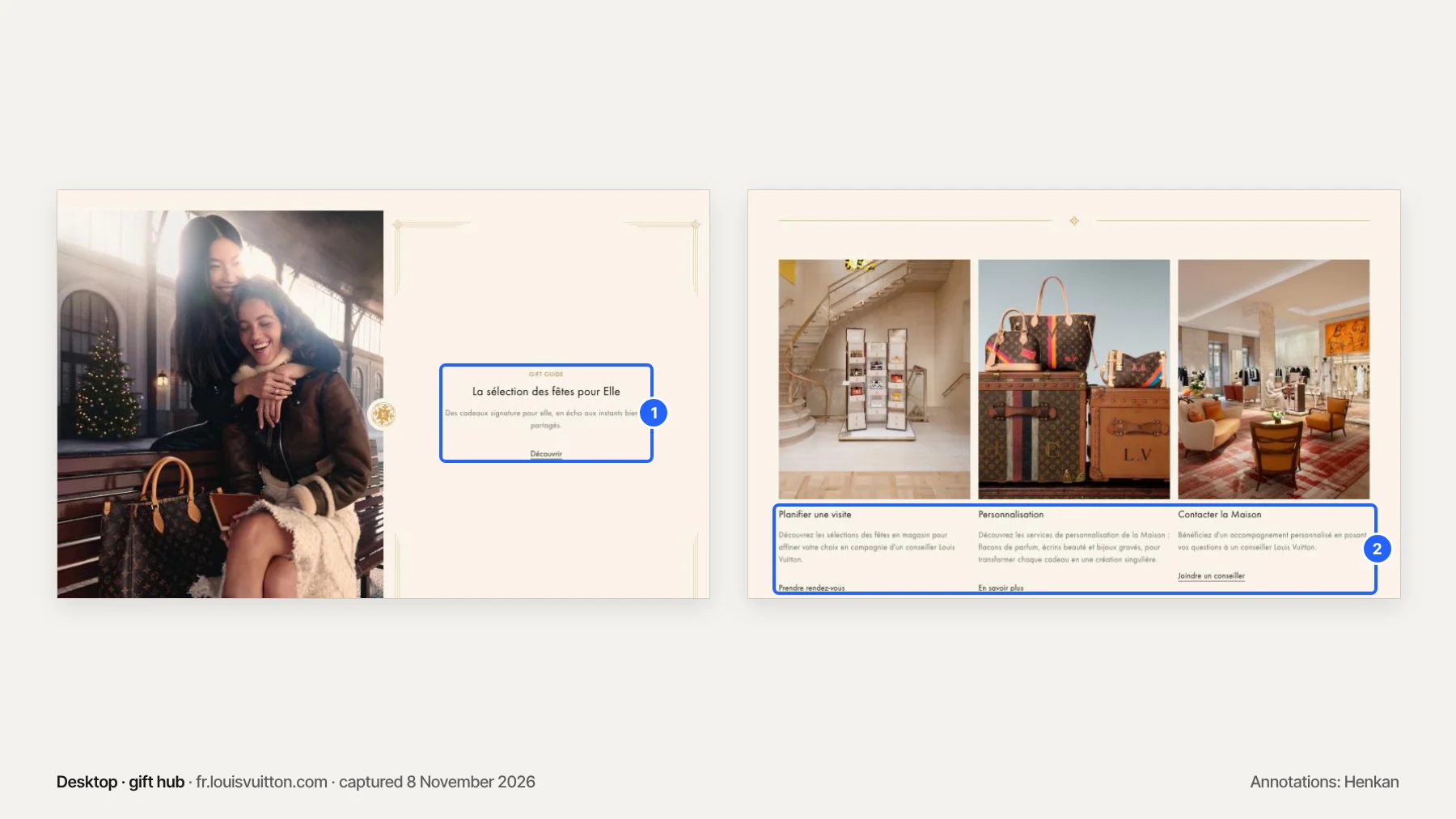
The services block is the best part of the page: book an in-store visit to see the gift selections, engrave a gift, or ask an advisor. It sits at the very end, after every category.
Section 3 · Gift listing
The gift listing mixes a €220 palette and a €1,850 bag, with no way to filter by price
"Cadeaux de fêtes pour Elle" opens with a video banner and a chapter selector. The first price appears about 2,600 pixels down, more than three laptop screens. The grid itself is beautiful: a bento layout where a make-up palette at €220 sits next to a Nano Speedy at €1,850 and a necklace at €460.
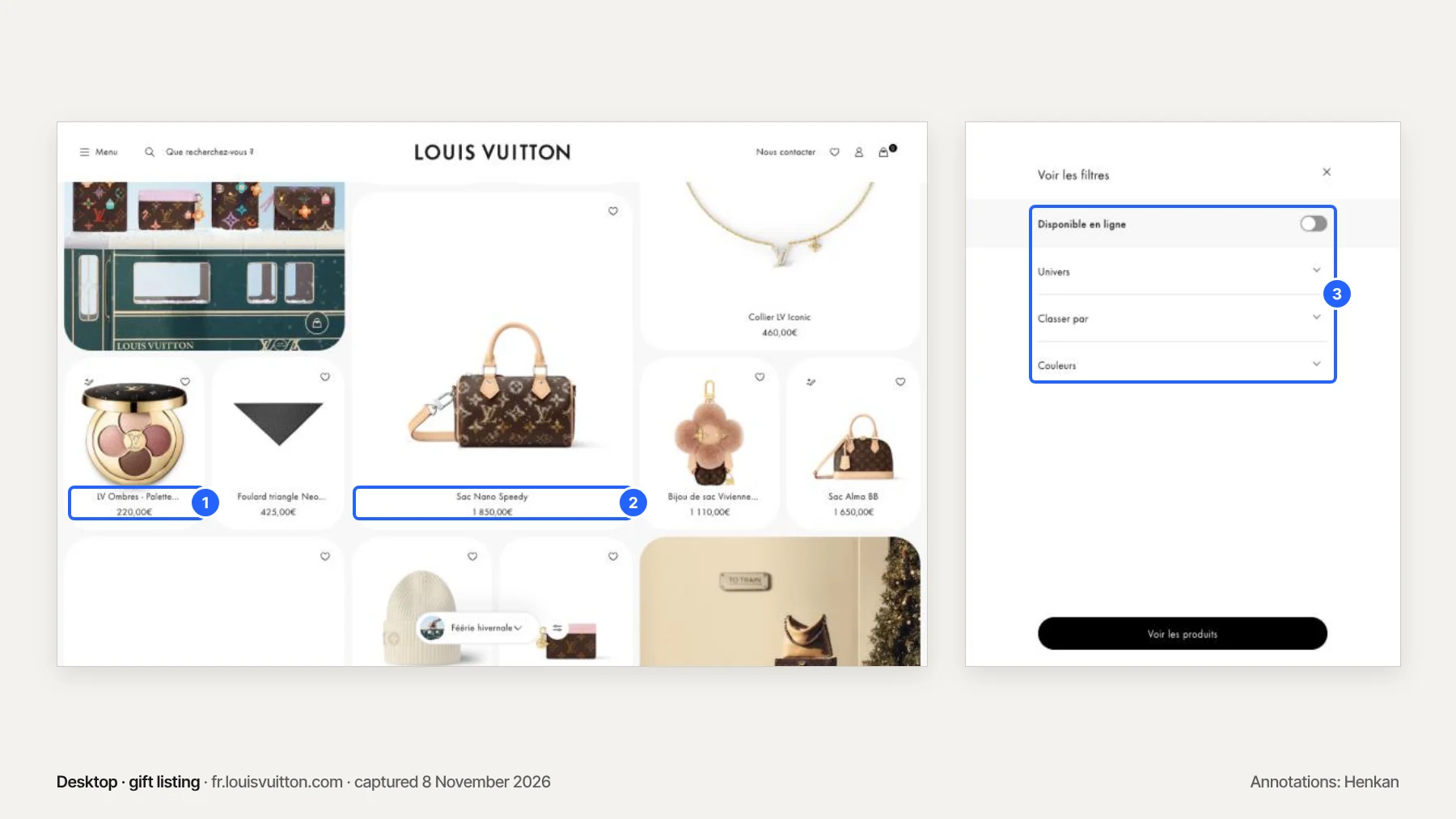
The filters offer online availability, universe, colours, and a sort by newness or price. There is no price range, so a shopper with €500 to spend scrolls the whole grid. Several product names are cut with an ellipsis, which hides what the product is, on a page where the photo alone does not always say it.
Section 4 · Product page
On the product page, delivery is promised next to the button
The Nano Speedy page is calm and focused: reference, name, price, one black button. Right under it, "Contacter un conseiller", then the delivery promise: free, the same day in Paris, the next working day for the rest of France. For a gift bought in December, that line does a lot of the selling.
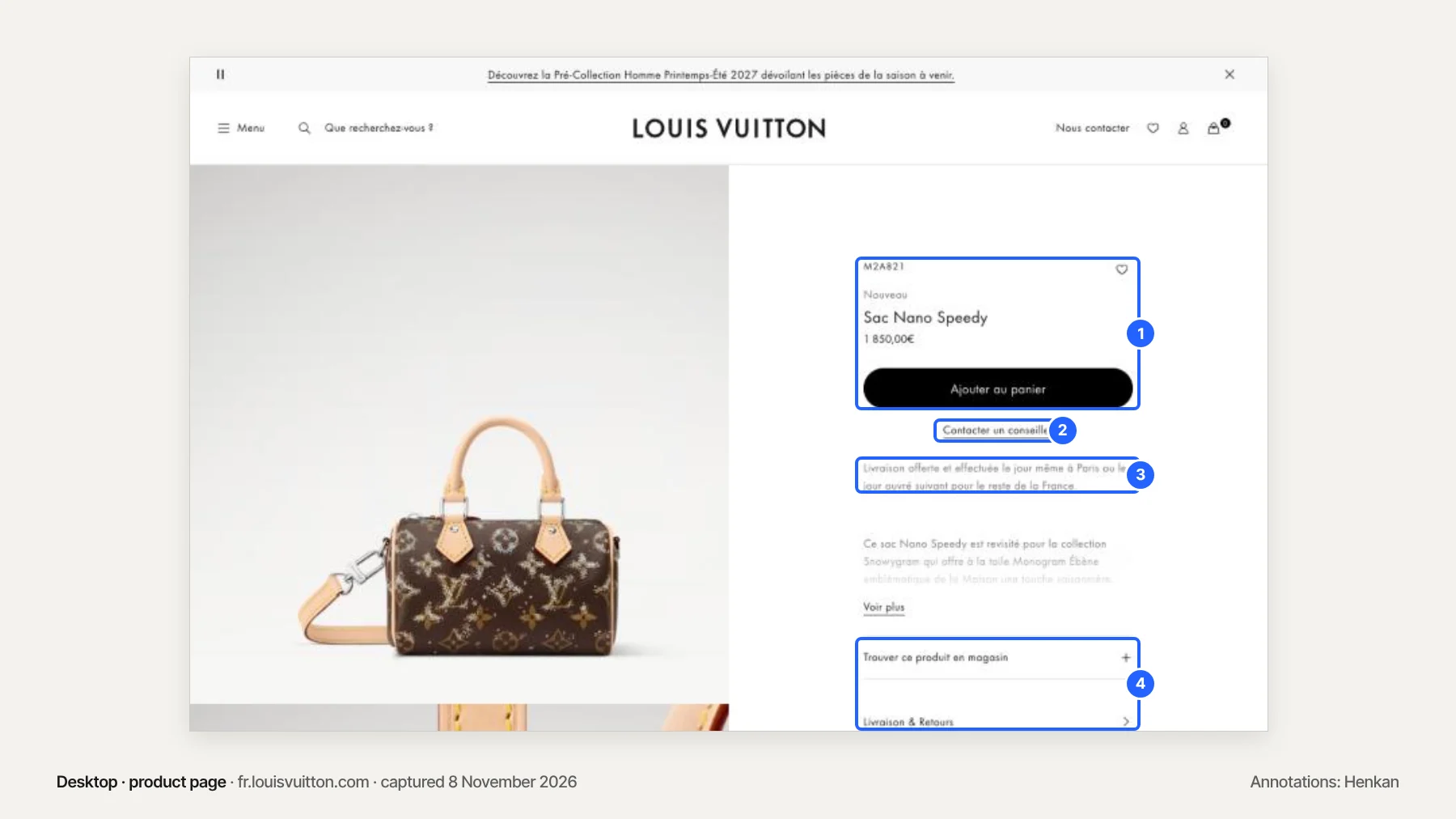
Then come three closed panels. Open "Livraison & Retours" and you find the holiday promise: exchanges and returns are free and extended until 31 January. Open "L'Art d'offrir" and you learn that every order ships in the signature box, with a message in an envelope, and "a discreet receipt, without the price". Advisors are one tap away on the phone, WhatsApp, Apple Messages or Messenger.
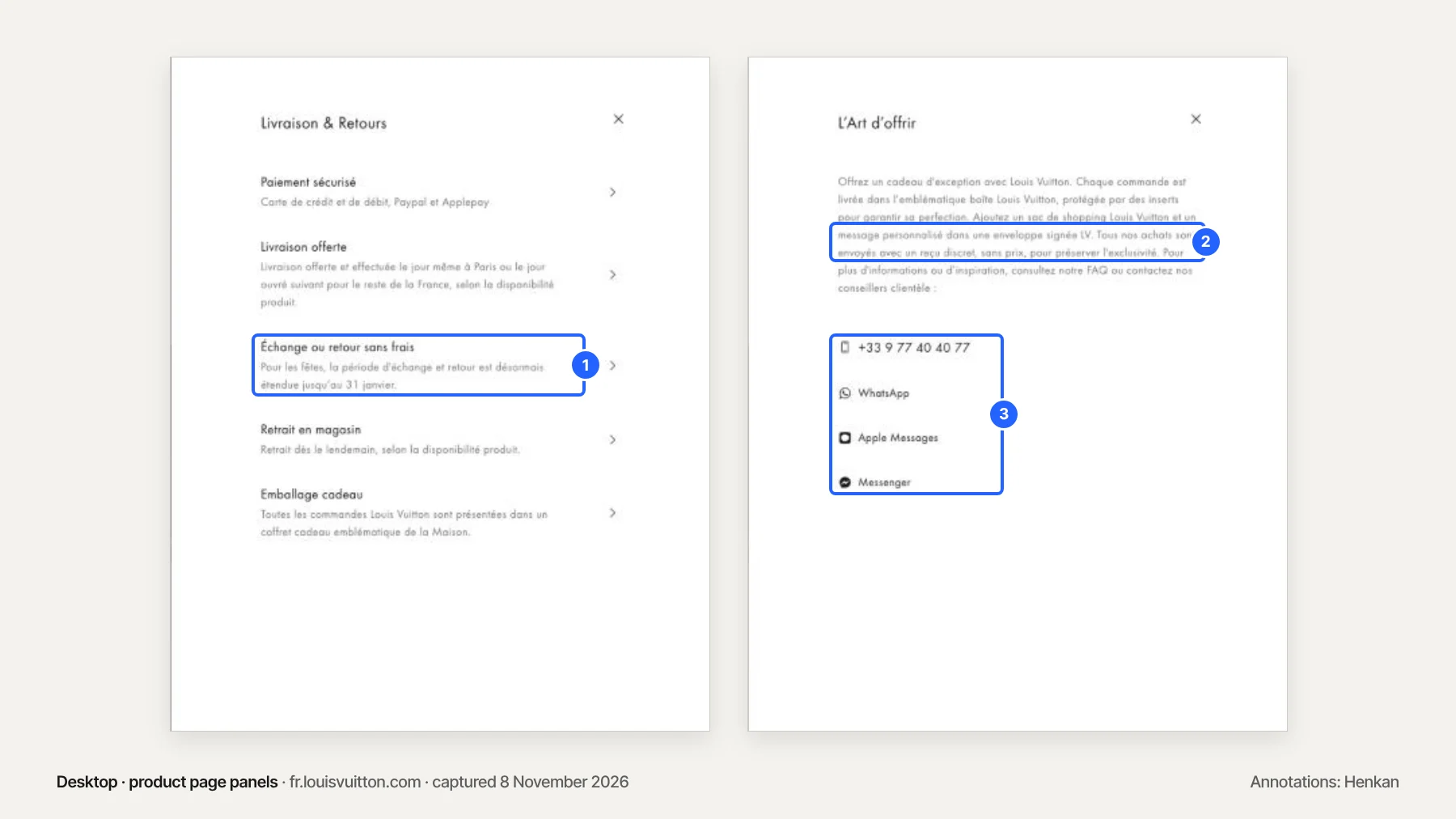
The biggest gap we found. The two questions every gift buyer asks, "what if they don't like it?" and "will they see the price?", are answered on the product page, but only after a click on a closed panel. The price-free receipt is never mentioned again, not in the bag and not at checkout. This is where we would start testing.
Section 5 · Add to bag and bag
The bag treats every order as a potential gift
Adding to the bag opens a short drawer: the product, "Commander maintenant" and "Continuer mes achats". No suggestions. The bag itself opens with a help bar and the phone number, then a section called "Cadeaux et packaging", marked free: tick "Cette commande est un cadeau" to print a message of up to six lines, or add a recycled paper bag. PayPal sits next to the main button as an express option.
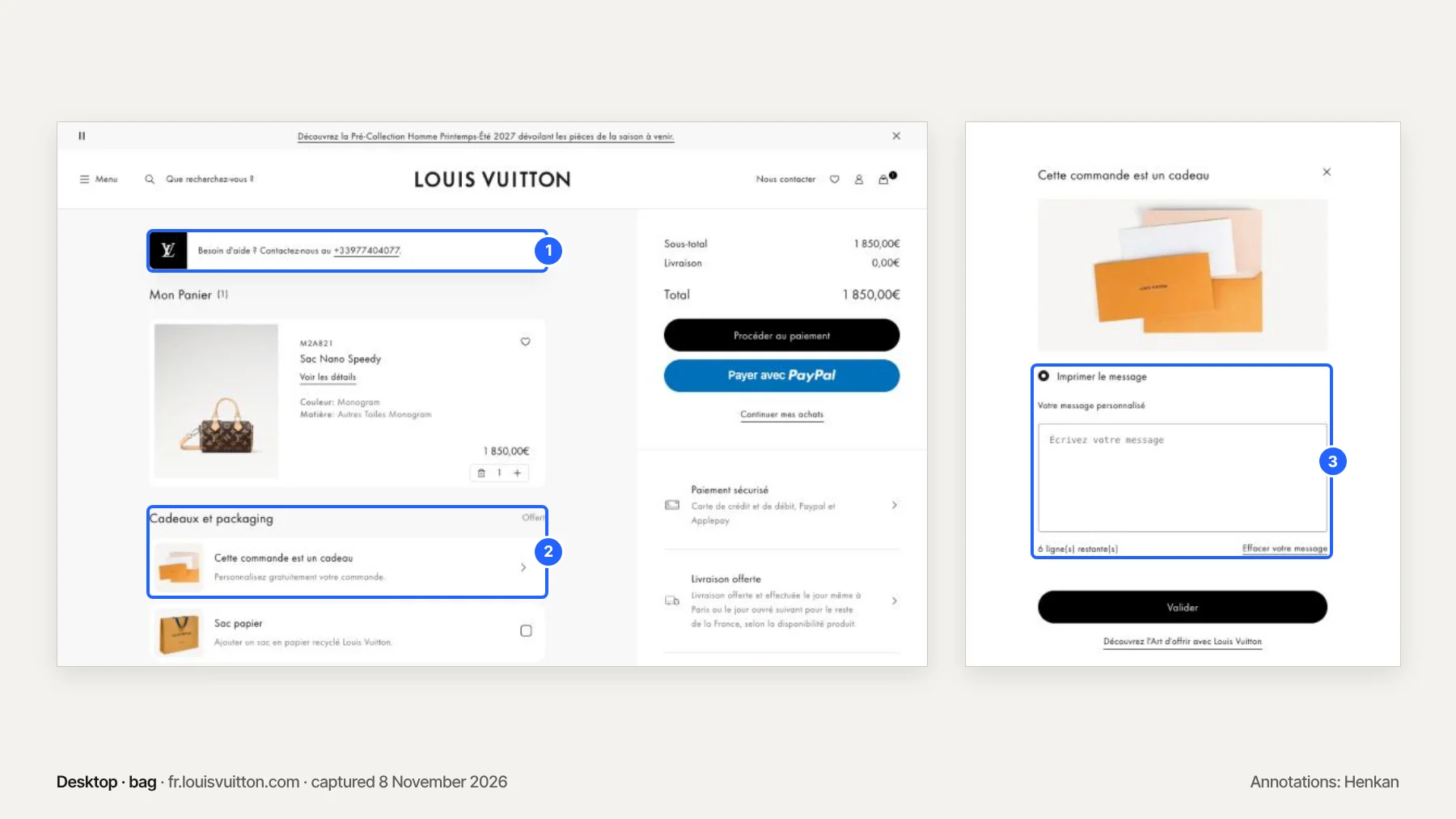
The gift panel is the natural place to say "the receipt will not show the price". Today it only talks about the message.
Section 6 · Checkout and mobile
Checkout is three steps, and repeats the returns promise
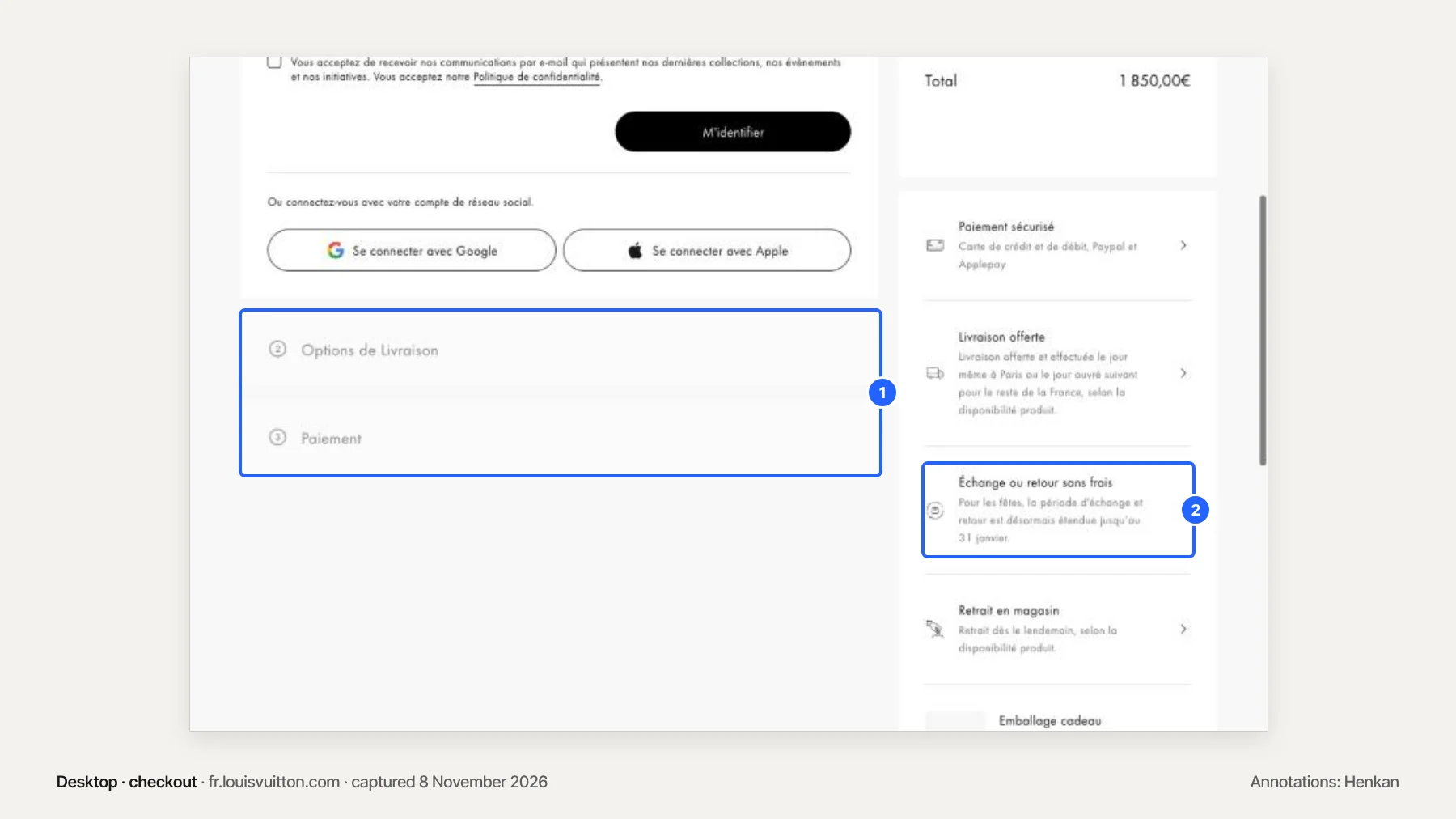
Checkout has three steps: email (with Google and Apple sign-in), delivery options, payment. The newsletter box under the email field is not ticked. The sidebar repeats the free delivery and, this time in plain sight, returns until 31 January.
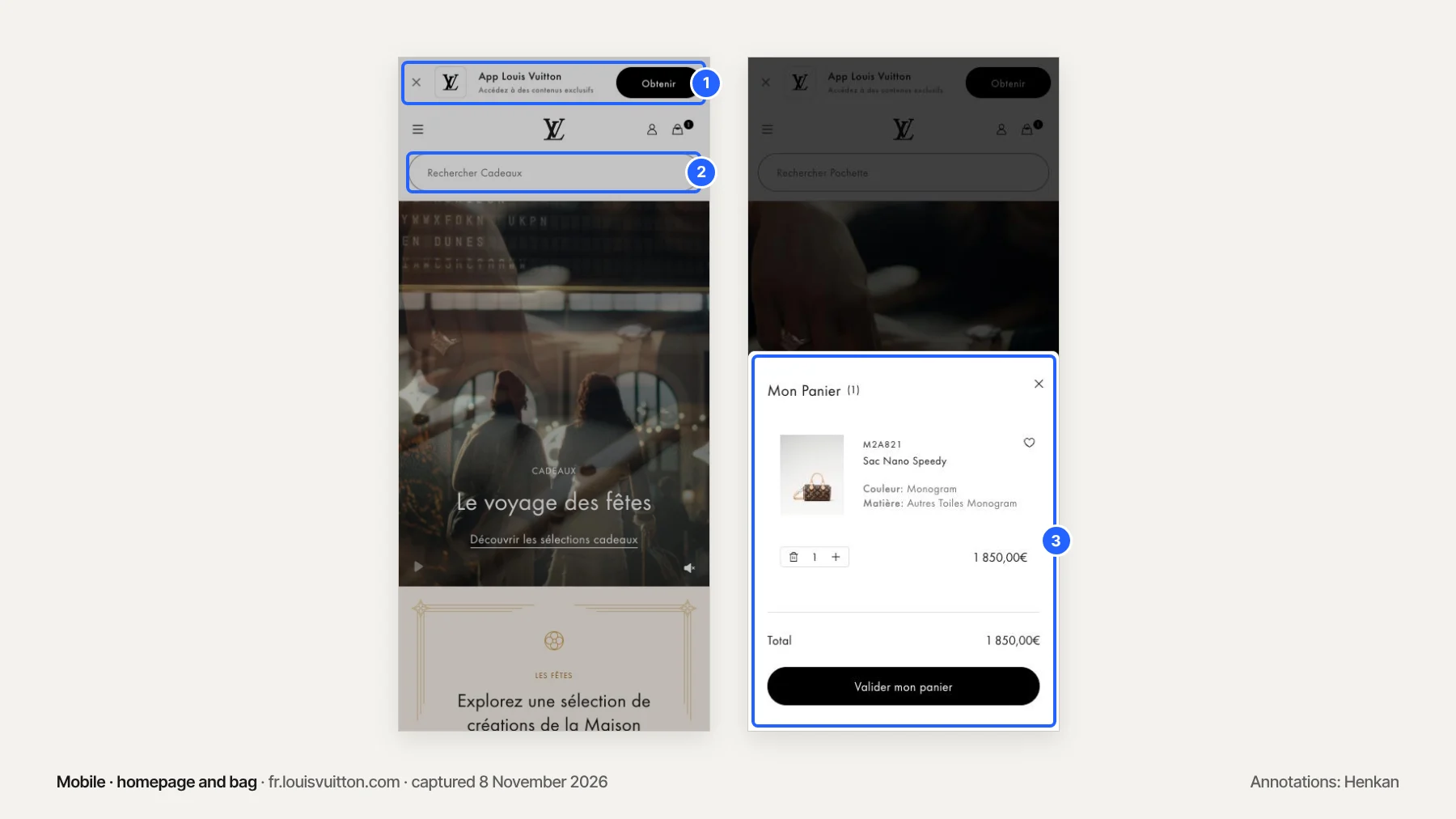
On mobile, the homepage opens with an app banner and a search bar that suggests seasonal searches ("Rechercher Cadeaux"). When we came back to the homepage, the bag reopened as a sheet with our Nano Speedy and a "Valider mon panier" button: a simple way to bring a shopper back to an unfinished purchase.
Section 7 · SEO
Strong product data, with a few loose ends
- Product structured data with price, stock status and free shipping to France.
- Gift pages titled the way people search: "Idées cadeaux de Noël luxe pour femme".
- 34 language and country alternates (hreflang) declared on the homepage.
- The homepage's Organization data gives its address as "undefined/fra-fr/homepage" and contains an empty social link.
- The gift hub has no H1 heading: its titles are all H3.
- The holiday returns policy is not in the product data, so search engines and AI assistants cannot read it.
The last point matters more each season. When a shopper asks an AI assistant "can I return a Louis Vuitton gift in January?", the answer depends on what the assistant can read. Today the extension lives in a closed panel.
Section 8 · What we would test
Five tests we would run next
| Test | Hypothesis | Main metric |
|---|---|---|
| "Returns until 31 January" under the button | Gift buyers fear choosing wrong; saying the extended returns next to "Ajouter au panier" removes that risk at the moment of decision. | Add-to-bag rate, November to December |
| Price-free receipt in the bag's gift panel | Confirming that the price will not appear makes more shoppers declare the order as a gift and go ahead. | Gift option usage, checkout start rate |
| Budget entry points on the gift hub and listing | Under €500, €500 to €1,000, over €1,000: shoppers with a budget reach a relevant product faster. | Hub and listing to product page rate |
| Products higher on the gift listing | A shorter banner brings the first prices into the first screen and gets more shoppers into the grid. | Listing to product page rate |
| Gift ideas in the "Produit ajouté" drawer | Suggesting a small leather good or a fragrance after a bag adds a second gift without leaving the page. | Items per order, average order value |
Want the same teardown of your own holiday journey, with the tests ranked for your traffic? Talk to us. The next issue, a Black Friday special, lands in two weeks: follow The E-commerce Teardown.
Key terms
- Teardown
- A screen-by-screen review of a site's customer journey, from homepage to checkout, on desktop and mobile.
- Gift hub
- An editorial landing page that groups gift ideas by recipient, category or theme for a season.
- Listing page (PLP)
- The category page that shows a grid of products, with filters and sorting.
- Product page (PDP)
- The page for a single product, where the visitor adds it to the bag.
- Structured data
- Code in the page that describes the product or the company (price, stock, shipping, returns) in a format search engines and AI assistants read.
- A/B test
- Showing two versions of a page to randomly split visitors at the same time to measure which performs better.
Method
Screens captured on 8 November 2026 on fr.louisvuitton.com (France store, French), desktop at 1,280 px, from the homepage to the first checkout step, without entering any details or placing an order. On mobile (390 px), the site's access protection stopped our session after the homepage, so mobile captures are limited to the homepage and the bag. Prices and features may have changed since. Henkan & Partners is not affiliated with Louis Vuitton.