Guide
The Essential Guide to Personalisation
Alexandre Suon · 2026-09-26
Personalisation means giving different customers different products, content, messages or offers, based on what you know about them. This guide explains what to personalise, the data and methods behind it, how to prove it works with a holdout group, how to stay on the right side of privacy rules and customer trust, and how teams of any size can start.
Executive summary
- Personalisation is a decision, not a technology. It is the choice to treat customers differently because it helps them. The technology ranges from a simple rule to AI that decides for each person, and most value comes from the simplest methods applied to the right moments.
- Customers expect it, but most still do not feel understood. McKinsey found that 71% of consumers expect personalised interactions, yet in Twilio's 2025 survey of 7,640 consumers only 45% felt that brands understand them, and 61% doubted that brands use their data responsibly.
- Start where customers show intent. Product recommendations, site search, abandoned-cart and post-purchase messages, and returning-visitor experiences use data customers have just given you. In a randomised experiment, simply adding the recipient's name to an email subject line raised opens by 20%.
- Build on first-party and zero-party data, with consent. Data customers give you directly, or tell you on purpose, is more accurate, more durable and easier to justify than data bought from others.
- Measure incrementally, not by attribution. Vendor dashboards credit personalisation with revenue that would often have happened anyway. Keep a random holdout group, typically up to 5% of customers, that never receives personalisation, and report the difference.
- Personalise experiences freely, prices very carefully. Regulators and customers accept relevant products and content but object strongly to prices set from personal data: over 80% of Dutch consumers surveyed in 2019 considered it to some extent unacceptable and unfair.
Section 1 · The basics
What is personalisation?
Personalisation is the practice of tailoring the products, content, messages, offers or service a customer receives, based on data about that customer, with the aim of making the experience more relevant and more valuable for both the customer and the business.
The idea is older than the internet. In 1993 Don Peppers and Martha Rogers argued in The One to One Future that companies should compete for "share of customer", building relationships one customer at a time. Academic researchers later drew a useful line: in a 2008 paper in Marketing Letters, personalisation "occurs when the firm decides what marketing mix is suitable for the individual", usually from data it has collected, while customisation "occurs when the customer proactively specifies" what they want. A size filter the customer sets is customisation; recommending sizes from past orders is personalisation.
In practice, personalisation comes in levels of increasing sophistication. We use the four levels below; the labels are ours, not an industry standard.
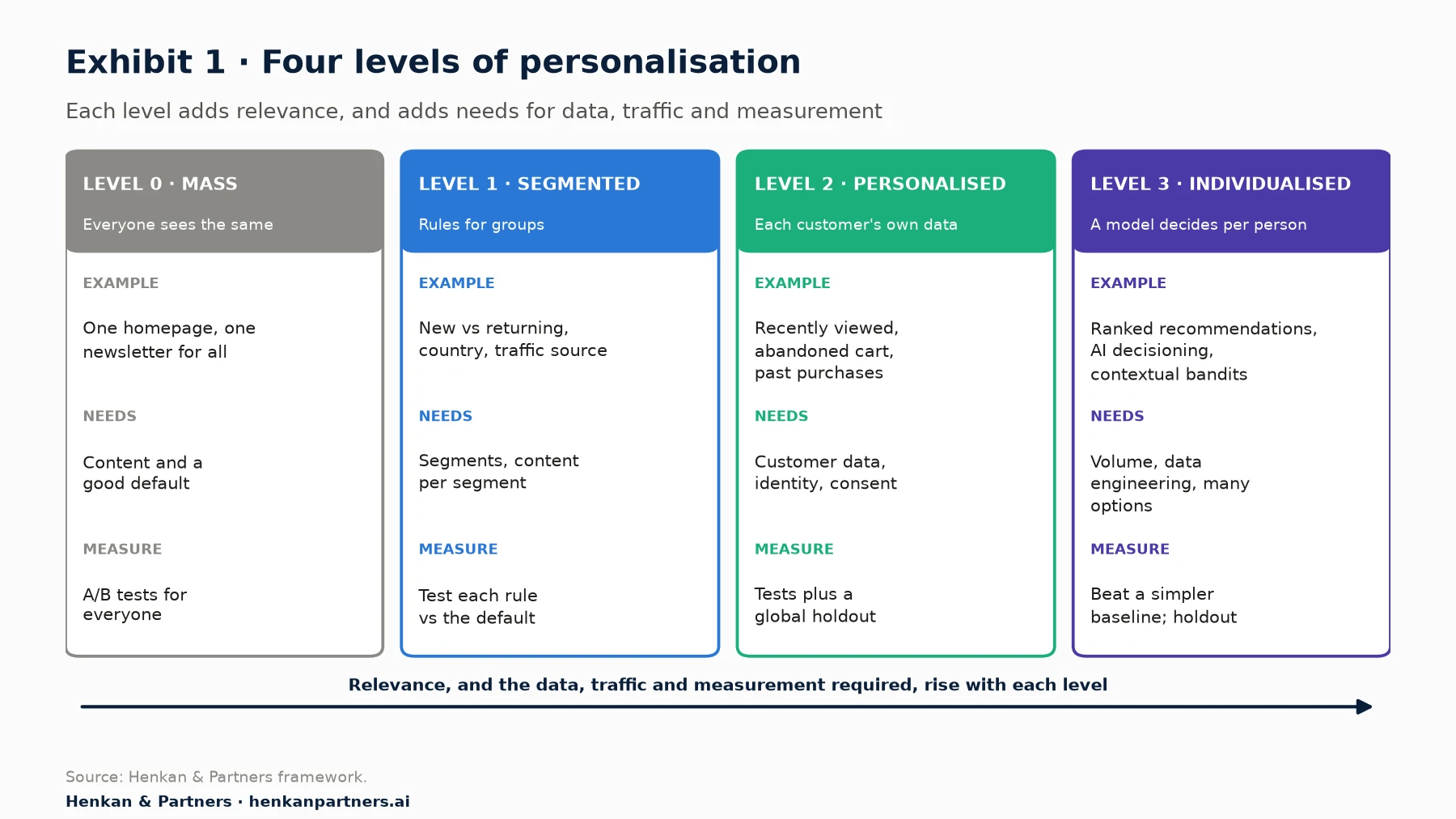
What this shows. Each level needs more data, more traffic and better measurement than the one before. In our experience, most businesses earn the bulk of their personalisation value at levels 1 and 2, with rules and the customer's own recent behaviour. Level 3 pays off only when there is enough data and a way to prove the model beats simpler rules.
Personalisation vs A/B testing
A/B testing finds the version that works best for everyone on average. Personalisation shows different versions to different people. The two belong together: every personalisation rule or model is a hypothesis that should be tested against a control. Our essential guide to A/B testing explains how to run those tests.
Section 2 · Why it matters
Customers expect personalisation, but most do not feel understood and many distrust how their data is used
The commercial case is well known. McKinsey reported in 2021 that 71% of consumers expect companies to deliver personalised interactions and 76% get frustrated when this does not happen, and that personalisation most often drives a 10–15% revenue lift. BCG's 2024 research estimated that $2 trillion of revenue will shift towards personalisation leaders over five years. But the customer's side of the story is less flattering.
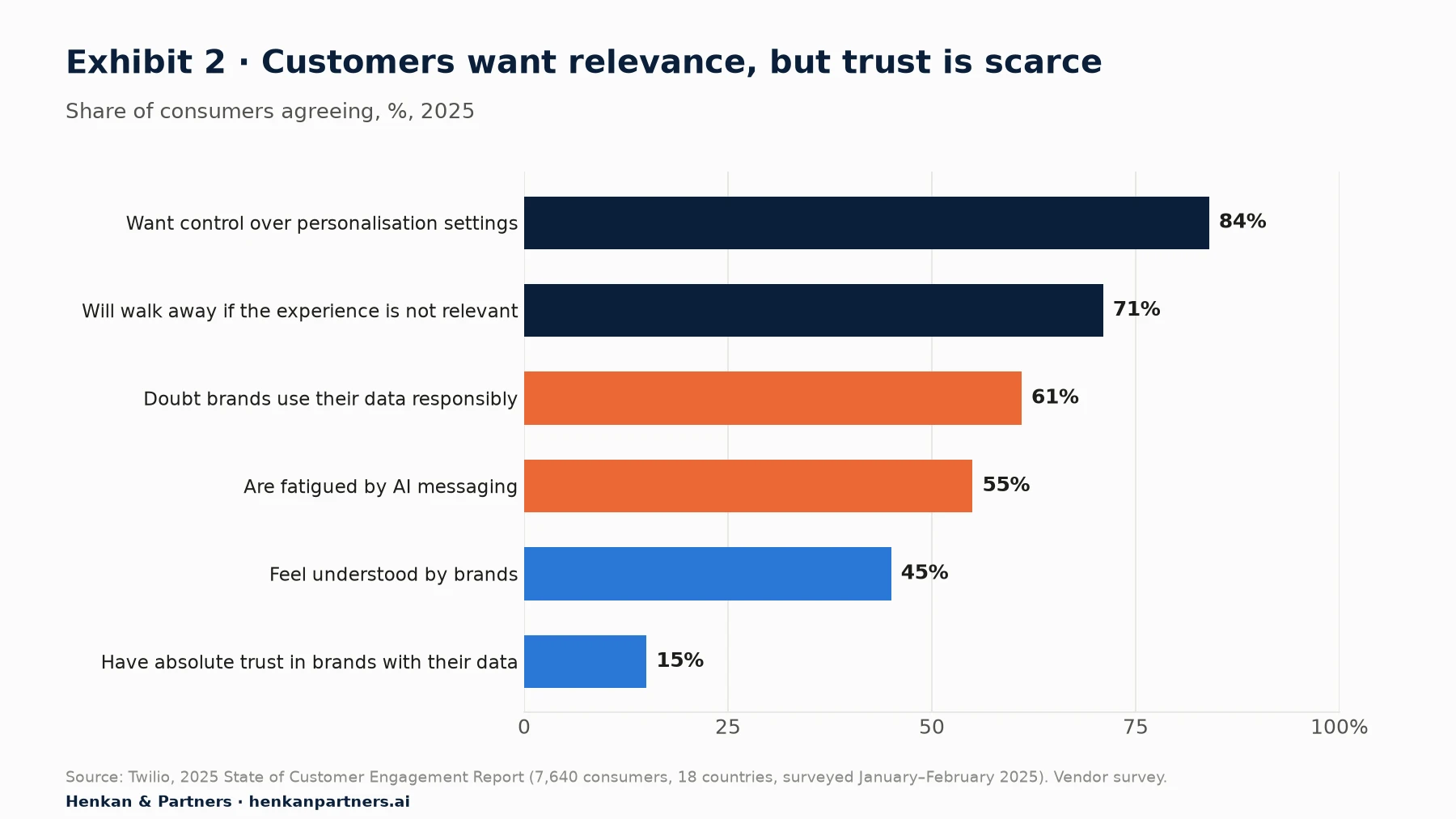
What this shows. Customers want relevance and will leave without it, but they do not trust brands with their data and want control. Personalisation that feels useful and transparent closes this gap; personalisation that feels intrusive widens it. A 2015 study in the Journal of Retailing found that personalised ads raised click intentions when data was collected openly, but backfired when customers felt it had been collected covertly.
- Relevance still fails at scale. In Salesforce's 2026 State of Marketing survey of 4,450 marketers, 75% had adopted AI, yet 84% admitted to running generic campaigns.
- Personalisation can backfire. Gartner's 2025 survey of 1,464 B2B buyers and consumers found that 53% had experienced negative effects from personalisation, and those who did were 3.2 times more likely to regret a purchase.
- The value can be large. Netflix economists estimated in 2025, using a model of how members respond to different algorithms, that replacing Netflix's recommendation system with popularity-based suggestions would cut engagement by about 12%.
For marketers. Ask of every personalisation idea: would the customer see this as helpful if they knew why they were seeing it? If the honest answer is no, do not ship it.
For leaders. Treat trust as a metric. Track complaints, opt-outs and unsubscribes alongside conversion for every personalisation programme; a lift that erodes trust is a loan, not a gain.
Section 3 · What to personalise
Five levers can be personalised, and products and messages usually pay first
Personalisation is not only about showing someone's name or a different banner. There are five levers, each with different data needs, value and risk.
| Lever | Examples | Typical data | Value and risk |
|---|---|---|---|
| Products | Recommendations, search ranking, category sorting, "complete the look", recently viewed | Browsing, cart and order history; product attributes | High value, low risk; the core of e-commerce personalisation |
| Content | Homepage banners, landing pages, editorial, imagery, language and currency | Context (country, device, traffic source), segment, interests | Medium value; needs content production capacity |
| Messages | Abandoned-cart, browse-abandonment, post-purchase, replenishment and win-back emails, SMS and push; send time and frequency | Behaviour, lifecycle stage, consent | High value; risk of fatigue and unsubscribes if overdone |
| Offers | Free-delivery thresholds, loyalty rewards, bundles, first-order incentives | Customer value, margin, lifecycle | Can pay well but can train customers to wait for discounts |
| Prices | Individual prices based on personal data | Personal data | Highest risk: legal scrutiny and customer backlash (Section 8) |
Channels matter as much as levers. The same customer can receive personalisation on the website, in email and SMS, in the app, in paid ads, from customer service and, increasingly, through AI shopping assistants that recommend products before the customer reaches your site. Our essential guide to web personalisation covers the website in depth.
Lifecycle messages: the clearest evidence
Messages triggered by a customer's own behaviour are the most reliable personalisation most businesses can run. The best causal evidence comes from a randomised experiment published in Marketing Science in 2018: adding the recipient's name to an email subject line raised the open rate by 20% (from 9.05% to 10.80%), increased sales leads by 31% and cut unsubscribes by 17%. Vendor data points the same way, with an important caveat.
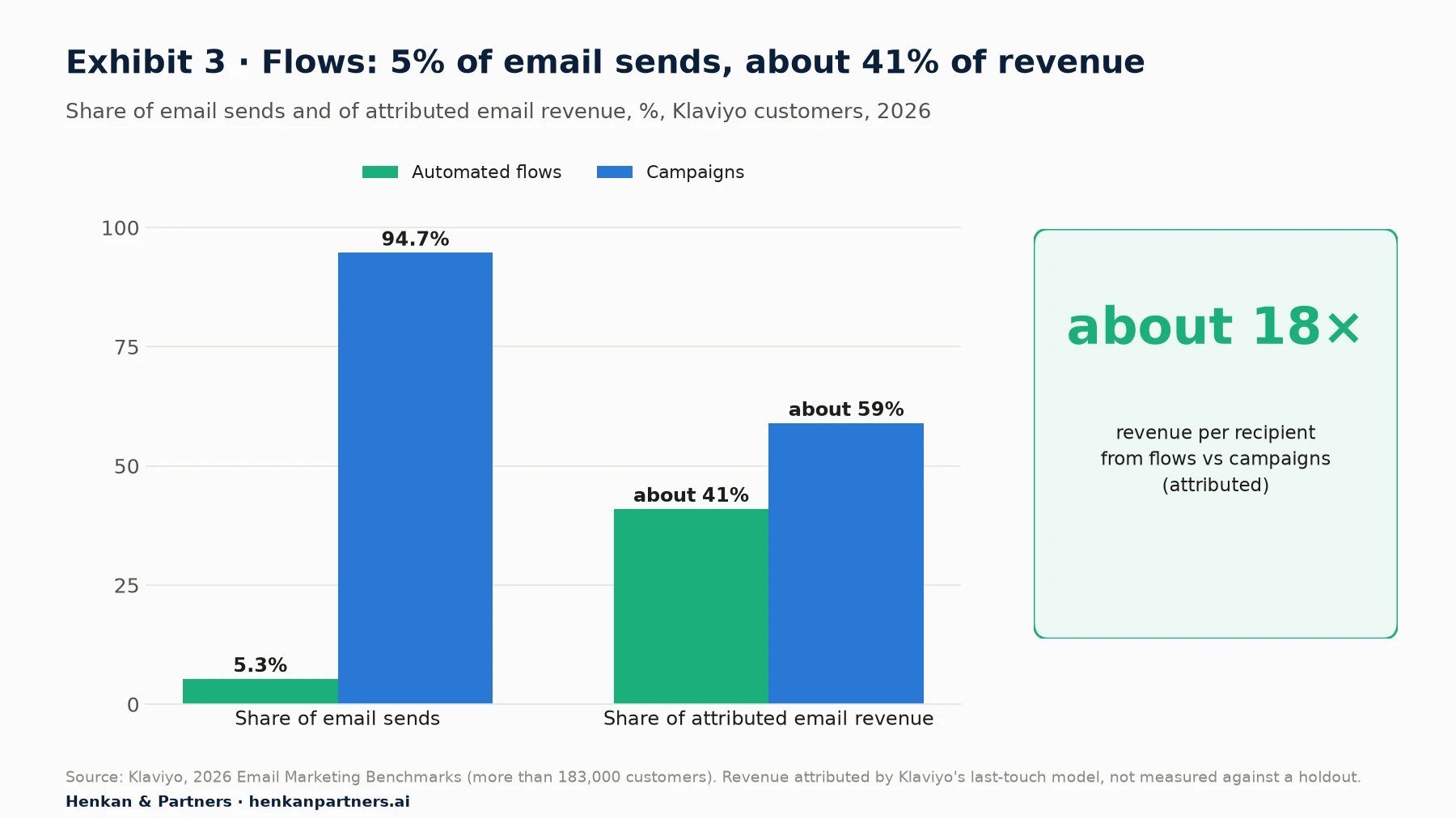
What this shows. Behaviour-triggered flows, such as abandoned cart, welcome and post-purchase, earn a large share of attributed revenue from a small share of messages. Omnisend's 2026 report shows the same pattern: automated emails were 2% of sends but 30% of attributed revenue. The caveat is attribution: these figures credit messages with purchases that would sometimes have happened anyway (Section 7). They show where to start, not how much you will gain.
For marketers. If you do only three things, set up abandoned-cart, welcome and post-purchase flows that use the customer's own products and behaviour, and test each against a control. They are cheap, low-risk and usually the fastest personalisation wins.
Section 4 · Data
Personalisation is only as good as its data, and the best data is the data customers give you
Four types of data feed personalisation. They differ in accuracy, durability and how easily you can justify using them.
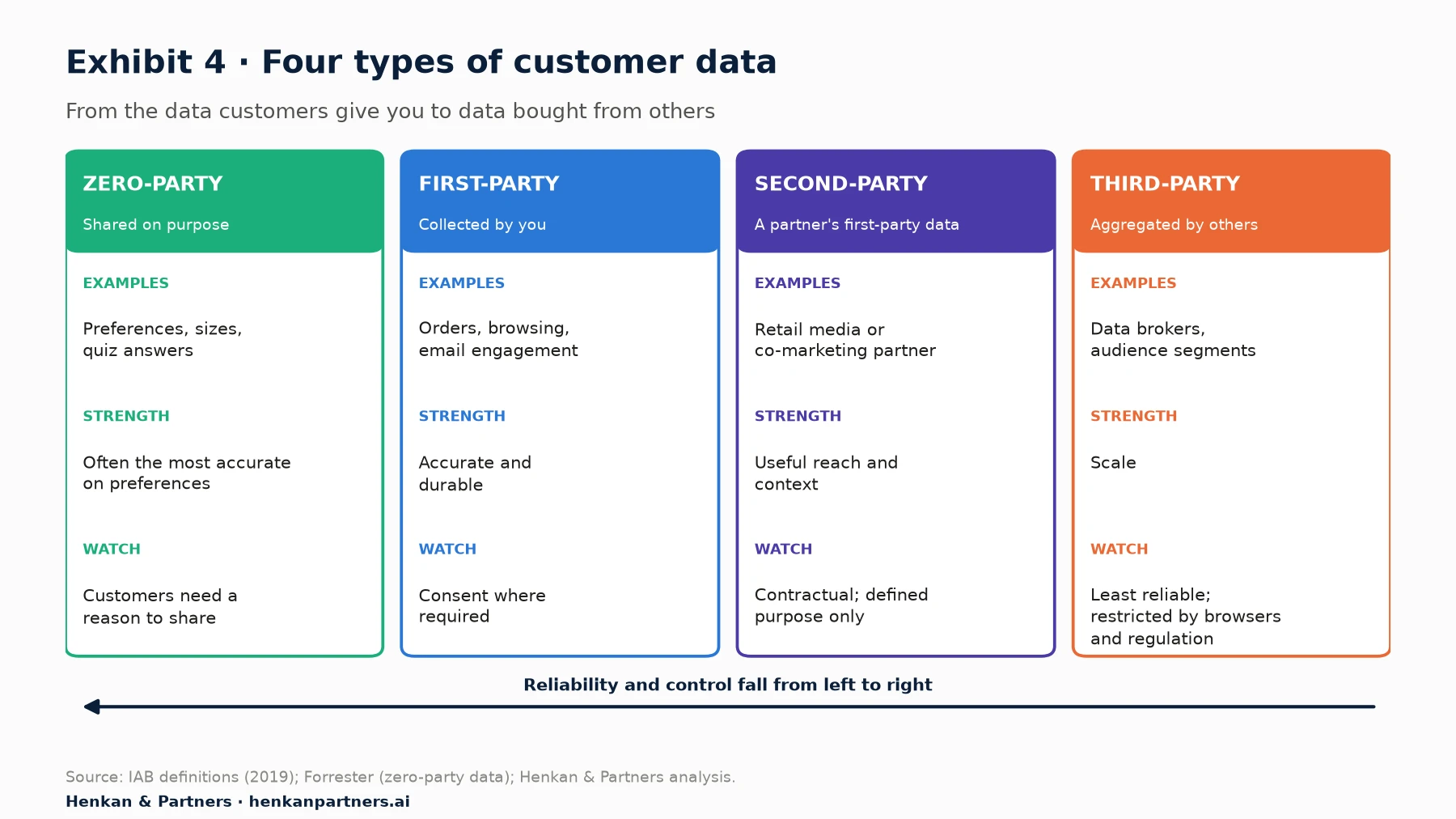
What this shows. Durable personalisation is built from the top two rows. Zero-party data, a term popularised by Forrester around 2017–18, is data a customer "intentionally and proactively shares", such as preferences and purchase intentions. First-party data is what you collect from customers directly. Third-party data has become less useful: Safari blocks third-party cookies by default, Firefox blocks known tracking cookies and isolates the rest by site, Apple requires apps to ask before tracking across other companies' apps, and although Chrome kept third-party cookies, it retired most of the Privacy Sandbox tools in October 2025.
What data each use case really needs
- Returning-visitor and recently viewed experiences: only on-site behaviour in the current or recent sessions.
- Product recommendations: product attributes plus browsing and purchase history. New products and new customers need a sensible default, because recommendation engines struggle with "cold start", as Google's recommendation-systems course explains.
- Lifecycle messages: consented contact data, lifecycle stage and recent behaviour.
- Cross-channel and AI decisioning: a unified customer profile, usually from a customer data platform or data warehouse, plus consistent identifiers across channels.
- Preference-based experiences: zero-party data from quizzes, preference centres and account settings. Ask only for what you will visibly use.
For leaders. The data foundation is usually the bottleneck, not the personalisation tool. In Salesforce's 2026 survey, only 51% of marketers had full access to commerce data, and those with unified data were 60% more likely to deploy AI agents. Fund data quality, identity and consent before adding another personalisation vendor.
Section 5 · How it works
Four methods power personalisation, and the simplest one that works is usually the right one
Personalisation decisions are made in one of four ways. Each has a place, and mature programmes use all four.
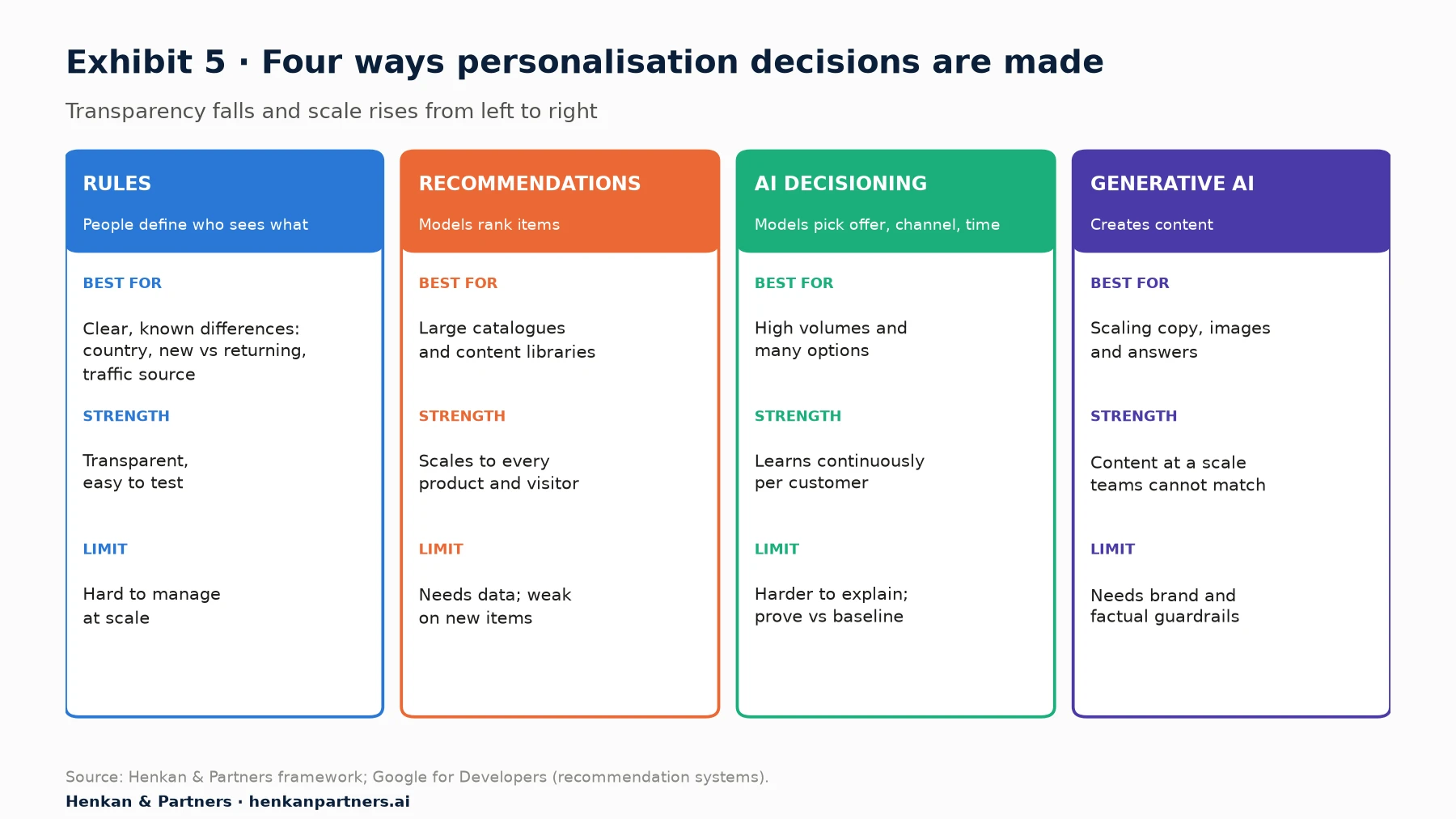
What this shows. The methods trade transparency for scale. Rules are easy to explain and test but, in our experience, become hard to manage beyond a few dozen segments. Models scale but need data, traffic and careful measurement. Start with rules and recommendations; move to decisioning when volumes are high and simpler methods have been beaten in a test.
Recommendations: content-based and collaborative
Content-based recommendations suggest items similar to what a customer liked, using product attributes; they need no data about other customers but can only extend existing interests. Collaborative filtering uses what similar customers did; it needs no product knowledge and can surprise, but it cannot recommend new items with no history, the "cold start" problem. Most modern systems combine the two.
Recommendations have known side effects. Research published in Management Science in 2009 showed that common recommenders can push each customer to new products while concentrating overall sales on the same popular items. A randomised field experiment at a retailer found that the effect of recommendations on sales depended on the algorithm, and one common algorithm had no measurable effect on the number of products bought. Choosing and testing the algorithm matters.
AI decisioning and generative AI
AI decisioning assigns a learning model to choose, for each customer, among offers, channels, send times and frequencies, and updates its choices from the results. Vendors including Braze (which bought OfferFit), Hightouch, Salesforce and Adobe launched or expanded such tools in 2025–26; our personalisation market report maps them. Generative AI adds a different capability: producing copy, images and conversational answers at a scale no content team could match. Both need guardrails on brand, facts and fairness, and both should be tested against a simpler baseline.
For leaders. McKinsey's model of personalisation at scale has four parts, the "4Ds": data, decisioning, design (content in small, reusable pieces) and distribution across channels. Weakness in any one limits the others. In our experience, most programmes that stall are short of content and measurement, not algorithms.
Section 6 · The process
How to launch a personalisation programme in 7 steps
The steps below work for a first abandoned-cart flow and for an enterprise programme across brands and markets.
Step 1: Find the moments that matter
Use analytics to find where customers drop out or where needs clearly differ: new versus returning visitors, mobile versus desktop, countries, traffic sources, product categories. Customer research explains why; our essential guide to Voice of Customer shows how to gather it.
Step 2: Define the audience and the data
Describe who should get a different experience and which data identifies them. Check that the data is accurate, available in real time where needed, and collected with the consent your markets require.
Step 3: Write a hypothesis
Because we observed [evidence about this audience],
we believe that [personalised experience] for [audience]
will cause [effect on customer behaviour],
compared with [the default experience].
We will know when [primary metric] improves against a control.
Step 4: Design the experience and the default
Design the personalised experience and an equally good default for everyone else, including new customers and products with no history. The default is what most customers, and search engines, will see.
Step 5: Test against a control
Run the personalised experience against the default for the same audience, with random assignment. Decide the primary metric, the sample size and the duration before launch.
Step 6: Roll out what wins, retire what does not
Ship winners, remove losers and document both. Personalisation rules accumulate quickly; every rule you keep should have evidence behind it and an owner.
Step 7: Keep a holdout and review regularly
Keep a small global holdout that receives no personalisation, and review the programme's incremental value every quarter. Refresh content and rules that have gone stale.
Section 7 · Measurement
Measure personalisation against a holdout, because attributed revenue flatters it
Most personalisation tools report the revenue they "influenced". That number answers the wrong question. The right question is how much more revenue customers produced because of personalisation, compared with what they would have spent anyway.
Why attributed revenue overstates the effect
- Attribution credits purchases that would have happened anyway. Klaviyo, for example, uses a last-touch model that by default credits an email with an order placed within five days of the customer opening it. Many of those customers were already going to buy.
- Personalisation targets people who are already likely to buy. An experiment at eBay, published in Econometrica in 2015, found that paid search mostly reached customers who would have bought anyway: brand-keyword ads had no measurable short-term benefit, and returns were a fraction of non-experimental estimates. The study covers search ads, but the same logic applies to personalisation.
- Non-experimental methods are unreliable. Across 15 large advertising experiments at Facebook, non-experimental estimates were off by a factor of three or more in about half the studies, usually overstating the effect.
How to measure it properly
Randomly assign a small share of customers to a global holdout that never receives personalisation, and compare their revenue per customer with everyone else's over a meaningful period.
Incremental lift = (revenue per customer, personalised group − revenue per customer, holdout)
÷ revenue per customer, holdout
| Tool | Documented holdout guidance |
|---|---|
| Optimizely (global holdouts) | Typically up to 5% of traffic; the system warns above 5% |
| Klaviyo (global holdout groups) | About 5% of marketable profiles for about 3 months; requires at least 400,000 profiles |
| Braze (global control group) | 1–15% of users; review over at least a month and reshuffle no more than monthly |
| Dynamic Yield (global control group) | 95% of users see personalisation, 5% never do |
For marketers. Report two numbers for every programme: attributed revenue from the tool, and incremental revenue from the holdout. If you can only report one, report the incremental figure.
For leaders. A holdout costs a little revenue to protect a lot of budget. Without one, you cannot tell which personalisation spend is working.
Section 8 · Privacy, pricing and trust
Personalise with consent and transparency, and treat personalised pricing as a legal and reputational risk
Personalisation relies on personal data, so it sits inside privacy law. The main rules for Europe, the UK and the US, as of September 2026, are summarised below. This is not legal advice.
- Consent and objection. In the EU, storing or reading information on a visitor's device needs consent unless it is strictly necessary (ePrivacy Directive), and under the GDPR people can object at any time to profiling for direct marketing. Decisions based solely on automated processing are restricted where they have legal or similarly significant effects, which ordinary product recommendations usually do not.
- Transparency for platforms. Under the EU Digital Services Act, online platforms must explain the main parameters of their recommender systems, and very large platforms must offer at least one option not based on profiling.
- AI rules. The EU AI Act bans AI that uses manipulative or deceptive techniques, or exploits vulnerabilities such as age or disability, to distort behaviour in ways that cause significant harm. Ordinary e-commerce recommenders are not classed as high-risk, but risk assessment and pricing for life and health insurance is, with high-risk obligations now due from December 2027.
- What is coming. The European Commission plans to propose a Digital Fairness Act in late 2026, covering dark patterns, addictive design and unfair personalisation practices.
- US state laws. About 20 US states had comprehensive privacy laws in force by early 2026.
Personalised pricing: the line customers draw
Customers accept personalised products and content far more readily than personalised prices. In a 2019 Dutch survey cited by a 2022 European Parliament study, more than 80% of respondents considered individual price personalisation to some extent unacceptable and unfair. Regulators are paying attention: the US Federal Trade Commission published initial findings of its "surveillance pricing" study in January 2025, and New York has required, since November 2025, a disclosure when prices are set by an algorithm using personal data. A 2018 European Commission study of 160 websites found no evidence of prices personalised to individuals, which suggests the practice is rarer than feared, but the scrutiny is real.
For marketers. Use this test: would you be comfortable explaining to the customer exactly why they saw this product, message or offer? Personalise experiences freely with consent; review any price or discount that varies by person with legal counsel first.
Section 9 · Mistakes
10 common personalisation mistakes, and how to avoid them
| Mistake | Why it hurts | What to do instead |
|---|---|---|
| 1. Starting with the tool | Expensive software runs a few banners | Start from the moments that matter and the data you have |
| 2. No control group | You cannot tell what personalisation earns | Test every rule against a default; keep a global holdout |
| 3. Trusting attributed revenue | Credits sales that would have happened anyway | Report incremental revenue against a holdout |
| 4. Too many segments | Each segment is too small to test or maintain | Start with a few segments with clearly different needs |
| 5. A weak default | New customers, new products and search engines see a poor experience | Design the default as carefully as the personalised version |
| 6. Creepy personalisation | Customers feel watched and trust falls | Use data customers expect you to use; explain why they see it |
| 7. Ignoring consent | Legal risk and data you cannot use | Build consent into the data flow from the start |
| 8. Discount-led personalisation | Trains customers to wait for offers and erodes margin | Personalise products, content and service before prices |
| 9. Stale rules and content | Old rules keep running with no evidence behind them | Give every rule an owner and a review date |
| 10. Letting AI decide without a baseline | You cannot tell if the model beats simple rules | Test AI decisioning against a rule-based or random baseline |
Section 10 · Building a programme
Every team can personalise, and the programme should grow with its data and measurement
Personalisation is not reserved for large companies. What changes with size is the number of levers, the level of automation and the measurement you can afford.
| Team | What to run | How to measure | Owner |
|---|---|---|---|
| One or two people (small store) | Abandoned-cart, welcome and post-purchase flows; built-in product recommendations; one or two segments on the website | A/B test each flow against a control; review monthly | The e-commerce or marketing lead |
| Growing digital, CRO or CRM team | Search and recommendations, lifecycle journeys, returning-visitor and traffic-source experiences, zero-party data from quizzes | Tests for every change; a global holdout once volumes allow | A personalisation lead within CRO or CRM |
| Multi-brand or international retailer | Unified customer data, cross-channel journeys, AI decisioning for offers and timing, generative content with guardrails | Global holdouts by brand and channel; quarterly incrementality review | A programme owner working across data, CRM, web and legal |
What AI changes
AI makes personalisation cheaper to produce and easier to automate. McKinsey's 2026 State of AI survey found that revenue gains are most often attributed to AI used in marketing and sales. But AI does not remove the need for data, content, consent or measurement; it raises it. The more decisions a model makes, the more you need a holdout to know whether it is helping, and the more you need to explain those decisions to customers and regulators.
For leaders. In due diligence or a budget review, ask for three numbers: incremental revenue against a holdout, the share of customers with usable consent, and the number of personalisation rules or models with an owner and recent evidence. Together they show whether personalisation is a capability or a cost.
Section 11 · What to do next
Five moves turn personalisation into a better customer experience and more revenue
1. Start with the customer's own behaviour
Launch or improve abandoned-cart, welcome, post-purchase and recently-viewed experiences. They use data customers have just given you and rarely feel intrusive.
2. Fix the default before the variants
Make the experience that most customers, new visitors and search engines see as good as it can be. Personalisation should improve on a strong default, not patch a weak one.
3. Put a holdout in place
Set aside a small random group that never receives personalisation and report incremental revenue against it every quarter.
4. Collect zero-party data with a clear value exchange
Ask customers for preferences, sizes or needs only where you will visibly use the answer to help them, such as better recommendations or fewer irrelevant emails.
5. Grow from rules to models only when you can measure the difference
Move to recommendation models and AI decisioning when volumes are high and you can test them against simpler rules. Our web personalisation guide and personalisation market report help you choose where and with which tools.
Our view. Personalisation is a means, not the goal. The goal is a better customer experience that grows revenue and lifetime value. Teams of any size can get there by personalising the moments that matter, with data customers are happy to share, and by proving every step against a control.
FAQ
Frequently asked questions about personalisation
Frequently asked questions
What is personalisation in marketing?
Personalisation is tailoring the products, content, messages or offers a customer receives, based on data about that customer, to make the experience more relevant. It ranges from simple rules for groups of customers to AI that decides for each person.
What is the difference between personalisation and customisation?
In personalisation, the company decides what each customer sees, based on data. In customisation, the customer chooses, for example by setting filters or preferences.
What are examples of personalisation?
Product recommendations, personalised search results, abandoned-cart and post-purchase emails, homepage content for returning visitors, local currency and delivery information, and offers based on loyalty status.
What is zero-party data?
Data a customer intentionally and proactively shares with a brand, such as preferences, sizes or purchase intentions, a term popularised by Forrester. It is often more accurate than inferred data because customers tell you directly.
How do you measure personalisation?
Test each personalised experience against a default with random assignment, and keep a global holdout group, typically up to 5% of customers, that never receives personalisation. Report incremental revenue against the holdout rather than the revenue tools attribute to themselves.
Does personalisation increase revenue?
Often. McKinsey reports that it most often lifts revenue by 10–15%, though it does not publish the method behind that estimate, and a randomised email experiment found 20% more opens from a personalised subject line. But results depend on the method and placement, so every programme should be tested.
Is personalised pricing legal?
It is heavily scrutinised and often disliked by customers. The US FTC has studied surveillance pricing and New York requires a disclosure for prices set by algorithms using personal data. Seek legal advice before personalising prices.
Key terms
- Personalisation
- Tailoring products, content, messages or offers to a customer, decided by the company from data it holds. It differs from customisation, where the customer makes the choice.
- Segmentation
- Treating groups of customers differently by rules, such as new versus returning visitors. It is the simplest form of personalisation, and often the best place to start.
- Individualisation
- A decision taken for each person, usually by a model. It needs more data and traffic, and is harder to explain.
- First-party data
- Data you collect directly from your own customers, such as orders, browsing on your site and email engagement. It is the foundation of durable personalisation.
- Zero-party data
- Data a customer intentionally and proactively shares, such as preferences, sizes or purchase intentions. It is often the most accurate data on preferences, because customers tell you, though what people say can differ from what they do.
- Third-party data
- Data collected and aggregated by a company that is not the original collector. It is less reliable and increasingly restricted.
- Recommendation engine
- Software that predicts which products or content a person will want. Content-based engines use similarity between items; collaborative filtering uses similarities between users and items.
- Cold start
- The problem of personalising for new customers or new products with little or no history. Every programme needs a good default for these cases.
- AI decisioning
- AI that chooses the best offer, message, channel or timing for each customer and learns from the results.
- Holdout group (global control group)
- A random share of customers who never receive personalisation. The most reliable way to measure what a whole personalisation programme adds.
- Incremental revenue
- Revenue that would not have happened without personalisation, measured against a holdout. Different from attributed revenue, which a tool credits to itself.
- Attribution window
- The period after a message or interaction during which a tool credits it with a purchase. Long windows and counting opens inflate apparent results.
- Personalised pricing
- Setting different prices for different people based on personal data. Heavily scrutinised by regulators and disliked by most consumers.
Sources
Research findings and regulatory texts were checked against the original publications or publishers' pages on 26 September 2026. Vendor benchmarks (Klaviyo, Omnisend) and vendor surveys (Twilio, Salesforce) come from each vendor's customer base or panel; email revenue figures are attributed, not incremental. The personalisation levels, method comparison, programme table and recommendations are Henkan & Partners' own and are labelled as such. Henkan & Partners works with several personalisation vendors, including as a certified partner of Kameleoon and AB Tasty (now part of Wingify); this guide does not rank vendors.
- Peppers and Rogers, The One to One Future, 1993
- Arora et al., Putting one-to-one marketing to work: personalization, customization, and choice, Marketing Letters, 2008
- McKinsey, The value of getting personalization right—or wrong—is multiplying, 2021
- BCG, capturing the $2 trillion personalization opportunity with AI, October 2024
- Twilio, 2025 State of Customer Engagement Report
- Aguirre et al., Unraveling the Personalization Paradox, Journal of Retailing, 2015
- Salesforce, State of Marketing, 10th edition, February 2026
- Gartner, personalization can triple the likelihood of customer regret, June 2025
- Zielnicki et al., The Value of Personalized Recommendations: Evidence from Netflix, 2025
- Sahni, Wheeler and Chintagunta, Personalization in Email Marketing, Marketing Science, 2018
- Klaviyo, 2026 Email Marketing Benchmarks
- Omnisend 2026 report on e-commerce messaging
- IAB, Understanding the Language of Data, 2019
- Forrester, collecting zero-party data from customers
- Polonioli, Zero party data between hype and hope, Frontiers in Big Data, 2022
- WebKit, full third-party cookie blocking, 2020
- Google Privacy Sandbox, update on plans, October 2025
- Google for Developers, recommendation systems: candidate generation
- Google for Developers, collaborative filtering advantages and disadvantages
- Fleder and Hosanagar, Blockbuster Culture's Next Rise or Fall, Management Science, 2009
- Lee and Hosanagar, Impact of Recommender Systems on Sales Volume and Diversity, ICIS 2014
- McKinsey, A technology blueprint for personalization at scale, 2019
- Klaviyo, understanding message attribution
- Blake, Nosko and Tadelis, Consumer Heterogeneity and Paid Search Effectiveness, Econometrica, 2015
- Gordon et al., A Comparison of Approaches to Advertising Measurement, Marketing Science, 2019
- Optimizely, global holdouts
- Klaviyo, getting started with global holdout groups
- Braze, global control group
- Mastercard Dynamic Yield, ten principles of personalization impact reporting
- GDPR Article 21
- GDPR Article 22
- DSA Article 27
- DSA Article 38
- EU AI Act Article 5
- European Parliament Legislative Train, Digital Fairness Act
- Mozilla, Firefox rolls out Total Cookie Protection by default to all users, 2022
- EU AI Act Annex III
- MultiState, 20 state privacy laws in effect in 2026
- European Parliament, Personalised Pricing study, 2022734008_EN.pdf)
- European Commission, consumer market study on personalised pricing and offers, 2018
- FTC, surveillance pricing study, January 2025
- Jones Day, New York's algorithmic pricing disclosure law, November 2025
- McKinsey, The state of AI, August 2026
- Henkan & Partners, The Personalisation Market, 2000–2026