Market Report
The Personalisation Market, 2000–2026: Platforms, Deals, AI and How E-commerce Teams Should Choose
Alexandre Suon · 2026-09-26
Personalisation software decides which products, pages, messages and offers each customer sees. In 25 years it has grown from rules and recommendation widgets into eight overlapping markets, a wave of acquisitions by payments, data and AI companies, and a shift towards AI agents that decide on their own. This report maps the vendors, the deals and the evidence, and shows e-commerce directors how to choose.
Executive summary
- Personalisation is eight markets, not one. Experimentation platforms, search and recommendations, customer data and engagement, AI decisioning, content platforms, on-site pop-ups, feature flags and the big commerce and AI platforms all sell it. Gartner sizes the core personalisation-engine market at just $1.2B in 2024 (+26.1%), while suites such as Adobe's Digital Experience business ($5.86B revenue in FY2025) capture most of the spend.
- The category was built by acquisition. Adobe entered by buying Omniture for about $1.8B in 2009, two years after Omniture bought the testing and targeting pioneers Offermatica and Touch Clarity. Salesforce, SAP, Twilio and Mastercard followed with deals for ExactTarget, Demandware, Evergage, Emarsys, Segment and Dynamic Yield.
- Since 2024, specialists have been absorbed by neighbouring platforms. OpenAI bought Statsig for $1.1B, Braze bought OfferFit for $325M, Rokt bought mParticle for $300M and Datadog bought Eppo. Private equity is merging the rest: VWO and AB Tasty became Wingify, Monetate bought SiteSpect, and Klevu and Searchspring formed Athos Commerce.
- AI is moving personalisation from rules to decisions, and from the website to AI assistants. Every major vendor launched AI agents in 2025–26, and visits to US retail sites from generative-AI assistants rose 393% year on year in Q1 2026, according to Adobe.
- The evidence is weaker than the marketing. McKinsey says personalisation most often lifts revenue by 10–15%, but controlled studies show results depend heavily on the algorithm, and non-experimental measurement often overstates effects several times over. Every programme needs a holdout group that never sees the personalised experience.
- Choose from the question, not the vendor. Most e-commerce teams should start with search and recommendations, a well-tested website and email, then add AI decisioning once the data and measurement are in place. Published prices range from free to $15,000 a month.
Section 1 · The segments
Eight segments sell personalisation, and most retailers buy from several of them
Ask ten vendors what personalisation is and you will get ten answers. A search vendor means ranking products for each shopper. An email platform means sending the right message at the right time. An experimentation platform means showing each segment the page variant that works best. All are right, which is why the market is hard to read and easy to overspend in.
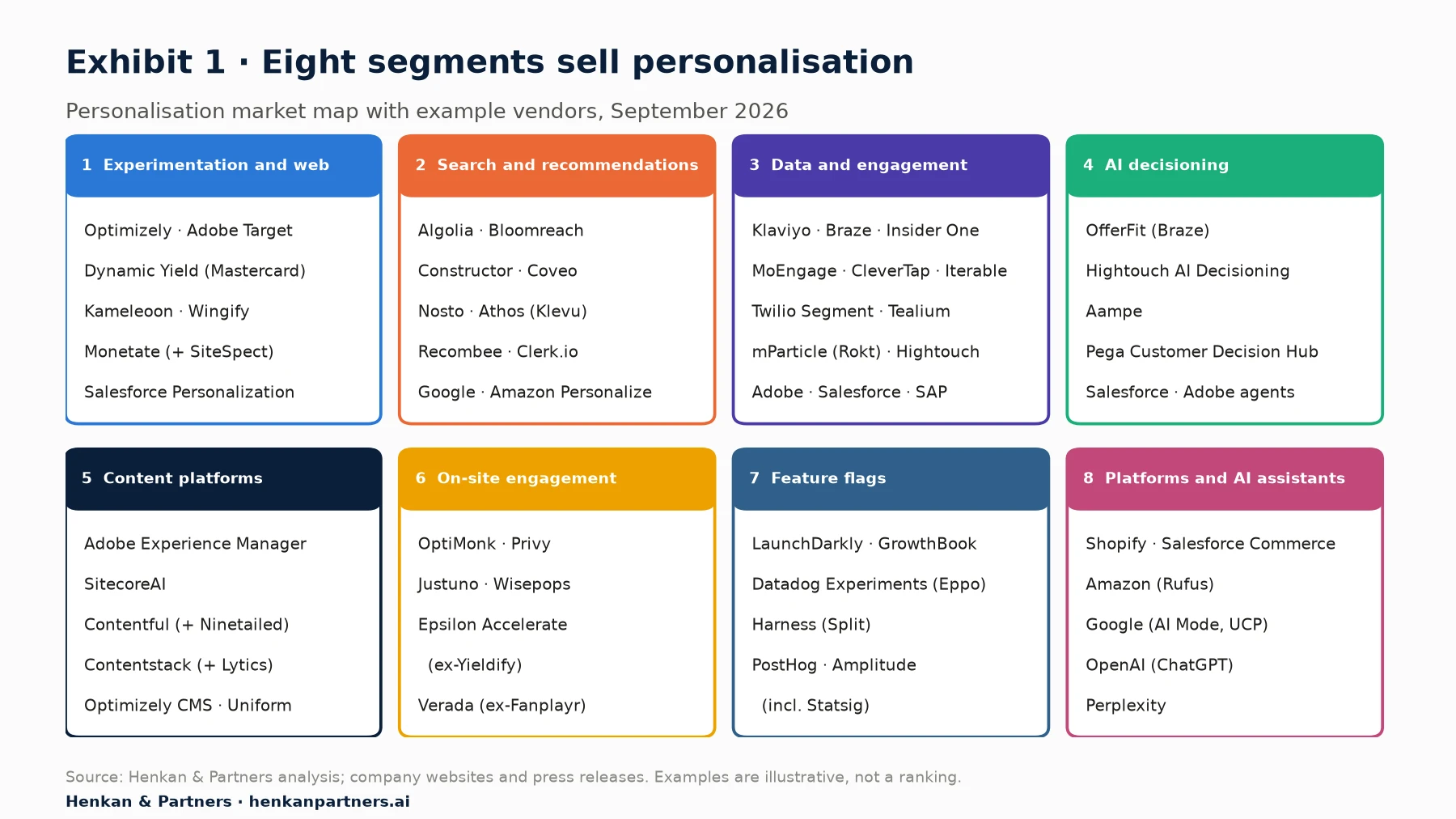
What this shows. The segments answer different questions with different data. Segments 1 and 2 personalise the website; 3 and 4 personalise messages across channels; 5 personalises content at the source; 6 captures intent cheaply; 7 serves product teams; and 8 is where platforms and AI assistants build personalisation in, often for free. The lines are blurring: most large vendors now sell across three or more segments.
| Segment | What it personalises | Typical buyer | Examples |
|---|---|---|---|
| 1. Experimentation and web personalisation | Pages, banners, layouts and offers by segment, tested against a control | CRO, e-commerce and digital teams | Optimizely, Adobe Target, Dynamic Yield (Mastercard), Kameleoon, Wingify, Monetate |
| 2. Search, merchandising and recommendations | Search results, category ranking, product recommendations | E-commerce and merchandising teams | Algolia, Bloomreach, Constructor, Coveo, Nosto, Athos Commerce (Klevu) |
| 3. Customer data and engagement | Email, SMS, push and in-app messages from a unified profile | CRM and lifecycle marketing | Klaviyo, Braze, Insider One, MoEngage, Twilio Segment, Tealium, Adobe, Salesforce |
| 4. AI decisioning | The offer, channel and timing for each customer, chosen by AI | CRM, growth and data teams | OfferFit by Braze, Hightouch, Aampe, Pega |
| 5. Content platforms | Content variants managed and delivered from the CMS | Digital, brand and web teams | Adobe Experience Manager, Sitecore, Contentful, Contentstack, Uniform |
| 6. On-site engagement | Pop-ups, forms and nudges by behaviour | Small and mid-sized stores | OptiMonk, Privy, Justuno, Wisepops |
| 7. Feature flags and product experimentation | Which users get which product feature | Product and engineering teams | LaunchDarkly, Datadog Experiments (Eppo), GrowthBook, PostHog, Amplitude |
| 8. Platforms and AI assistants | Built-in recommendations and AI shopping help | Everyone, often without buying anything | Shopify, Salesforce Commerce Cloud, Amazon, Google, OpenAI |
Section 2 · Market size
Published market sizes range from $1.2B to $455B, but most personalisation spend sits inside larger suites
Market estimates for personalisation disagree by a factor of several hundred, because they measure different things. Gartner counts only the revenue of personalisation-engine vendors. Other firms add services, customer data platforms or any software that uses AI to tailor something.
| Source | What it measures | Estimate |
|---|---|---|
| Gartner (Magic Quadrant, February 2026) | Personalisation-engine vendor revenue | $1.2B in 2024, up 26.1% |
| Mordor Intelligence | Personalisation-engine software plus services | $3.66B in 2025, rising to $11.93B by 2031 |
| Research and Markets | All "personalisation software" across channels | $14.44B in 2026, rising to $45.11B by 2032 |
| Grand View Research | "AI-based personalisation engines", defined very broadly | $455.4B in 2024 |
Company revenues are a better guide to where the money goes. The largest personalisation businesses are parts of broader suites, and the specialists are much smaller.
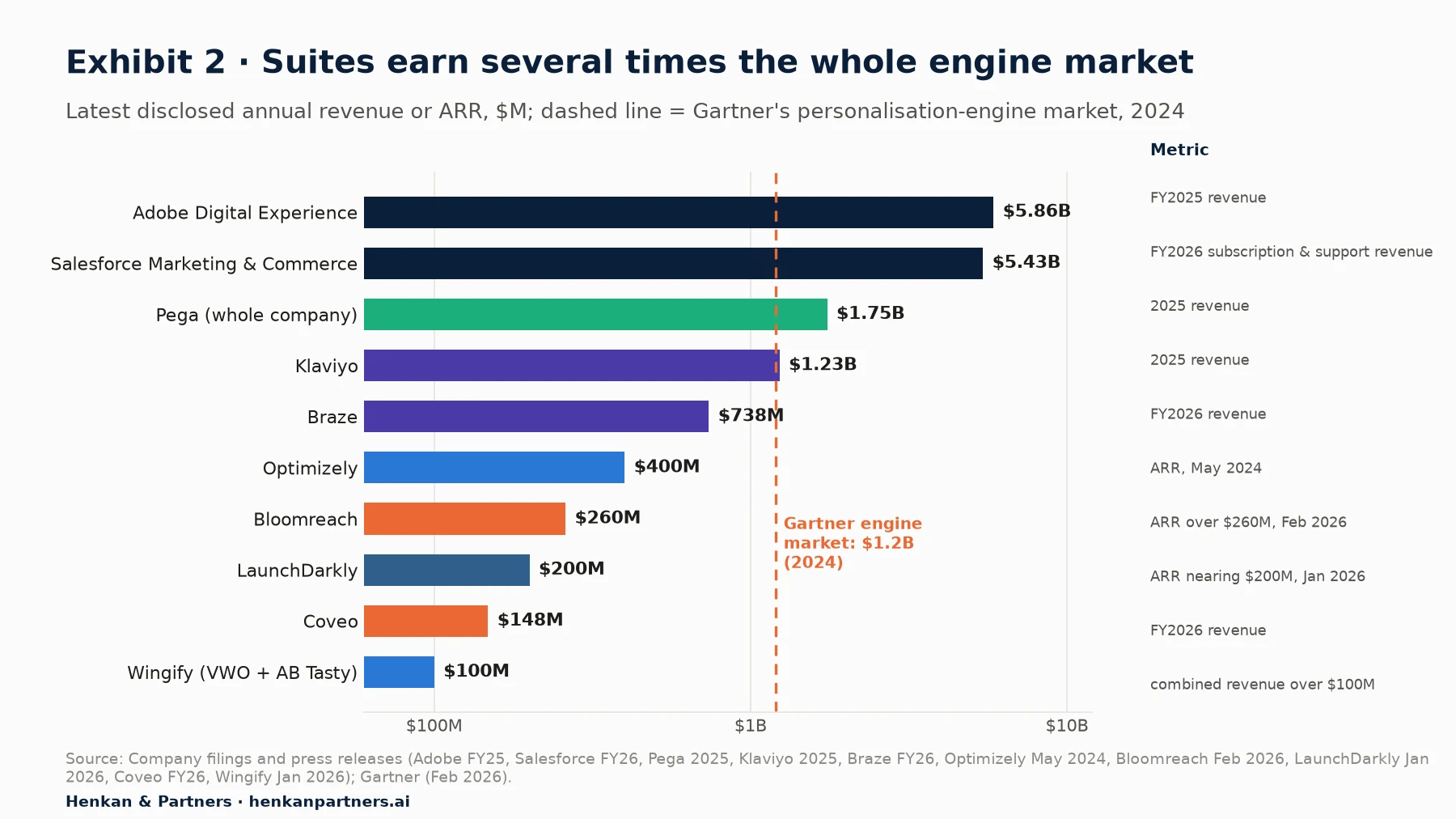
What this shows. Adobe's Digital Experience business alone earns about five times Gartner's entire engine market, and Salesforce's marketing and commerce clouds nearly as much. Most personalisation is therefore bought as part of a suite, an email platform or a commerce platform, not as a stand-alone engine. Among specialists, only a handful have passed $100M in annual revenue.
For e-commerce directors. Before buying a personalisation engine, check what your existing email, search, testing and commerce platforms already include. In our experience, many teams pay for the same capability more than once.
For investors. Market-size reports are not a sound basis for a personalisation investment case. Anchor valuations on disclosed revenue, net retention and the share of spend at risk of being bundled into a suite.
Section 3 · 2000–2012
Recommendation engines and testing tools created the category, and Adobe bought its way in
Modern personalisation has two roots. The first is the recommendation engine. In 2003 Amazon engineers Greg Linden, Brent Smith and Jeremy York published "Item-to-Item Collaborative Filtering", describing how Amazon recommended products similar to the ones a customer had already bought or rated, instead of searching for similar customers. In 2006 Netflix offered $1M to anyone who could improve its recommendations by 10%; the prize was awarded in September 2009 to the team BellKor's Pragmatic Chaos.
Netflix later put numbers on the value. In a 2015 paper, two of its executives wrote that recommendations influence choice for about 80% of hours streamed, and that personalisation and recommendations together "save us more than $1B per year", mostly by reducing cancellations. A widely quoted claim that 35% of Amazon's sales come from recommendations goes back to a 2013 McKinsey article that cites no source; we found no primary evidence for it.
The second root is website testing and targeting. In 2007 the analytics company Omniture bought Offermatica, an A/B and multivariate testing tool, for $65M, and Touch Clarity, a UK behavioural-targeting company, for about $50M. In September 2009 Adobe agreed to buy Omniture for about $1.8B. Their technology lives on in Adobe Target, which still anchors Adobe's personalisation offer.
A new generation of specialists appeared around the same time: Monetate (2008), Evergage and Optimizely (2010) and Dynamic Yield (around 2011). They made testing and targeting usable by marketers without developers, and set up the fight between suites and specialists that still shapes the market.
Section 4 · 2013–2021
Suites assembled personalisation stacks through a decade of $1–5B acquisitions
Between 2013 and 2021 the big software companies bought the pieces of a full personalisation stack: messaging, commerce, customer data and targeting. At the same time, investors valued specialists at up to $2B or more.
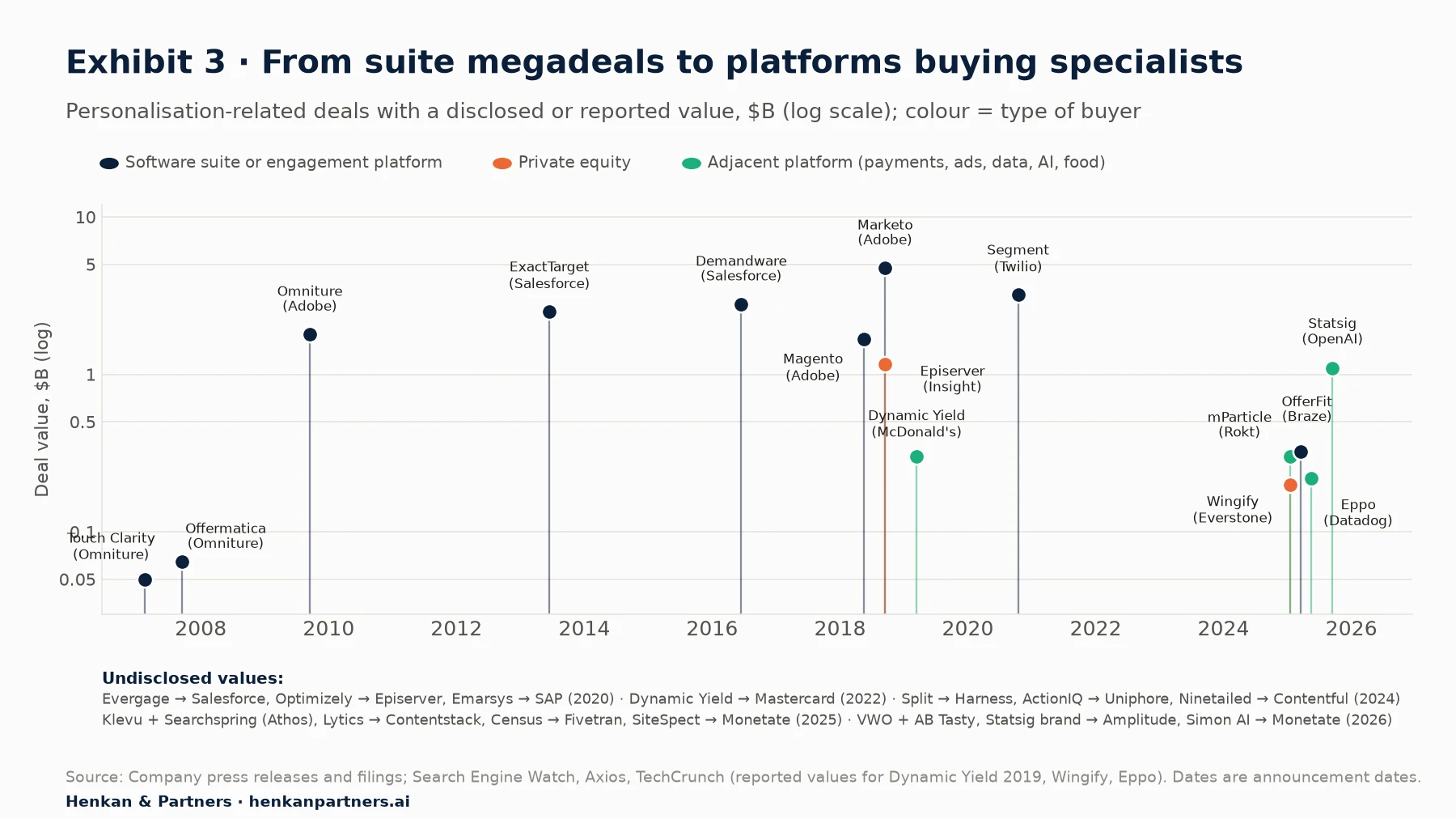
What this shows. Two waves stand out. From 2009 to 2020, software suites paid $1–5B to add marketing, commerce and customer-data capabilities. From 2024, the buyers changed: payments, data, advertising and AI companies are buying specialists, at lower prices, to add personalisation to platforms of their own.
- Salesforce bought ExactTarget for $2.5B (2013), which became Marketing Cloud, Demandware for $2.8B (2016), which became Commerce Cloud, and Evergage (2020), now Marketing Cloud Personalization.
- Adobe added Magento for $1.68B and Marketo for $4.75B in 2018, then built Real-Time CDP and Journey Optimizer on Adobe Experience Platform.
- Insight Partners bought the content-management company Episerver for $1.16B in 2018; Episerver bought Optimizely in 2020 and took its name in January 2021. Optimizely reported $400M of annual recurring revenue in May 2024.
- McDonald's bought Dynamic Yield in 2019 for a reported $300M, then sold it to Mastercard, which completed the deal in April 2022.
- Twilio bought the customer data platform Segment for about $3.2B in stock (2020), and SAP bought Emarsys the same year.
- Investors valued Algolia at $2.25B (2021) and Bloomreach at $2.2B (2022) after it bought Exponea. Braze (2021), Coveo (2021) and Klaviyo (2023, at about $9.2B) listed on public markets.
The period also brought the first backlash. In December 2019 Gartner predicted that by 2025, 80% of marketers who had invested in personalisation would abandon their efforts "due to lack of ROI, the perils of customer data management or both". Spending did not collapse: Gartner's own 2026 report says engine revenue grew 26% in 2024. But the prediction captured a real problem, which Section 7 returns to: many programmes cannot prove what they earn.
Privacy changes also began to bite. Apple's Safari blocked third-party cookies by default from March 2020, and Apple's App Tracking Transparency, introduced in April 2021, made iPhone apps ask before tracking users across other companies' apps and websites. Personalisation based on data collected by other companies became harder, and first-party data became more valuable.
Section 5 · 2022–2026
Since 2024, neighbouring platforms and private equity have absorbed the specialists
The last three years have reshaped every segment. Specialists that raised money at high valuations in 2021 have been bought by companies whose main business is elsewhere, merged by private-equity owners, or folded into larger platforms.
| Segment | What happened | Why it matters |
|---|---|---|
| Experimentation and web personalisation | Everstone bought a majority of Wingify (VWO) for about $200M (January 2025), then merged it with AB Tasty (January 2026; over $100M combined revenue), relaunched as Wingify in September 2026. Monetate, spun out of Kibo to Centre Lane Partners in 2022, bought SiteSpect (June 2025) and Simon AI (July 2026) | Consolidation into a few larger specialists competing with Adobe, Optimizely and Dynamic Yield |
| Feature flags | Harness bought Split (2024). Datadog bought Eppo (2025, about $220M reported) and relaunched it as Datadog Experiments. OpenAI bought Statsig for $1.1B (September 2025); in May 2026 Amplitude took over Statsig's brand and customers | Experimentation is becoming a feature of observability, analytics and AI platforms |
| Search and recommendations | Klevu and Searchspring formed Athos Commerce, backed by PSG (January 2025). Crownpeak bought Attraqt, owner of Fredhopper, for £63.2M (2022). Bloomreach passed $260M ARR and reported positive free cash flow in 2025 | Scale players emerge; AI shopping agents become the new battleground |
| Customer data | Rokt bought mParticle for $300M (January 2025). Uniphore bought ActionIQ (2024), Fivetran bought Census (2025) and Contentstack bought Lytics (2025). Hightouch was valued at $2.75B in April 2026 | Stand-alone CDPs are being absorbed; data activation moves to the warehouse |
| AI decisioning | Braze bought OfferFit for $325M (announced March 2025, completed June 2025) | Engagement platforms buy AI that replaces manual A/B tests and rules |
| Content platforms | Contentful bought Ninetailed (2024). Sitecore launched SitecoreAI (November 2025) | Personalisation moves into the content system itself |
| On-site engagement | Publicis bought Yieldify (January 2023), now part of Epsilon. Fanplayr rebranded as Verada (September 2026) | Entry-level tools move upmarket or into agency groups |
The customer data platform segment shows the pattern most clearly. In 2024, Gartner placed CDPs in the "trough of disillusionment" of its hype cycle, reporting that 67% of marketers had adopted one but only 17% reported high use, according to AdExchanger. The CDP Institute reported in July 2025 that acquisitions of independent CDPs were a clear trend, even as the industry returned to growth. Buyers want customer data to live in their own warehouse, and vendors are responding by becoming "composable" or by selling out. Engagement platforms, by contrast, are still raising large rounds: MoEngage completed a $280M Series F in December 2025, led in its second tranche by ChrysCapital and Dragon Funds, and says it serves more than 1,350 consumer brands.
For investors. The exits of 2022–26 went mostly to strategic buyers from adjacent markets: payments (Mastercard), advertising (Rokt), observability (Datadog), AI (OpenAI) and data movement (Fivetran). Few specialists reached a large independent exit. Underwrite personalisation assets on who would buy them, not on a future listing.
Section 6 · AI and agents
AI is moving personalisation from rules written by marketers to decisions made by agents
Personalisation has gone through four technology stages, and each still exists in the market. Rule-based targeting lets marketers define segments and choose what each one sees. Machine-learning recommendations predict products for each person. AI decisioning uses reinforcement learning to choose offers, timing and channels for each customer and learns from every response. AI agents now go further, proposing hypotheses, building variants and running campaigns with limited human input.
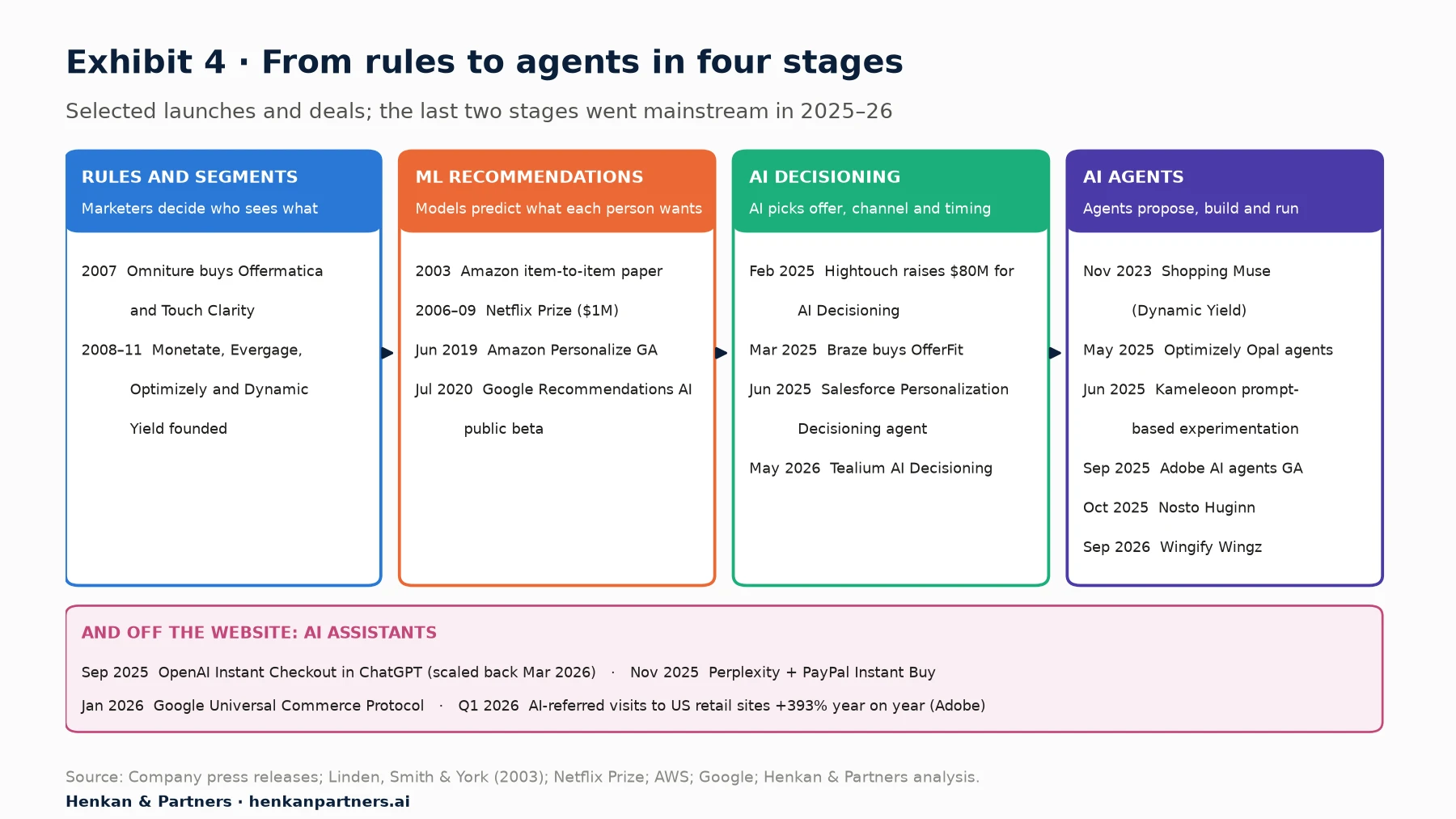
What this shows. The first two stages took two decades to mature; the last two went mainstream in about two years, mostly in 2025–26. Almost every vendor in this report now markets AI agents, but most agent features are less than a year old, and published evidence of their incremental value comes mainly from the vendors themselves.
From rules to decisioning
- Braze bought OfferFit, whose reinforcement-learning agents "replace the manual work of A/B testing", for $325M, and now sells it as OfferFit by Braze.
- Hightouch, whose AI Decisioning product assigns learning agents to individual customers across email, push, in-app and ads, raised $150M at a $2.75B valuation in April 2026.
- Salesforce added a Personalization Decisioning agent to Marketing Cloud Next (June 2025). Adobe made six AI agents generally available in September 2025, including Journey, Audience and Experimentation agents. Tealium launched AI Decisioning in May 2026, and Pega, whose Customer Decision Hub has sold next-best-action decisioning for years, reported $1.75B of 2025 revenue.
- MoEngage, an engagement platform, launched Merlin AI custom agents in June 2026: marketers set rules on audience, channels, content and budget, and choose whether agents act alone or wait for approval. It also opened an MCP server so that outside AI assistants such as ChatGPT and Claude can use MoEngage data.
From the website to AI assistants
A second shift is happening off the retailer's website. Shoppers increasingly ask AI assistants what to buy, and the assistants personalise the answer before the shopper arrives, if they arrive at all.
- Traffic is growing fast from a small base. Adobe reports that visits to US retail sites from generative-AI sources rose 393% year on year in Q1 2026, and that in March 2026 those visitors converted 42% better than other traffic. Adobe does not publish AI's share of total visits.
- Assistants are adding checkout. OpenAI launched Instant Checkout in ChatGPT in September 2025 with an open protocol built with Stripe, then scaled native checkout back in March 2026, according to trade press. Google launched the Universal Commerce Protocol with Shopify, Etsy, Wayfair, Target and Walmart in January 2026. Perplexity added shopping with PayPal in November 2025.
- Retail platforms are building their own. Amazon said its Rufus assistant was used by 250 million shoppers in 2025. Shopify's Winter '26 release added "agentic storefronts" that list merchants' products in ChatGPT, Perplexity and Microsoft Copilot.
For e-commerce directors. In an AI-assistant world, personalisation starts with product data: complete attributes, accurate stock and prices, and clear policies that an assistant can read. Treat product feeds and structured data as personalisation infrastructure, not an SEO chore.
For investors. If assistants personalise before the visit, on-site personalisation vendors risk losing part of their value to whoever controls the assistant. Vendors that feed product data and offers into assistants, or run the retailer's own assistant, are better placed.
Section 7 · Does it pay?
Personalisation can pay well, but the evidence is thinner than vendor claims, so every programme needs a holdout
The case for personalisation rests on a few widely quoted studies. They are useful, but most are surveys or company-reported figures. Controlled experiments tell a more cautious story.
| Evidence | What it found | How strong it is |
|---|---|---|
| McKinsey (2021) | 71% of consumers expect personalisation and 76% get frustrated without it; personalisation most often drives a 10–15% revenue lift, ranging from 5% to 25% by company | Consultancy research; sample size not stated in the article |
| BCG (2017) | Personalisation leaders saw revenue lifts of 6–10%; only about 15% of companies qualified as leaders | Consultancy research |
| Netflix (2015 and 2025) | Recommendations influence about 80% of hours streamed and save over $1B a year; a 2025 study by Netflix economists estimates engagement would fall about 12% if its recommender were replaced by popularity-based suggestions | Company-authored; the 2025 paper uses a structural model on real algorithm changes |
| Lee and Hosanagar (randomised field experiment) | The effect of recommendations on sales depends on the algorithm; one common algorithm had no measurable effect on the number of products bought | Randomised controlled experiment at a retailer |
| Booking.com (2019) | In a review of about 150 production models, gains in offline model accuracy did not reliably translate into business gains measured in randomised experiments | Large set of randomised experiments |
| Facebook ad measurement (2019) | Non-experimental methods often failed to match randomised results, and in about half the studies were off by a factor of three or more, usually overstating the effect | 15 large field experiments; advertising, used here as an analogy |
| Gartner (2025) | 53% of 1,464 buyers had experienced negative effects from personalisation; they were 3.2 times more likely to regret a purchase | Survey |
Three lessons follow. First, personalisation is not one thing: the same budget can produce a large gain or none, depending on the algorithm, the data and the placement. Second, vendor case studies without a randomised control group are not reliable evidence of incremental value. Third, customers notice when personalisation goes wrong. A 2015 study in the Journal of Retailing found that personalised ads raised click intentions when data was collected openly, but backfired when customers felt it had been collected covertly.
Testing culture explains why. Most ideas fail when tested properly: at Microsoft only about one third of ideas improved the metrics they were designed to improve. Personalisation rules and models are ideas too, and should be tested in the same way. Amazon's own history shows the upside: its early shopping-cart recommendations were launched as a controlled experiment against a senior executive's objection, and won by a wide margin.
For e-commerce directors. Keep a permanent holdout group, typically a small random share of visitors or customers who never see personalisation, and report incremental revenue against it every month. If a vendor cannot support a holdout, you will never know what you are paying for.
For investors. Ask targets for the share of customers who measure results against a holdout, and for renewal rates among them. Programmes that cannot prove value are the first to be cut or bundled.
Section 8 · Privacy and regulation
Regulators are targeting profiling, pricing and transparency, while third-party cookies survive in Chrome
Personalisation depends on data, and the rules on data have changed several times since 2020. The picture in 2026 is less dramatic than predicted for cookies, but tighter on transparency and pricing.
| Date | Change | What it means for personalisation |
|---|---|---|
| Mar 2020 | Safari blocks third-party cookies by default | Cross-site data stops working for a large share of shoppers |
| Apr 2021 | Apple App Tracking Transparency (iOS 14.5) | Apps must ask before tracking users across other companies' apps and websites |
| Jul 2024 – Oct 2025 | Google drops its plan to remove third-party cookies from Chrome (July 2024), confirms it will keep them without a new prompt (April 2025) and retires most Privacy Sandbox technologies (October 2025) | Cross-site tracking survives in Chrome, but first-party data remains the more durable foundation |
| Feb 2024 | EU Digital Services Act applies to all platforms | Platforms must explain the main parameters of their recommender systems; very large platforms such as Amazon, Zalando, Temu and Shein must offer at least one option not based on profiling |
| Jan 2025 | US FTC publishes initial findings of its surveillance-pricing study | Intermediaries including Mastercard, Bloomreach and McKinsey were asked how personal data such as location and browsing is used to set individual prices |
| Feb 2025 – Dec 2027 | EU AI Act obligations phase in | Manipulative AI banned from February 2025; most transparency rules apply from August 2026; ordinary e-commerce recommenders are not high-risk, but life and health insurance pricing is, with high-risk obligations applying from December 2027 |
| Nov 2025 | New York Algorithmic Pricing Disclosure Act takes effect | Prices set by an algorithm using personal data must carry a disclosure; penalties up to $1,000 per violation |
| Q4 2026 (planned) | EU Digital Fairness Act proposal | Expected to address dark patterns and "unfair personalisation practices"; not yet proposed as of September 2026 |
Two further rules apply across the EU. Under the GDPR, people can object at any time to profiling for direct marketing, and a decision based solely on automated processing is restricted only where it has legal or similarly significant effects, which ordinary product recommendations usually do not. Under the ePrivacy Directive, storing or reading information on a visitor's device needs consent unless it is strictly necessary. In the US, about 20 states had comprehensive privacy laws in force by early 2026.
Personalised pricing is the most sensitive area. In July 2025 Delta Air Lines faced questions from US senators about AI-based fares and stated that it does not target customers with individualised prices based on personal data. In December 2025 Instacart ended item price tests after an investigation led by Consumer Reports found different shoppers seeing different prices; Instacart said the tests were randomised and did not use personal data.
For e-commerce directors. Personalise products, content and service freely, with consent; be very careful before personalising prices. Document what data each personalisation uses, keep a non-personalised option where required, and review any price variation with legal counsel.
Section 9 · Choosing a tool
E-commerce directors should choose personalisation tools from the question they need answered
Most personalisation buying mistakes start with a vendor demo rather than a business question. A team buys an enterprise engine to "personalise the experience", then runs a handful of homepage banners while the biggest opportunities, search and product recommendations, stay generic. The framework below starts from six questions e-commerce teams actually ask.
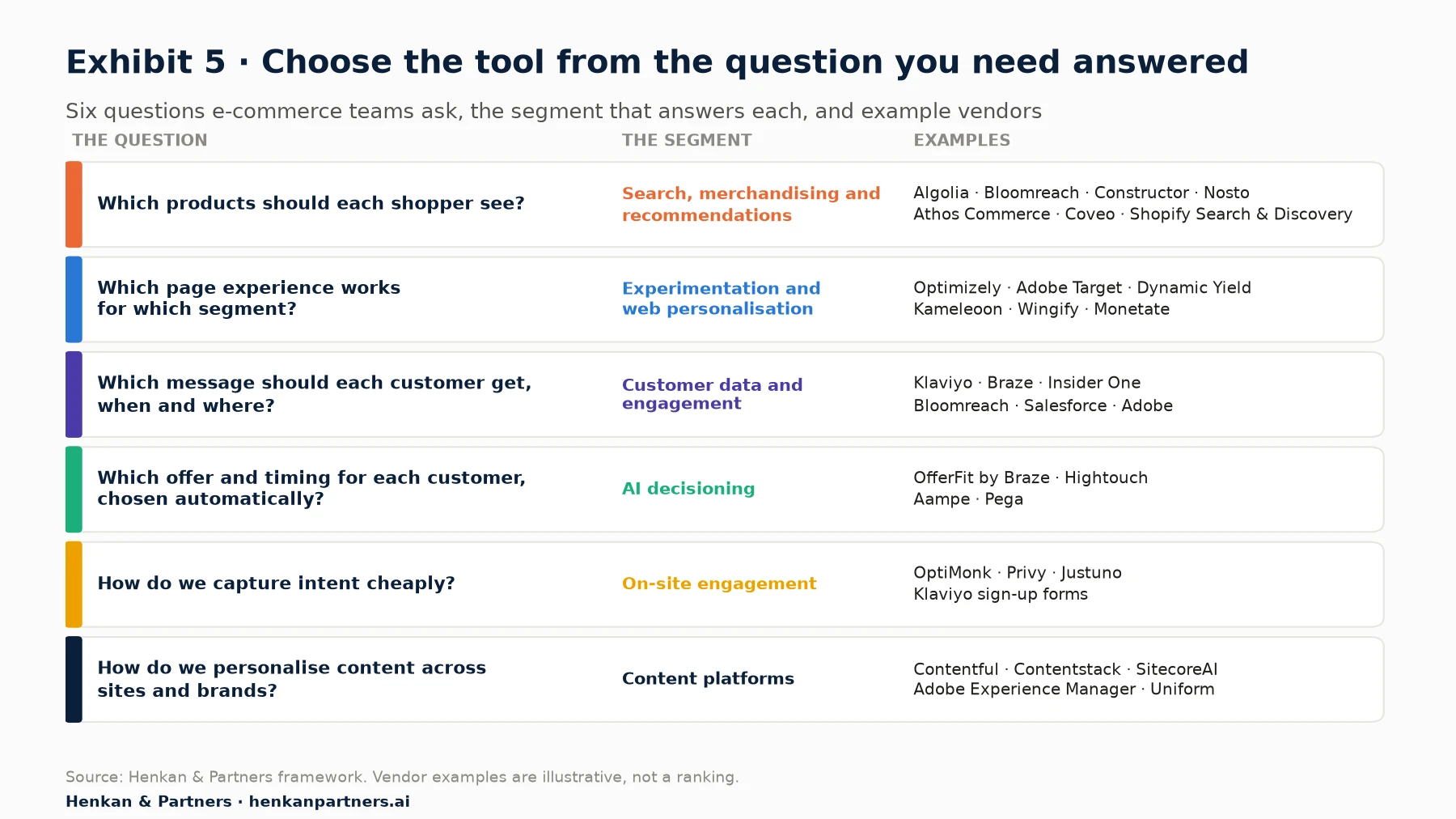
What this shows. Each question maps to a different segment and a different data source. In our experience, most online retailers need the first three rows and one of the last three. AI decisioning pays off only once the messaging programme, the data and a holdout measurement are in place.
Step 1: Match the stack to the size of your team and business
| Your situation | What to start with | Typical tools | Budget guide |
|---|---|---|---|
| Small team, one store (a few people) | Built-in recommendations and search, email flows, one well-tested pop-up | Shopify Search & Discovery (free), Klaviyo, OptiMonk or Privy, Recombee | Free to a few hundred dollars a month |
| Growing brand (a CRO or CRM team, regular A/B tests) | A search and recommendations platform, lifecycle messaging, a testing tool with targeting | Algolia, Nosto, Athos Commerce or Constructor; Klaviyo, Braze or Insider One; Kameleoon, Wingify or Optimizely | Mostly quote-based; plan for several thousand dollars a month and up |
| Multi-brand or international retailer | Unified customer data, cross-channel journeys, AI search, experimentation at scale | Bloomreach, Coveo, Dynamic Yield, Optimizely, Monetate; Braze or SAP Engagement Cloud; Hightouch or Tealium | Quote only; tens of thousands of dollars a year and up |
| Enterprise with a suite strategy | Suite personalisation plus AI decisioning, with a holdout on every programme | Adobe (Target, Journey Optimizer, Real-Time CDP), Salesforce (Personalization, Data 360), Pega | Quote only; Salesforce lists Personalization from $8,000 per org per month, billed annually |
Step 2: Compare what you will actually pay
Pricing models differ widely. Search vendors charge by queries or records, engagement platforms by contacts or monthly active users, experimentation platforms by traffic, and feature-flag tools by seats, events or service connections. Published prices run from free to $15,000 a month; most enterprise vendors publish none.
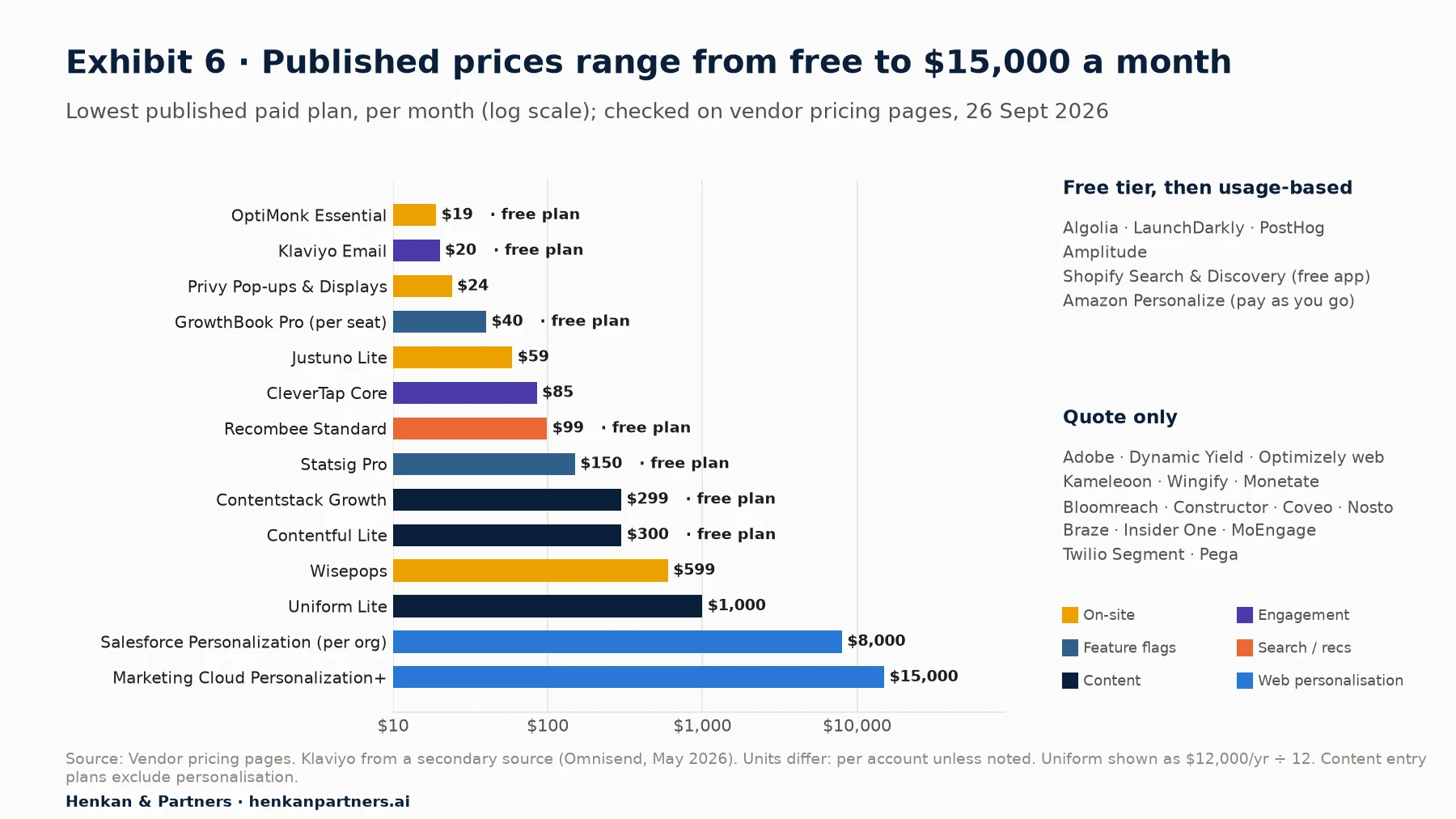
What this shows. A small store can personalise search, recommendations, email and on-site messages for under $100 a month. Prices jump when you add enterprise web personalisation, unified customer data and AI decisioning, and most of those vendors only quote. Free tiers are generous in search (Algolia, Recombee), feature flags (LaunchDarkly, Statsig, GrowthBook, PostHog) and content platforms (Contentful, Contentstack), although content-platform entry plans exclude personalisation modules, which are sold separately or in enterprise plans.
Step 3: Ask ten questions before you sign
- Which decision will this improve first? Name the page, message or ranking and the metric it should move in the next 90 days.
- Can we keep a permanent holdout? Insist on a random group that never sees personalisation, and on reporting against it.
- Do we already own this capability? Check your commerce platform, email tool, search and testing contracts.
- What data does it need, and where does it live? Prefer tools that use your own first-party data and warehouse over copying data into another silo.
- How does it handle consent and privacy? Check consent integration, EU hosting, data-processing terms and non-profiling options.
- Will it help us in AI assistants? Ask how the vendor feeds products, prices and offers to ChatGPT, Gemini and other agents.
- What does the AI actually decide, and can we see why? You need to explain decisions to colleagues, customers and, increasingly, regulators.
- How is it priced as we grow? Model the cost at two and five times today's traffic, contacts or events.
- Who will run it? Personalisation needs content, data and testing capacity; a tool without an owner produces a few banners and no results.
- Who owns the vendor, and what is its roadmap? After a merger or buyout, ask which products will be kept and how pricing will change.
For e-commerce directors. The best first personalisation programme is usually unglamorous: better site search, product recommendations tested against a control, email flows triggered by behaviour, and a holdout to measure it all. Add one-to-one web experiences and AI decisioning once those are proven. That is how personalisation turns into a better customer experience, higher revenue and customer lifetime value.
Section 10 · The private-equity view
Investors should back data ownership, measurable decisioning and exposure to AI assistants
Four investment theses stand out in 2026, each with different risks:
- Suite consolidation. Adobe and Salesforce dominate spend and keep adding AI agents. The opportunity is in companies that suites need to buy; the risk is being bundled away.
- Specialist roll-ups. Private-equity owners are merging mid-sized specialists: Everstone with Wingify, PSG with Athos Commerce, and investor-backed Monetate with SiteSpect and Simon AI. Scale and cross-selling can work, but integration and product overlap are real risks.
- AI decisioning. In our view, investors are paying premiums for AI that replaces manual testing and rules: Braze paid $325M for OfferFit, and Hightouch, which sells AI Decisioning, was valued at $2.75B. The risk is that suites and engagement platforms build the same capability.
- Personalisation inside other platforms. Payments, advertising, observability and AI companies bought specialists in 2022–26. Assets that plug into these platforms, or into AI shopping assistants, have more buyers.
| Due-diligence question | Why it matters |
|---|---|
| What share of customers measure results against a holdout, and how do they renew? | Proven incremental value is the best defence against budget cuts and bundling |
| How much revenue depends on third-party data or cross-site tracking? | Browser, platform and regulatory changes keep reducing this data |
| What overlaps with Adobe, Salesforce, Shopify or the customer's email platform? | Overlapping features are the first to be cut when budgets tighten |
| How does the product work with AI assistants and agent protocols? | Personalisation value may shift to whoever controls the assistant |
| Does the product touch pricing, credit or insurance decisions? | These uses face surveillance-pricing scrutiny, disclosure laws and possible high-risk rules |
| After the last acquisition, which products will be retired? | Product sunsets drive churn among customers of acquired tools |
Section 11 · Implications
Personalise what customers search for and buy first, prove it with a holdout, and prepare for AI assistants
Personalisation software is abundant, consolidating and increasingly automated. The winners, for vendors and for retailers, will be those that can show incremental value and adapt to shopping that starts in AI assistants. Our recommendations:
1. Start with search, recommendations and lifecycle messages
In our experience these three touch the most revenue for most online retailers. Get them working and tested before investing in one-to-one web experiences.
2. Measure everything against a holdout
Keep a permanent random group without personalisation and report incremental revenue against it. Treat vendor case studies as hypotheses, not proof. Our essential guide to A/B testing explains how to design tests you can trust.
3. Build on first-party data you control
Collect data with consent, keep it in systems you own, and make sure every tool can read from it and export to it. This protects you from browser changes, vendor mergers and product sunsets.
4. Make your products readable by AI assistants
Complete product attributes, accurate prices and stock, and clear policies are now personalisation assets, because assistants use them to decide what to recommend. Track traffic and conversion from AI assistants separately.
5. Use the customer's voice to decide what to personalise
The best personalisation ideas come from knowing why different customers behave differently. Our essential guide to Voice of Customer shows how to find those reasons and turn them into tests.
Our view. Personalisation is a means, not the goal. The goal is a better customer experience that grows revenue and lifetime value. Teams of every size, from a two-person Shopify store to a multi-brand retailer, can get there by personalising what matters most to customers, testing it properly and scaling only what works.
FAQ
Frequently asked questions about personalisation software
Frequently asked questions
What is a personalisation engine?
A personalisation engine is software that decides in real time which content, products or offers each visitor sees, based on their behaviour and profile, and usually tests the results. Examples include Adobe Target, Dynamic Yield, Optimizely, Kameleoon and Salesforce Personalization.
What are the best personalisation tools for e-commerce in 2026?
It depends on the question. Search and recommendation platforms (Algolia, Bloomreach, Constructor, Nosto, Athos Commerce) personalise products; experimentation platforms (Optimizely, Dynamic Yield, Kameleoon, Wingify) personalise pages; engagement platforms (Klaviyo, Braze, Insider One) personalise messages. Small stores can start with Shopify's free Search & Discovery app and Klaviyo.
How big is the personalisation market?
Gartner sized the personalisation-engine market at $1.2B in 2024, up 26.1%. Broader estimates run from $3.7B to $14B or more, depending on whether they include services, customer data platforms and other software. Suite vendors such as Adobe and Salesforce capture most of the spend.
Does personalisation increase revenue?
Often, but not always. McKinsey reports a typical lift of 10–15%, but controlled experiments show results depend on the algorithm and placement, and non-experimental measurement can overstate effects several times over. Measure every programme against a holdout group.
What is the difference between personalisation and A/B testing?
A/B testing finds the version that works best for everyone on average. Personalisation shows different versions to different people. The two work together: personalisation rules and models should themselves be tested against a control.
Is personalised pricing legal?
It is heavily scrutinised. The US FTC has studied "surveillance pricing", New York requires a disclosure when prices are set by an algorithm using personal data, and the EU plans to address unfair personalisation practices in its Digital Fairness Act. Seek legal advice before personalising prices.
Are third-party cookies going away?
Not in Chrome. Google abandoned its plan to remove them in 2024 and retired most Privacy Sandbox technologies in October 2025. Safari and Firefox block them by default, and Apple's App Tracking Transparency limits tracking in apps, so first-party data remains the safer foundation.
Key terms
- Personalisation
- Showing different content, products, prices or messages to different people based on what is known about them. Done well, it makes shopping easier; done badly, it feels intrusive or wrong.
- Personalisation engine
- Software that decides, in real time, which experience each visitor sees, and usually tests it. Gartner's narrow market definition covers these engines only.
- Rule-based targeting
- Personalisation written by people as "if this segment, show that". Easy to understand, but hard to scale beyond a few dozen rules.
- Recommendation engine
- Software that predicts which products or content a person is likely to want, often from what similar customers bought or viewed (collaborative filtering).
- Search and merchandising
- On-site search, category ranking and product placement. In our experience, it is where personalisation touches the most revenue for most retailers.
- Customer data platform (CDP)
- Software that unifies customer data from many sources into one profile per customer, then sends audiences to other tools. It is the data layer behind cross-channel personalisation.
- Composable CDP
- A CDP that works on top of the company's own data warehouse instead of copying data into the vendor's system. It gives more control, but needs more data expertise.
- AI decisioning
- AI that chooses, for each customer, which offer, message, channel and timing to use, and learns from the results. It replaces many hand-built rules and A/B tests.
- Multi-armed bandit
- A testing method that shifts traffic towards better-performing variants while the test runs. Faster to exploit a winner, but less suited to learning why it won.
- Holdout group
- A random share of customers who never receive the personalised experience. Comparing them with everyone else is the only reliable way to measure what personalisation adds.
- First-party data
- Data a company collects directly from its own customers, with their consent. It matters more as browsers and regulators restrict tracking across sites.
- Feature flag
- A switch in software that turns a feature on or off for chosen users. Product teams use flags to release, test and target features.
- Agentic commerce
- Shopping done or assisted by AI agents, such as ChatGPT, Gemini or a retailer's own assistant, which search, compare and sometimes buy for the customer.
- Surveillance pricing
- Setting individual prices from personal data such as location, browsing or demographics. US regulators are studying it, and New York requires it to be disclosed.
Sources
Company facts, deals and financials come from press releases, investor relations pages and filings, cross-checked with reputable outlets (TechCrunch, Axios, Business Wire, PR Newswire). Deal values marked "reported" come from press coverage rather than the companies. Prices were checked on vendor pricing pages on 26 September 2026 and exclude taxes. Market-size estimates use different definitions and are not comparable. Research findings were checked against the original papers or publishers' pages. Henkan & Partners works with several vendors named in this report, including as a certified partner of Kameleoon and AB Tasty (now Wingify); this report does not rank vendors.
- Gartner, Magic Quadrant for Personalization Engines, February 2026
- SAP, a Leader in the 2026 Gartner Magic Quadrant for Personalization Engines
- Mordor Intelligence, personalization engine software market
- Research and Markets, personalization software market
- Grand View Research, AI-based personalization engines market
- Adobe, Q4 and FY2025 results (SEC)
- Salesforce, Q4 FY2026 results
- Pega, Q4 2025 results (SEC)
- Klaviyo, 2025 results
- Braze, fiscal 2026 results
- Optimizely reaches $400M ARR, May 2024
- Bloomreach surpasses $260 million ARR, February 2026
- LaunchDarkly expands leadership team, January 2026
- Coveo, fiscal 2026 results
- TechCrunch, Everstone combines Wingify and AB Tasty, January 2026
- TechCrunch, Everstone acquires Wingify for $200M, January 2025
- AB Tasty and VWO unite under Wingify, September 2026
- Linden, Smith and York, Amazon.com recommendations: item-to-item collaborative filtering, 2003
- Netflix Prize (overview)
- Gomez-Uribe and Hunt, The Netflix Recommender System, ACM TMIS, 2015
- McKinsey, How retailers can keep up with consumers, 2013
- Search Engine Watch, Omniture acquires Offermatica, 2007
- Adobe to acquire Omniture, September 2009 (SEC)
- Insight Venture Partners invests in Episerver, 2018
- Episerver to acquire Optimizely, 2020
- Axios, McDonald's agrees to buy Dynamic Yield, 2019
- Mastercard closes Dynamic Yield acquisition, April 2022
- Salesforce acquires Evergage, 2020
- VentureBeat, Salesforce acquires Demandware for $2.8B, 2016
- TechCrunch, Adobe buys Marketo for $4.75B, 2018
- Twilio completes acquisition of Segment, 2020
- SAP completes acquisition of Emarsys, 2020
- TechCrunch, Algolia raises $150M at $2.25B valuation, 2021
- Bloomreach valuation reaches $2.2B, 2022
- CNBC, Klaviyo IPO, September 2023
- Gartner predicts 80% of marketers will abandon personalization efforts, 2019
- WebKit, full third-party cookie blocking, 2020
- TechCrunch, Apple's App Tracking Transparency has arrived, 2021
- Monetate acquires SiteSpect, June 2025
- Monetate acquires Simon AI, July 2026
- Kibo spins off Monetate, 2022
- Harness completes acquisition of Split, 2024
- TechCrunch, Datadog acquires Eppo, 2025
- TechCrunch, OpenAI acquires Statsig, September 2025
- Amplitude and Statsig partnership, May 2026
- Klevu and Searchspring form Athos Commerce, January 2025
- Attraqt backs £63.2M Crownpeak takeover offer, 2022
- Rokt and mParticle merge, January 2025
- AdExchanger, Rokt acquires mParticle for $300 million
- Uniphore to acquire ActionIQ, December 2024
- TechCrunch, Fivetran acquires Census, May 2025
- Contentstack acquires Lytics, January 2025
- PYMNTS, Hightouch valued at $2.75 billion, April 2026
- Braze announces agreement to acquire OfferFit, March 2025
- Braze completes acquisition of OfferFit, June 2025
- Contentful to acquire Ninetailed, August 2024
- Sitecore unveils SitecoreAI, November 2025
- Publicis Groupe acquires Yieldify, January 2023
- SalesTechStar, Fanplayr rebrands to Verada, September 2026
- AdExchanger, CDPs in Gartner's trough of disillusionment, 2024
- CDP Institute, CDP industry is growing again, 2025
- AWS, Amazon Personalize generally available, June 2019
- TechRadar, Google Recommendations AI, 2020
- Hightouch Series C and AI Decisioning, February 2025
- MoEngage, additional $180 million in Series F funding, December 2025
- MoEngage, Merlin AI custom agents and open MCP architecture, June 2026
- Salesforce announces Marketing Cloud Next, June 2025
- Adobe, general availability of AI agents, September 2025
- Tealium newsroom (AI Decisioning, May 2026)
- Mastercard, Dynamic Yield unveils Shopping Muse, November 2023
- Optimizely Opal transformation, May 2025
- Kameleoon, introducing prompt-based experimentation, June 2025
- Nosto introduces Huginn, October 2025
- Wingify, Wingz AI
- Adobe, AI traffic to retail sites, 2026
- Stripe, Instant Checkout in ChatGPT, September 2025
- Checkout.com, OpenAI's agentic commerce shift, April 2026
- Google, Universal Commerce Protocol, January 2026
- PayPal and Perplexity launch Instant Buy, November 2025
- Yahoo Finance, Amazon's Rufus AI shopping assistant, November 2025
- Shopify, Winter '26 Edition
- McKinsey, The value of getting personalization right—or wrong—is multiplying, 2021
- BCG, personalization programs increase revenues by 6% to 10%, 2017
- Zielnicki et al., The Value of Personalized Recommendations: Evidence from Netflix, 2025
- Lee and Hosanagar, Impact of Recommender Systems on Sales Volume and Diversity, ICIS 2014
- Bernardi et al., 150 Successful Machine Learning Models, Booking.com, KDD 2019
- Gordon et al., A Comparison of Approaches to Advertising Measurement, Marketing Science, 2019
- Gartner, personalization can triple the likelihood of customer regret, June 2025
- Aguirre et al., Unraveling the Personalization Paradox, Journal of Retailing, 2015
- Kohavi, Tang and Xu, Trustworthy Online Controlled Experiments, chapter 1
- Google Privacy Sandbox, a new path, July 2024
- Google Privacy Sandbox, next steps, April 2025
- Google Privacy Sandbox, update on plans, October 2025
- European Commission, very large online platforms and search engines
- DSA Article 38
- EU AI Act implementation timeline
- EU AI Act Annex III
- GDPR Article 21
- GDPR Article 22
- European Parliament Legislative Train, Digital Fairness Act
- FTC, surveillance pricing study, January 2025
- Jones Day, New York's algorithmic pricing disclosure law, November 2025
- MultiState, 20 state privacy laws in effect in 2026
- Delta, response on AI pricing, July 2025
- Grocery Dive, Instacart ends price tests, December 2025
- Vendor pricing pages checked 26 September 2026: Salesforce Personalization, LaunchDarkly, Statsig, GrowthBook, PostHog, Algolia, Recombee, OptiMonk, Privy, Justuno, Wisepops, CleverTap, Contentful, Contentstack, Uniform
- Omnisend, Klaviyo pricing (secondary source), May 2026