Market Report
The Tag Management Market, 2007–2026: Free Containers, Server-Side Tagging, Consent and Where Value Goes Next
Alexandre Suon · 2026-09-26
Tag management began as a paid enterprise product in 2007 and became free for everyone when Google launched Tag Manager in 2012. Since then the money has moved to where Google is weaker: server-side collection, consent and customer data. This report explains how the market formed, who bought whom, what analyst sizes miss, where value is going, and how e-commerce teams and investors should read it.
Executive summary
- Tag management is now three layers, not one product. The client-side tag manager in the browser, server-side collection that routes data through a company's own servers, and consent management that decides what may be collected at all. Vendors increasingly sell two or three of these together.
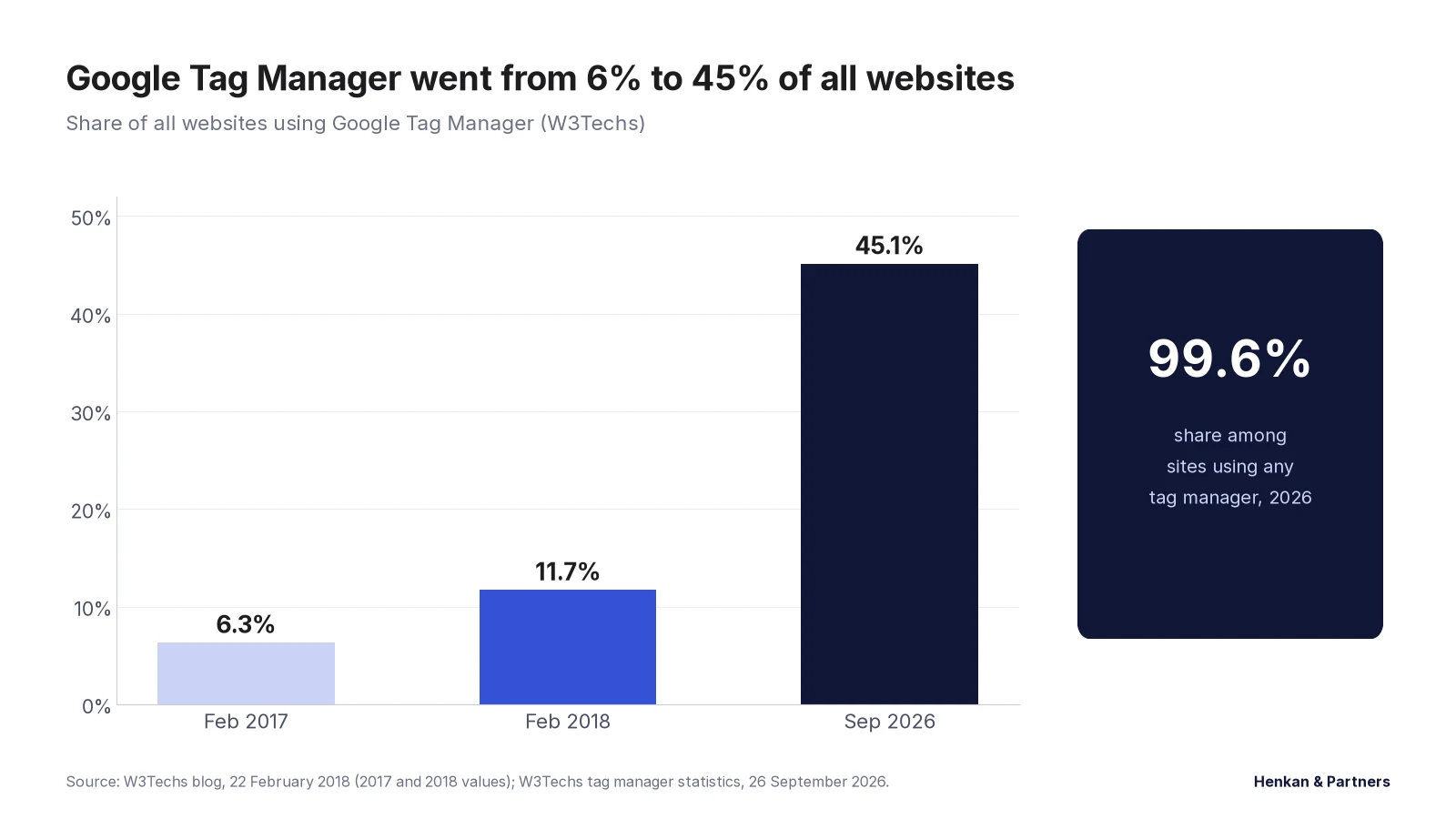
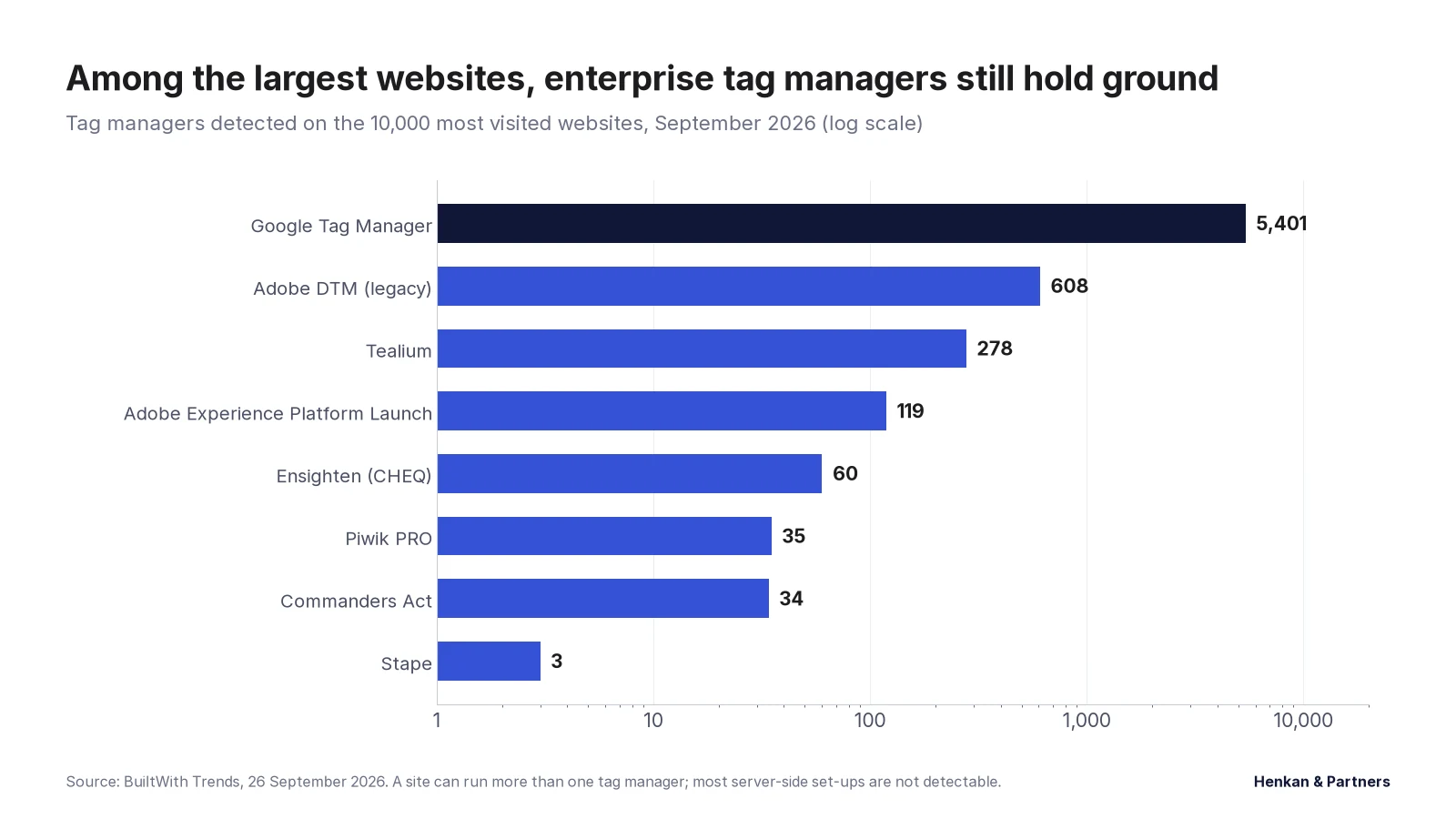
- Google made the core product free, and won the market. Google Tag Manager launched in October 2012 at no cost and today runs on 45.1% of all websites, with 99.6% of the sites that use any tag manager. Paid vendors survive in large enterprises, where Tealium and Adobe still appear on hundreds of the 10,000 most visited sites.
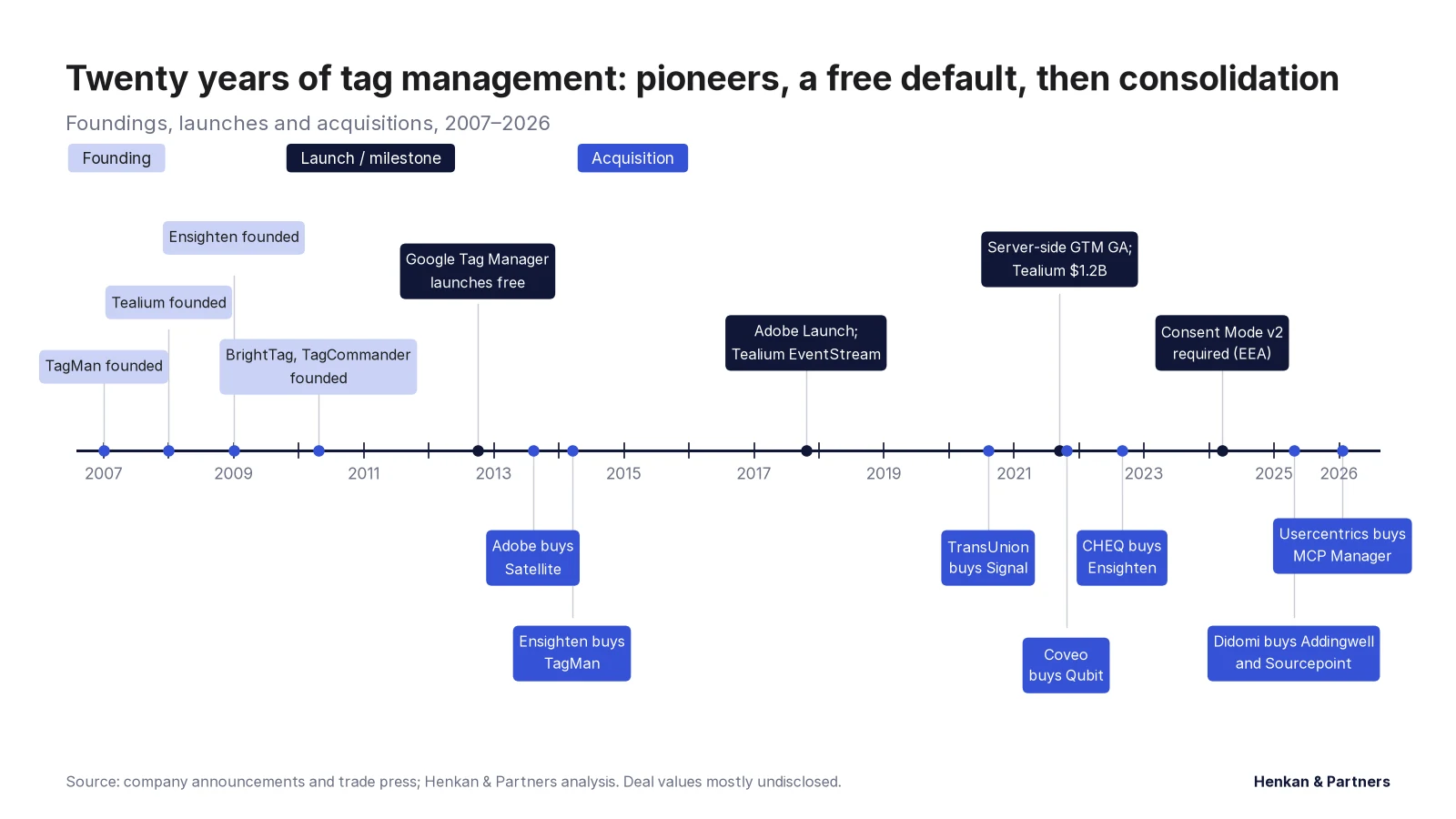
- The pioneers were bought or changed business. TagMan went to Ensighten in 2014, Ensighten to CHEQ in 2022, BrightTag (renamed Signal) to TransUnion in 2020, Adobe bought Satellite in 2013, and Qubit, the company behind the free OpenTag, went to Coveo in 2021. Tealium, the largest independent, repositioned as a customer data platform and was valued at $1.2 billion in 2021.
- Published market sizes disagree and overstate pure tag management. Analyst estimates range from about $0.9 billion to $1.9 billion for 2024–2025, with growth forecasts from 11.5% to 20.3% a year. With the leading product free, much of what they count is customer data platform, server-side and consent revenue.
- Privacy created a second market: server-side tagging. Safari's cookie limits, ad blockers and the GDPR pushed companies to collect data through their own servers. Google made server-side Tag Manager generally available in 2021, and bootstrapped hosts such as Stape (claiming 200,000+ customers) and Addingwell (bought by Didomi in 2025) built businesses on top of it.
- Consent became part of the tag stack. Google's Consent Mode v2, required for European traffic since March 2024, and record fines by France's CNIL made consent a technical requirement. Consent vendors are now buying data-collection tools: Didomi bought Addingwell and Sourcepoint in 2025, and Usercentrics bought MCP Manager in 2026.
- AI is making tag configuration machine-editable. Tealium launched managed Model Context Protocol (MCP) servers in 2025–2026 that let AI agents read and edit configurations, and third parties built MCP servers for Google Tag Manager. Google has so far kept its official AI tools read-only.
- For investors, value sits in owned data flows and compliance, not in the container. The best-returning plays have been infrastructure for first-party data and consent. Pure client-side tag management is a feature Google gives away.
Tag management is now three layers: client-side containers, server-side collection and consent
When the category was born around 2007, tag management meant one thing: a container script in the browser that loaded other companies' tags. By 2026 the same job is split across three layers, each with its own vendors and economics.
- Client-side tag management: the container in the browser. Google Tag Manager dominates; Tealium iQ, Adobe Experience Platform Tags, Commanders Act, Piwik PRO and CHEQ (formerly Ensighten) serve enterprises and privacy-focused buyers.
- Server-side collection: a server on the company's domain that receives events and forwards them to vendors. Google's server-side Tag Manager is the most used engine; managed hosts such as Stape, Addingwell and JENTIS run it or their own version as a service; Tealium EventStream and Adobe event forwarding cover the enterprise.
- Consent management: the banner and the rules that decide which tags may run. OneTrust, Usercentrics (which owns Cookiebot), Didomi, Sourcepoint and Commanders Act's TrustCommander lead here.
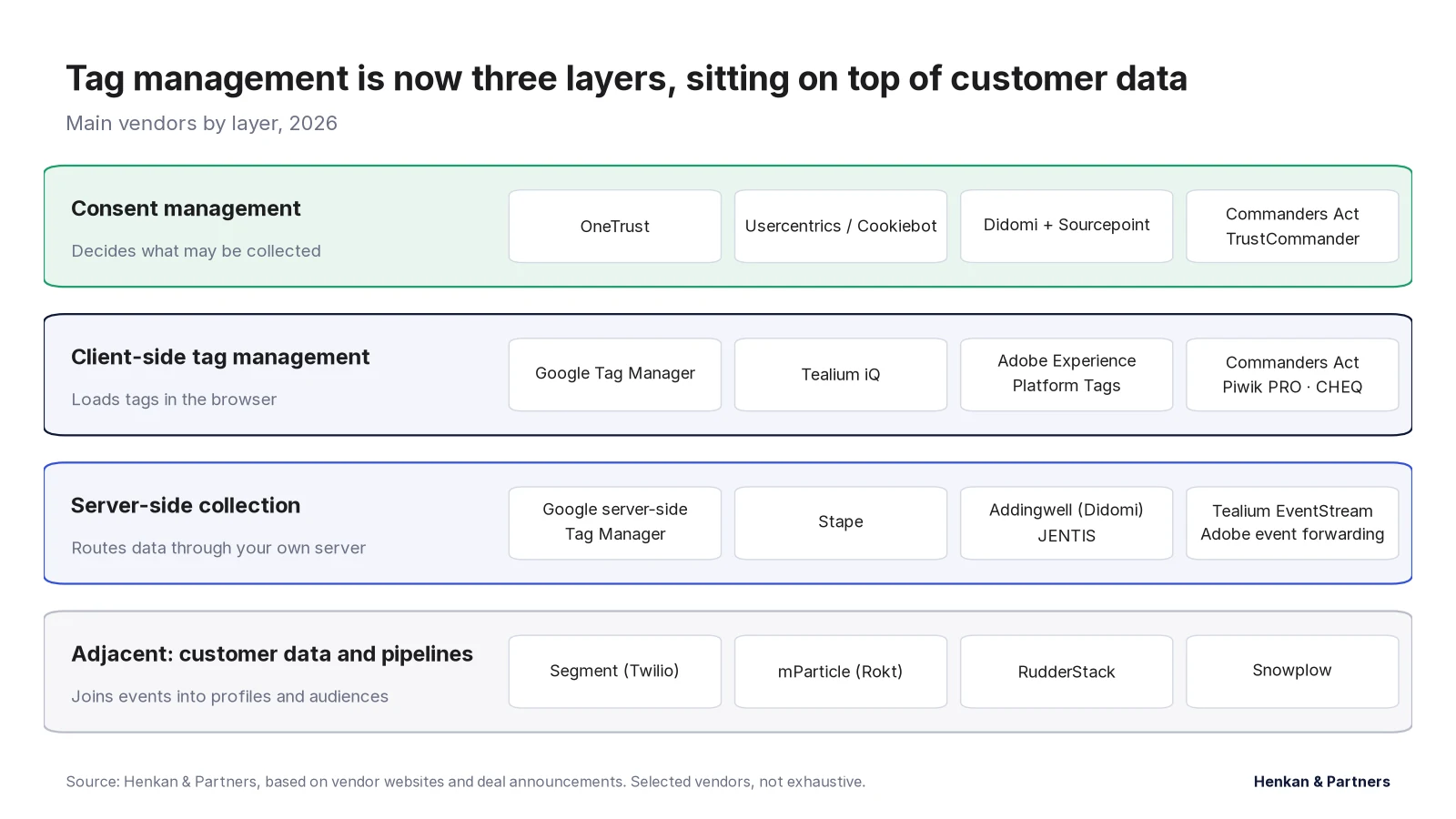
Why it matters. The layers are converging. Tealium sells all three plus a customer data platform; Commanders Act sells tag management, consent and server-side; Didomi now owns a consent platform and a server-side host. Buyers increasingly choose a data-collection stack, not a tag manager, and investors should value vendors by how much of that stack they control.
Published market sizes disagree, and most of the money is not in tag management itself
Market research firms publish very different figures for the size of the tag management market. For the same period, the estimates differ by a factor of two, and the forecast growth rates range from 11.5% to 20.3% a year.
| Source | Base year and size | Forecast | Annual growth |
|---|---|---|---|
| MarketsandMarkets | $0.57B (2017) | $1.28B (2023) | 14.2% |
| KBV Research | $0.92B (2022) | $2.4B (2030) | 12.8% |
| SkyQuest | $0.90B (2024) | $4.75B (2033) | 20.3% |
| Grand View Research | $1.2B (2024) | $6.4B (2033) | 11.5% |
| Verified Market Research | $1.62B (2024) | $4.65B (2031) | 14.1% |
| Mordor Intelligence | $1.85B (2025) | $3.57B (2030) | 14.05% |
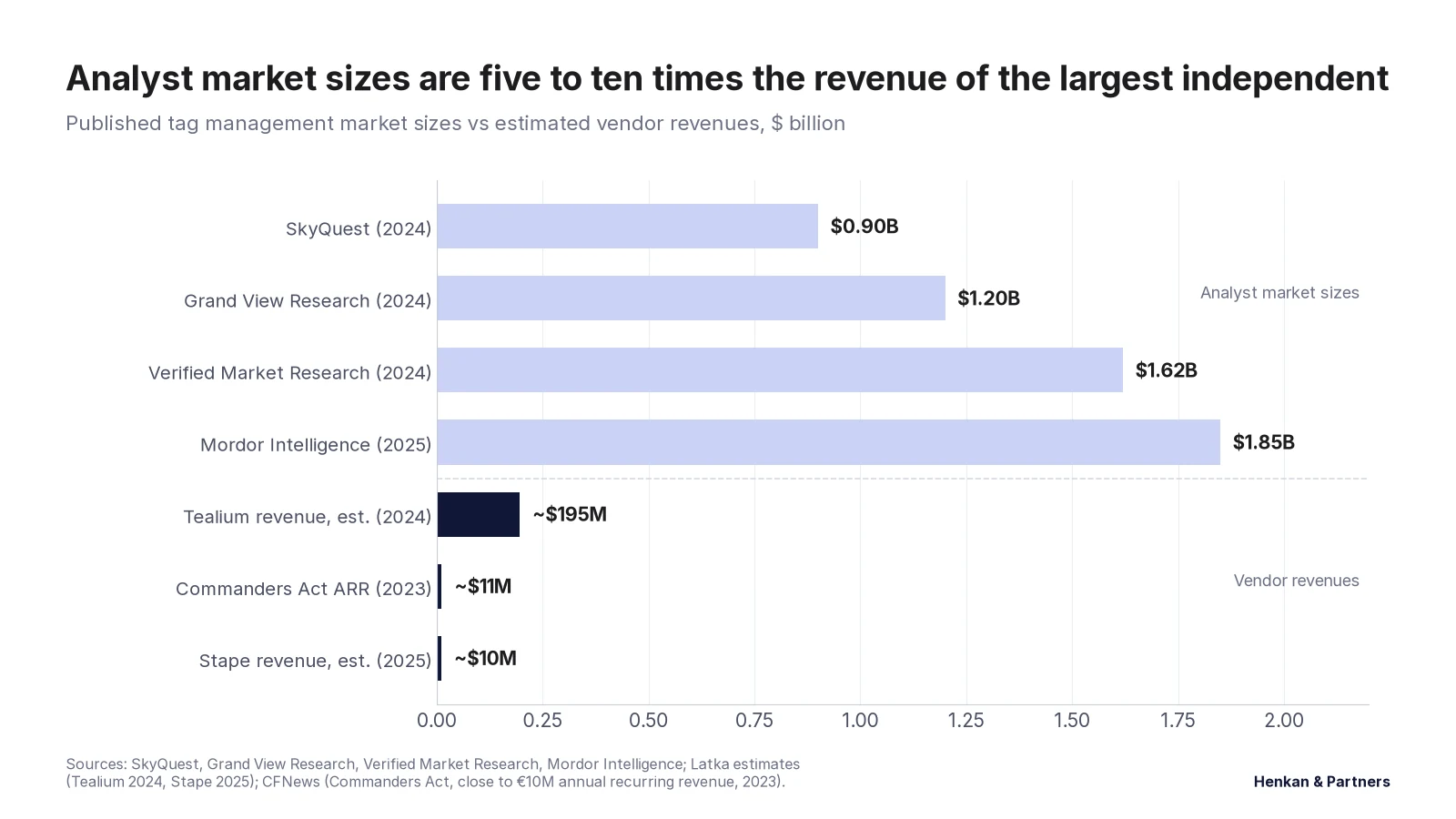
The vendor numbers explain the gap. The dominant product, Google Tag Manager, earns no direct revenue. Tealium, the largest independent, is estimated by Latka at about $195 million of revenue in 2024, but most of that comes from its customer data platform, not its tag manager. Commanders Act, a leading European tag manager, had close to €10 million of recurring revenue in 2023 according to French financial press. Stape, a fast-growing server-side host, is estimated at around $10 million.
What this means for investors. Treat analyst sizes of $1–2 billion as the size of the wider data-collection market, including customer data platforms, server-side hosting and some consent revenue. The revenue pool for client-side tag management on its own is much smaller, because the default product is free. Growth is in the adjacent layers.
Paid pioneers created the category between 2007 and 2012
Tag management emerged because websites were drowning in tags. By the late 2000s, a large retailer might run dozens of analytics, advertising, affiliate and testing snippets, each hard-coded by developers. Marketing teams waited weeks for changes, and pages slowed down. A handful of start-ups offered a way out: one container on the site, with tags managed from a web interface.
These vendors sold to large companies, often at tens of thousands of dollars a year, and competed on features such as rules, testing environments and vendor libraries. Investors backed them: Tealium had raised $27 million by 2013, Ensighten $55.5 million by early 2014 and BrightTag $54 million by late 2013.
Google made tag management free in 2012, and the paid market had to move up
Google Tag Manager changed the economics overnight. It offered the core features the paid tools charged for, templates, rules, preview and debug and version history, at no cost, and it integrated natively with Google Analytics and Google Ads, the two tools almost every company used. Google's motive was not tag management revenue but better and faster adoption of its advertising and analytics products.
Adoption followed. W3Techs measured Google Tag Manager on 6.3% of all websites in February 2017 and 11.7% in February 2018; by September 2026 it was on 45.1%. Among sites that use a tag manager, its share is 99.6%. Adobe bought a tag manager of its own: in July 2013 it acquired Satellite from the agency Search Discovery, turned it into Dynamic Tag Management, replaced it with Adobe Launch in 2017, and renamed it Tags within Adobe Experience Platform in 2021, bundled with its enterprise licences.
The independents took three routes. Some sold to larger platforms. Some moved up-market into customer data, where Google did not compete. And a few specialised in governance, privacy and security, which large, regulated companies would pay for.
Large companies still use them. BuiltWith's September 2026 data shows Google Tag Manager on 5,401 of the 10,000 most visited websites, but also Adobe's two tag manager signatures on a combined 727 of them (some sites may carry both) and Tealium on 278. Across the whole web those vendors are rounding errors; among the largest companies they are standard.
Consolidation: the independents were bought, pivoted, or folded into bigger platforms
Between 2013 and 2026, nearly every early independent tag manager changed hands or changed business. Deal values were almost never disclosed, which in our reading suggests strategic tuck-ins rather than headline exits.
| Date | Deal | Value | What it meant |
|---|---|---|---|
| Jul 2013 | Adobe acquires Satellite (Search Discovery) | Not disclosed | Adobe builds tag management into its marketing cloud |
| Mar 2014 | Ensighten acquires TagMan | Not disclosed | Consolidation of two pioneers against Adobe and Google |
| Jun 2014 | BrightTag acquires Signal and takes its name | Not disclosed | Move from tags to identity and data onboarding |
| Sep 2017 | OpenX acquires Mezzobit | Not disclosed | Publisher tag and data management folded into ad tech |
| Aug 2020 | TransUnion acquires Signal (formerly BrightTag) | Not disclosed | Tag and identity technology absorbed by a credit bureau |
| Nov 2020 | Twilio completes Segment acquisition | ~$3.2B in stock | Adjacent: event collection and CDP at a premium price |
| Oct 2021 | Coveo acquires Qubit (creator of OpenTag) | Not disclosed | Personalisation, not tags, was the asset |
| Aug 2022 | CHEQ acquires Ensighten | Not disclosed | Tag control repositioned as security and compliance |
| Oct 2023 | Commanders Act acquires Adloop | Not disclosed | European tag manager broadens into marketing analytics |
| Jan 2025 | Rokt acquires mParticle | $300M | Adjacent: CDP sold for little more than the ~$270M it had raised |
| Apr 2025 | Didomi acquires Addingwell, alongside an $83M (€72M) investment from Marlin Equity Partners | Addingwell price not disclosed | Consent platform buys server-side collection |
| Jun 2025 | Supermetrics acquires Relay42 | Not disclosed | Former tag manager turned CDP joins a data-pipeline company |
| Jul 2025 | Didomi acquires Sourcepoint | Not disclosed | Consolidation of consent platforms |
| Jan 2026 | Usercentrics acquires MCP Manager | Not disclosed | Consent extended to AI agents |
Tealium: the independent that became a customer data platform
Tealium is the one pioneer that stayed independent and grew large. It raised $55 million in 2019 at a reported valuation of about $850 million, when its chief executive projected about $100 million of revenue, and $96 million in February 2021 at a $1.2 billion valuation, with more than 1,000 customers. It has raised about $264 million in total according to Crunchbase. Along the way it repositioned from tag management to a real-time customer data platform, and it now markets itself as data infrastructure for AI.
Its own releases describe "more than 850" customers in mid-2026, compared with "more than 1,000" in 2021, and no new funding has been announced since 2021. Latka estimates its 2024 revenue at about $195 million. Taken together, and if the Latka estimate is close, these numbers suggest a company that grew revenue per customer while its customer count shrank, and that faces a long wait for an exit in a market where CDP valuations have fallen, as the mParticle sale in 2025, for $300 million against about $270 million raised, illustrates.
Privacy and browsers created a second market: server-side tagging
From 2017, three forces made browser-only tagging less reliable. Apple's Safari began limiting cookies in 2017 and, from 2019, deleted cookies set by scripts after seven days. The GDPR, applicable from May 2018, made companies responsible for every piece of personal data their tags sent to vendors. And ad blockers spread: around 29.5% of internet users say they use one.
Server-side tagging answered all three. Instead of every vendor's script running in the browser, one stream of data goes to a server on the company's own domain, which cleans it and forwards it. Tealium launched its server-side EventStream in 2017, but the tipping point was Google: server-side Tag Manager entered beta in August 2020 and became generally available in September 2021, running on Google Cloud or any container host. In 2025 Google added a lighter option, Google tag gateway for advertisers, which serves Google's own tags from the advertiser's domain through a content delivery network.
Because Google provides the software but not a managed service, an ecosystem of hosts grew around it. They are small, capital-efficient and growing fast:
| Host | Origin and ownership | Scale indicators | Entry pricing |
|---|---|---|---|
| Stape | Started 2020 (as Stape since 2021), bootstrapped | Claims 200,000+ customers; revenue estimated around $10M (Latka) | Free tier (10k requests); from $17/month (billed annually) for 500k requests |
| Addingwell | Lille, France; acquired by Didomi in April 2025 | 1,000+ clients at acquisition | Free sandbox; from €90/month for 1M requests |
| JENTIS | Vienna, founded 2020 | €11M Series A, November 2023 | Quote-based |
| Google Cloud Run (self-hosted) | Google's recommended engine | About $45 per server per month; minimum two servers recommended |
In our experience, server-side tagging is where most tag management budgets are moving for mid-sized and large e-commerce companies, because it improves advertising measurement and gives legal teams control over what leaves the site. It does not remove consent obligations, and vendors that suggest otherwise create regulatory risk for their clients.
Consent became part of the tag stack, and consent vendors are buying collection tools
Consent used to be a legal banner bolted onto the site. Three changes turned it into a core part of data collection.
- Regulation and enforcement. The GDPR from 2018 and the ePrivacy rules require consent for most marketing tags. France's CNIL fined Google €100 million and Amazon €35 million in 2020, Google €150 million and Facebook €60 million in 2021, and Google €325 million and Shein €150 million in 2025, over cookies and consent.
- Google's Consent Mode. Launched in 2020, and in version 2 required for European users from March 2024 to use Google's personalised advertising. Every tag manager had to support it.
- Industry standards. The IAB's Transparency and Consent Framework, updated to version 2.2 in 2023 and 2.3 in 2025, sets how consent is recorded and passed along the advertising chain.
The consent market has consolidated faster than tag management. OneTrust raised $300 million at a $5.1 billion valuation in December 2020. Usercentrics merged with Cookiebot's parent in 2021. Didomi, backed by an $83 million investment from Marlin Equity Partners, bought Addingwell in April 2025 and Sourcepoint in July 2025. The logic is simple: whoever controls consent controls which tags may fire, so owning the collection pipe as well makes the product stickier and the data more trustworthy.
On the other side, tag management vendors added consent: Commanders Act sells its own consent platform, Piwik PRO bundles one, and Google Tag Manager added consent controls and templates for more than 30 consent platforms. In our view, consent and collection will be bought together within a few years, and stand-alone vendors of either will struggle to hold price.
Pricing runs from free to six figures, and most of the spend is not on the container
| Product | How it is sold | Indicative price |
|---|---|---|
| Google Tag Manager | Self-service | Free |
| Google Tag Manager 360 | Bundled with Google Analytics 360 | Quote only; agencies cite GA360 packages around $150,000 a year |
| Tealium | Annual contracts, priced by visitors and modules | Buyer data from Vendr: average about $146,000 a year, range about $21,000–457,000 |
| Adobe Experience Platform Tags | Included with Adobe Experience Cloud licences | No separate price |
| Commanders Act, CHEQ, Piwik PRO | Annual contracts | Quote only |
| Server-side hosting (Stape, Addingwell) | Self-service by request volume | Free tiers; about $17–167 or €90–1,190 a month on published plans |
| Self-hosted server-side (Google Cloud Run) | Cloud consumption | From about $90 a month for two servers |
For a typical mid-sized online retailer, the container is free and the costs are elsewhere: the people who build and maintain tracking, server-side hosting, the consent platform and, for larger companies, a customer data platform. That is also where vendors are putting their pricing power.
AI is making tag configuration machine-editable
Tag management has always been repetitive configuration work: build a tag, set a trigger, map variables, test, publish. It is a natural target for AI assistants, and 2025–2026 brought the first real tools.
- Tealium launched a managed Model Context Protocol (MCP) server and AI features in October 2025, a Context API with managed MCP in June 2026 and, in August 2026, a Configuration MCP that lets AI agents edit configurations, with changes held in draft for human review.
- Google released an official MCP server for Google Analytics in July 2025, but it is read-only and labelled experimental. It has not released an official AI tool that edits Tag Manager; its 2026 changes focus on bringing Tag Manager features into the Google tag and a visual event builder.
- Third parties filled the gap: Stape published an open-source MCP server that lets AI assistants create, edit and manage Google Tag Manager tags, triggers and variables.
- Consent for AI: Usercentrics bought MCP Manager in January 2026 to manage consent when AI agents act for users.
Two consequences follow. The cost of building and maintaining tracking will fall, which pressures agencies and freelancers who bill for configuration hours, and strengthens vendors that own the underlying data. And governance becomes more important: an AI agent with publish rights can break tracking or send data it should not, so draft-and-approve workflows, a strength of enterprise tools, gain value. AI browsers that run tags as they act for users also add a new source of noise in behavioural data.
Investors have made money from data infrastructure and consent, not from containers
The history of this market gives investors a clear lesson. Client-side tag management became a feature when Google gave it away; the returns came from what surrounds it.
Where value was created
- Event collection and customer data. Segment's $3.2 billion sale to Twilio in 2020 and Tealium's $1.2 billion valuation in 2021 rewarded companies that turned collected events into customer profiles and audiences. The later reset is just as clear: Rokt bought mParticle in 2025 for $300 million, little more than the roughly $270 million it had raised.
- Consent. OneTrust's $5.1 billion valuation in 2020 and Didomi's 2025 buy-and-build show that compliance software attracts growth and private equity capital.
- Capital-efficient server-side hosting. Stape grew to a claimed 200,000+ customers without outside funding, and Addingwell was bought by Didomi in 2025.
How private equity can create value
| Strategy | How it creates value | Examples and signals |
|---|---|---|
| Buy-and-build around consent | Combine consent, server-side collection and preference management into one compliance-led data stack | Didomi with Marlin Equity: Addingwell and Sourcepoint in 2025 |
| European sovereignty play | Consolidate European tag, consent and analytics vendors for buyers who want EU hosting and non-US ownership | Commanders Act, Piwik PRO, JENTIS, Didomi |
| Server-side hosting roll-up | Combine small hosts to gain scale, support coverage and pricing power | Many regional hosts around Google's server-side engine |
| Carve-out or take-private of a CDP | Buy a mature customer data platform with sticky enterprise contracts at post-2021 multiples, cut costs, sell AI data features | CDP prices reset: mParticle sold for $300M in 2025, close to the capital it had raised |
| Security and compliance angle | Reposition script control as protection against skimming and data leakage, with PCI DSS 4.0 as a driver | CHEQ's acquisition of Ensighten |
What to check in due diligence
- Dependence on Google. How much of the product only exists because Google Tag Manager or Consent Mode works a certain way today, and what happens if Google adds it for free?
- Revenue mix. How much revenue is tag management, how much is server-side, consent or customer data, and which part is growing?
- Customer concentration and churn. Enterprise tag management contracts are sticky but few; watch net revenue retention and whether customer counts are falling, as Tealium's public statements suggest for that company.
- Regulatory exposure. Could a regulator treat the product as a way to bypass consent? Server-side vendors that market "recovering" non-consented data carry real risk.
- AI readiness. Does the product expose clean APIs and governance for AI agents, or will AI tools route around it?
Exit routes
Strategic buyers have been marketing clouds (Adobe), data and identity companies (TransUnion), security vendors (CHEQ), consent platforms (Didomi, Usercentrics) and data-pipeline companies (Supermetrics). Private equity has been active mainly in consent. We see few paths to a public listing for pure tag management; the likely exits are sales to consent, analytics, security or cloud data companies.
Risks investors will price in
- Google bundling more for free, as it did in 2012 and continues to do with the Google tag and tag gateway.
- Regulatory change, in either direction: stricter enforcement raises demand for compliance tools, but rulings on data transfers or pixels can hit specific products.
- Browser changes that alter what server-side or first-party collection can do.
- AI agents reducing the configuration work that services-heavy vendors depend on.
We expect value to concentrate in owned data flows, consent and governance
Where value concentrates
- First-party collection infrastructure: server-side pipelines and data layers that companies own and can feed to analytics, advertising and AI models.
- Consent linked to collection: products that prove, for every event, that it was collected lawfully.
- Governance for humans and AI: approvals, audits, monitoring and security for scripts and configurations, driven by regulators, PCI DSS 4.0 and AI agents with write access.
Where value erodes
- Stand-alone client-side containers, which Google gives away and keeps improving.
- Manual tag implementation work, which AI assistants will increasingly do.
- Tools that promise to recover data without consent, which face regulatory pressure.
The contested middle
Customer data platforms sit between the two. They own valuable data flows but compete with cloud data warehouses and with the analytics and advertising platforms moving into audiences. Our digital analytics market report covers how that competition is playing out.
Buyers should design the collection stack around data ownership, not around the tag manager
1. Use the free tag manager unless you need governance
Google Tag Manager is enough for most companies. Pay for an enterprise tool when many teams and brands publish, when regulation demands approvals and audit trails, or when you are buying the vendor's customer data platform anyway.
2. Own the data layer and the server-side pipe
The data layer and a server-side collection point on your own domain are the assets that outlive any vendor. Build them so you can change tools without rebuilding tracking.
3. Buy consent and collection together, or make sure they talk
Every event should carry the visitor's consent status from the banner to the server and on to each vendor. Check this end to end before signing with a consent or server-side vendor.
4. Check who owns your vendor
Tag management vendors have changed hands often. Ask about ownership, funding and roadmap, and keep an exit plan: export your configurations regularly and document your data layer.
5. Prepare for AI, with guardrails
Use AI assistants to speed up tagging and audits, but keep their changes in drafts, keep a human approver, and monitor tracking for sudden changes. Our guide to tag management sets out the day-to-day practices.
Frequently asked questions about the tag management market
Frequently asked questions
How big is the tag management market?
Published estimates range from about $0.9 billion to $1.9 billion for 2024–2025, with forecast growth of 11.5% to 20.3% a year. These figures include adjacent revenue such as customer data platforms and server-side collection; the market for client-side tag managers alone is much smaller because Google Tag Manager is free.
What is the market share of Google Tag Manager?
According to W3Techs, Google Tag Manager runs on 45.1% of all websites and has a 99.6% share among sites that use a tag manager (September 2026). Paid tools such as Tealium and Adobe are more common among the largest websites.
Who are the main tag management vendors?
Google Tag Manager dominates. Enterprise alternatives include Tealium iQ, Adobe Experience Platform Tags, Commanders Act, Piwik PRO and CHEQ (formerly Ensighten). Server-side hosts include Stape, Addingwell and JENTIS.
Who owns Ensighten?
Ensighten was acquired by CHEQ, a marketing security company, in August 2022, and is now part of CHEQ's Control & Compliance products. Ensighten had itself acquired TagMan, one of the first tag managers, in 2014.
How much is Tealium worth?
Tealium was valued at $1.2 billion when it raised $96 million in February 2021, its last disclosed funding round. It has raised about $264 million in total. Its current value is not public.
Why did Google make Tag Manager free?
Google Tag Manager makes it easier for companies to install and use Google Analytics and Google Ads, which earn Google revenue. Giving the tag manager away increased adoption of those products and set Google's tags as the default on the web.
What is driving growth in tag management?
Growth comes mainly from server-side tagging, consent management and customer data, driven by browser privacy limits, ad blockers, the GDPR, Google's Consent Mode v2 requirement and the need for reliable first-party data for advertising and AI.
What does AI change for tag management vendors?
AI assistants can now read and edit tag configurations through Model Context Protocol servers, which lowers the cost of building tracking and raises the value of governance, approval workflows and clean data layers. Tealium has launched such tools; Google's official AI tools remain read-only.
Key terms
- Tag management system (TMS)
- Software that loads and controls the tracking and marketing code (tags) on a website from one container, so tags can be changed without a website release. Our guide to tag management explains how it works.
- Client-side tagging
- Tags run in the visitor's browser and send data directly to each vendor. This is the classic tag manager.
- Server-side tagging
- The browser sends data to a server the company controls, which forwards it to vendors. It gives more control over data and is less exposed to browser limits.
- Consent management platform (CMP)
- The software behind a cookie banner. It records each visitor's choices and tells the tag manager which tags may fire.
- Customer data platform (CDP)
- Software that collects customer data from many sources, joins it into profiles and sends audiences to marketing tools. Several tag management vendors grew into CDPs.
- Event forwarding / API hub
- Vendor names for server-side collection. Adobe calls it event forwarding; Tealium calls it EventStream.
- Consent Mode
- Google's system for passing a visitor's consent choices to Google tags. Version 2 has been required for European users since March 2024.
- ARR
- Annual recurring revenue: the yearly value of subscription contracts, the standard size measure for software companies.
Sources
- W3Techs: Usage statistics of tag managers · W3Techs, February 2018 · BuiltWith: Google Tag Manager trends
- Google Analytics blog: Google Tag Manager launch, 2012 · Simo Ahava: GTM's fifth birthday · TechCrunch: Analytics 360 Suite, 2016
- TechCrunch: Qubit launches OpenTag, 2011 · Wikipedia: Tag management system · Wikipedia: Tealium
- TechCrunch: Adobe buys Satellite, 2013 · Adobe: DTM sunset · Adobe: terminology updates
- TechCrunch: Tealium raises $55M, 2019 · Tealium: $96M Series G, 2021 · Latka: Tealium · Tealium: Q3 2026 releases
- VentureBeat: Ensighten raises $40M, 2014 · GlobeNewswire: Ensighten acquires TagMan · CHEQ acquires Ensighten
- Built In Chicago: BrightTag funding · BrightTag becomes Signal · TransUnion acquires Signal
- Commanders Act acquires Adloop · CFNews: Commanders Act, 2023 · Fusacq: TagCommander funding, 2014
- OpenX acquires Mezzobit · Coveo acquires Qubit · Silicon Canals: Supermetrics acquires Relay42
- Twilio completes Segment acquisition · AdExchanger: Rokt acquires mParticle · mParticle raises $150 million, 2021
- Didomi acquires Addingwell · Clipperton: Didomi and Marlin Equity · AdExchanger: Didomi acquires Sourcepoint · Usercentrics acquires MCP Manager · OneTrust Series C
- JENTIS Series A · Founder Reports: Stape interview · Stape · Stape pricing · Addingwell pricing
- Simo Ahava: server-side tagging beta, 2020 · Google: server-side tagging generally available, 2021 · Google Cloud Run setup guide · Tealium EventStream, 2017
- WebKit: ITP 2.1 · Google: Consent mode overview · IAB Europe: TCF v2.3 · CNIL: Google fined €325 million
- MarketsandMarkets · Grand View Research · Mordor Intelligence · Verified Market Research · SkyQuest · KBV Research
- Vendr: Tealium pricing data · Measure Minds Group: GTM cost · Tealium: AI features, October 2025 · Stape: MCP server for GTM · Google Analytics MCP server
Rethinking your data collection stack?
Henkan & Partners helps e-commerce teams and investors assess tag management, server-side collection and consent: vendor selection, due diligence, audits and implementation on Google Tag Manager, Tealium, Adobe and Commanders Act. Talk to our analytics team.