Market Report
The Voice of Customer Market, 2000–2026: Platforms, Deals, AI and How E-commerce Teams Should Choose
Alexandre Suon · 2026-09-26
Voice of Customer (VoC) software tells a business what its customers think, and why they behave as they do. In 25 years it has grown from online surveys into seven overlapping segments, attracted tens of billions of dollars of buyouts and acquisitions, and is now being reshaped by AI. This report maps the market for investors and gives e-commerce directors a practical way to choose the right tool.
Executive summary
- Voice of Customer is seven overlapping segments, not one market. Enterprise experience-management platforms, survey tools, reviews, conversation analytics, AI feedback analytics, user research, and analytics or testing tools with a VoC module all compete for the same question: why do customers do what they do?
- The core software market is smaller than headline estimates suggest. Published sizes run from about $2B for VoC software to $15–19B for broad customer-experience management. The largest pure-play vendor, Qualtrics, last reported $1.46B of revenue (2022), which points to a core pool in the low single-digit billions.
- Private equity bought the category in 2021–23, and 2025–26 brought consolidation and a reset. Thoma Bravo paid $6.4B for Medallia and Silver Lake $12.5B for Qualtrics. In 2026 Qualtrics closed its $6.75B purchase of Press Ganey Forsta (which already owned InMoment), while Medallia passed to its lenders in a debt-for-equity deal.
- Value is moving from asking customers to listening to them. Fewer than one in three consumers give feedback after a bad experience (Qualtrics XM Institute, 2025), so vendors are adding AI analysis of reviews, support conversations and interviews. AI-interview start-up Listen Labs reached a $500M valuation in January 2026.
- Analytics and experimentation vendors are building VoC in. Contentsquare, Amplitude, Pendo, PostHog, Fullstory, Quantum Metric, Air360, Kameleoon and Wingify (VWO and AB Tasty) all now offer surveys or feedback, often linked to session replay. In our experience, many e-commerce teams already pay for a VoC module they do not use.
- For e-commerce directors, the right tool depends on the question, not the brand. Start from what you need to learn, check what your current stack already does, and pick the smallest tool that links what customers say to what they do. Entry prices range from free to $25,000 a year.
Section 1 · The segments
Seven segments answer the same question from different data
"Voice of Customer" covers software that does very different jobs. A survey tool asks customers a question. A reviews platform collects and displays their opinions publicly. A conversation-analytics system listens to support calls. An AI interview tool runs hundreds of in-depth interviews in a day. What unites them is the question they help answer: why do customers behave the way they do, and what would make their experience better?
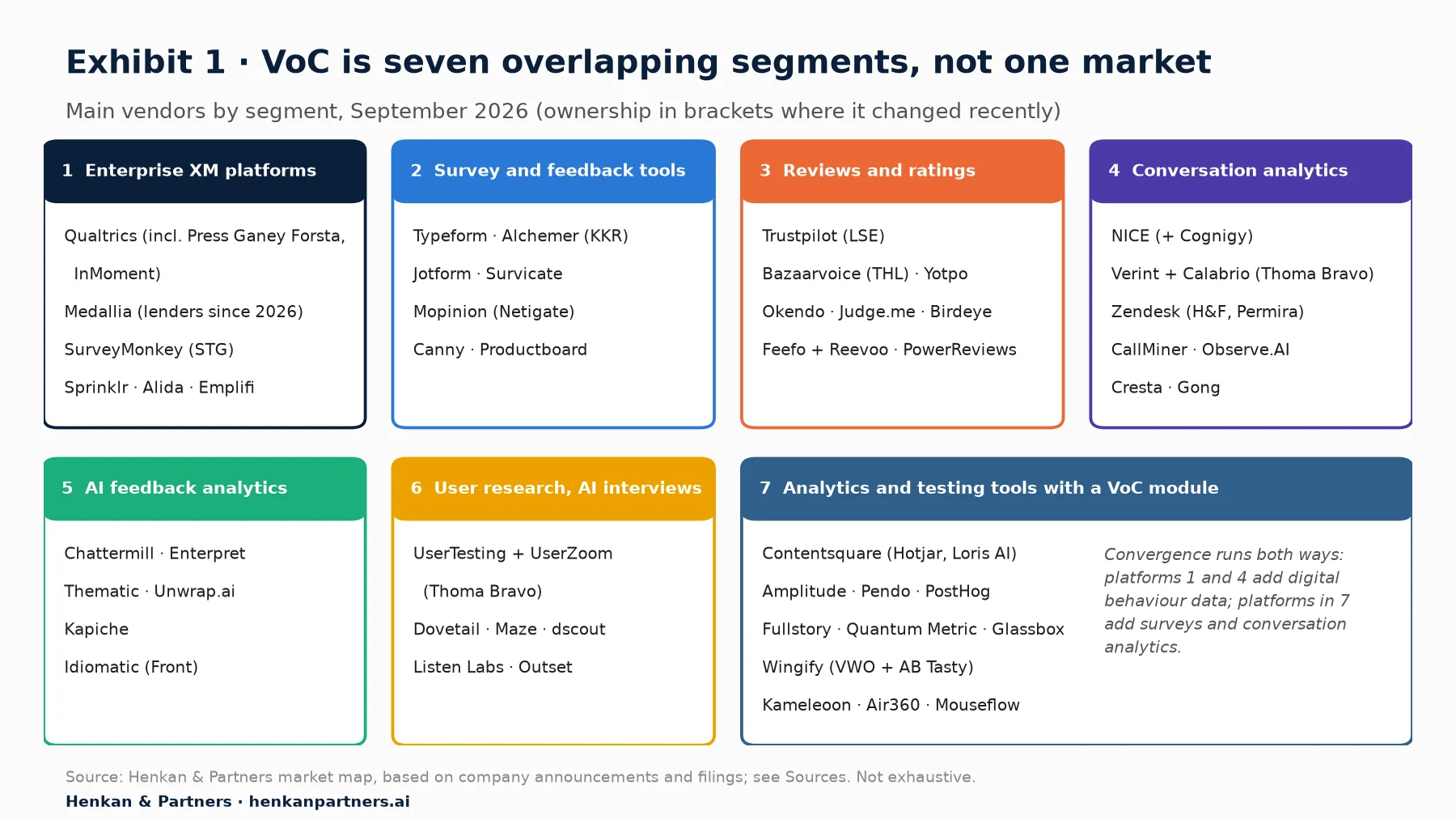
What this shows. The segments overlap. Enterprise platforms have bought digital feedback, text analytics and review tools; analytics vendors have added surveys and conversation analytics. For a buyer, the practical consequence is that the same need can often be met by two or three different kinds of tool.
| Segment | What it answers | Typical buyer | Examples |
|---|---|---|---|
| 1 · Enterprise XM platforms | How do customers and employees feel across every touchpoint? | CX or insights director in large companies | Qualtrics, Medallia, SurveyMonkey Enterprise, Sprinklr |
| 2 · Survey and feedback tools | What do customers think about a specific question? | Marketing, product and research teams of any size | Typeform, Alchemer, Jotform, Survicate, Mopinion |
| 3 · Reviews and ratings | What do buyers say publicly about our products and service? | E-commerce and marketing | Trustpilot, Bazaarvoice, Yotpo, Okendo, Judge.me, Feefo |
| 4 · Conversation analytics | Why do customers contact us, and how do those contacts go? | Customer service and contact-centre leaders | NICE, Verint, Zendesk, CallMiner, Observe.AI, Cresta |
| 5 · AI feedback analytics | What themes run through all our feedback, from every source? | CX, product and insights teams | Chattermill, Enterpret, Thematic, Unwrap.ai, Kapiche |
| 6 · User research and AI interviews | Why do people struggle, and what would they value? | UX research, product and innovation teams | UserTesting, Dovetail, Maze, dscout, Listen Labs, Outset |
| 7 · Analytics and testing tools with a VoC module | Why did this visitor behave this way on this page? | Digital, CRO and product teams | Contentsquare, Amplitude, Pendo, PostHog, Fullstory, Quantum Metric, Wingify, Kameleoon, Air360, Mouseflow |
For an e-commerce business, three segments usually matter most: reviews (because they sell), digital feedback linked to behaviour (because it explains conversion problems) and conversation analytics (because support contacts reveal what went wrong after the order).
Section 2 · Market size
Published market sizes range from $2B to $19B; vendor revenues point to the low end
Research firms define the market very differently. Broad "customer experience management" estimates include journey orchestration, web and content analytics and contact-centre tools, and put the market at $15.5–19.3B for 2024–2026 (MarketsandMarkets, Fortune Business Insights, and Grand View Research, whose global figure we derive from its US estimate). A single, narrow "VoC software" estimate from Verified Market Research puts it at about $2.1B in 2025. All forecast growth of 13–17% a year.
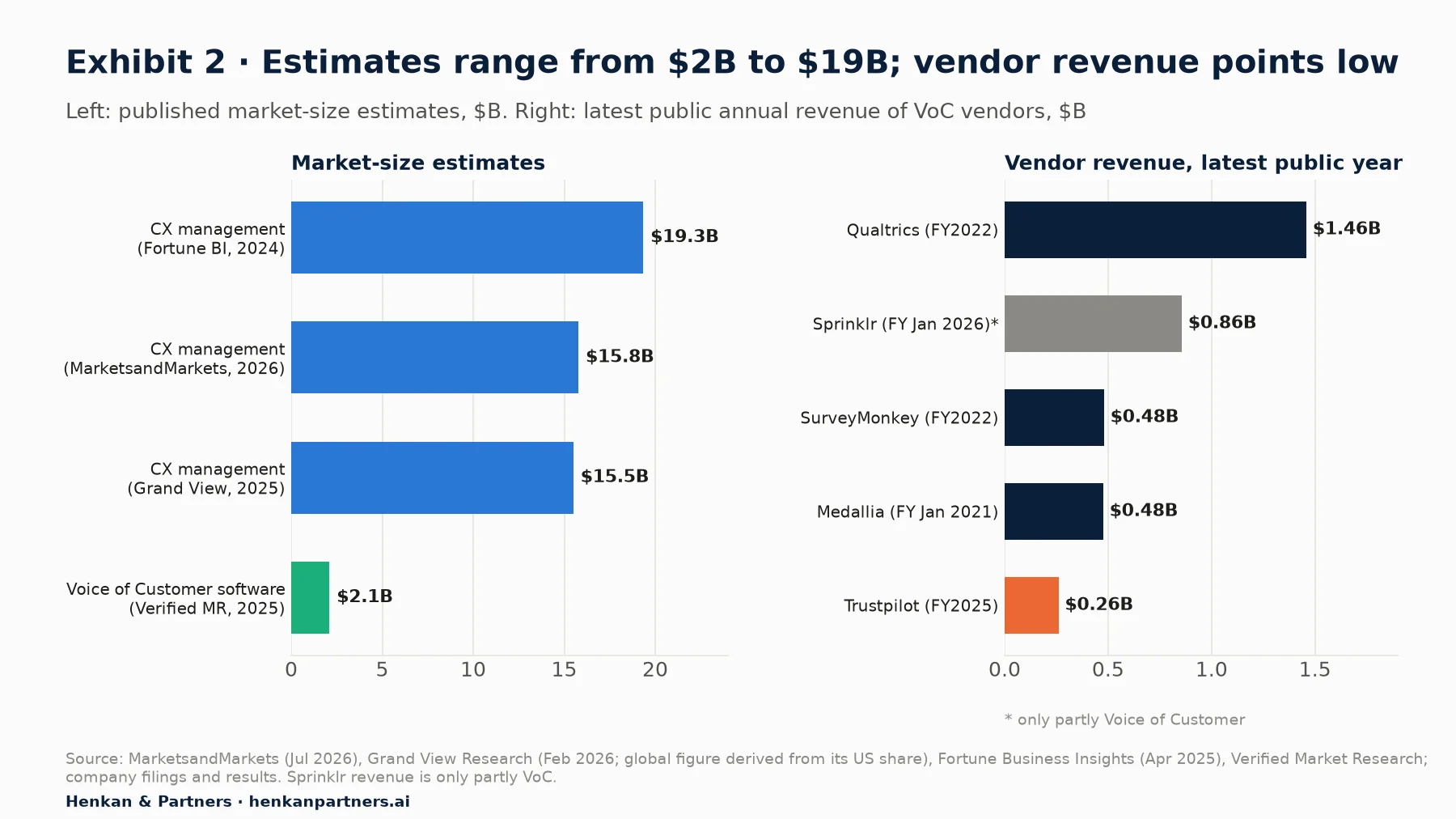
What this shows. Vendor revenues give a reality check. The largest pure-play platform, Qualtrics, reported $1.46B of revenue in its last public year (2022). Medallia and SurveyMonkey were each below $0.5B when they last reported. Trustpilot, the listed reviews leader, reported $261M for 2025. Even adding private vendors, core VoC software is a pool of a few billion dollars a year, not $15B or more.
Why the gap? First, scope: broad reports count adjacent software such as contact-centre suites and marketing clouds, where VoC is one feature. Second, services: some include consulting and research services. Third, method: most estimates are built top-down from surveys of buyers rather than from vendor revenues. None of the major analyst firms (Gartner, IDC) publishes a VoC market size that we could find.
For investors. Size a VoC target's market from the revenues of its named competitors and treat report totals as an upper bound. The more useful question is which segment the target sits in, because growth and pricing power differ sharply between surveys, reviews and conversation analytics.
For e-commerce directors. Market size matters less than stability. With so much consolidation (Sections 4 and 5), check who owns a vendor and whether its product is being merged into another before you sign a multi-year contract.
Section 3 · 2000–2017
Online surveys created the category, and NPS gave executives one number to follow
Customer feedback existed long before software: Press Ganey, the healthcare patient-experience firm, was founded in 1985. The modern software category began in the early 2000s, when online surveys replaced mail and phone questionnaires. Medallia was founded in 2001, Qualtrics in 2002 (in Provo, Utah) and Mindshare (later InMoment) in 2002.
In December 2003, Fred Reichheld of Bain & Company published "The One Number You Need to Grow" in Harvard Business Review, introducing the Net Promoter Score. NPS gave executives a single loyalty metric, and it turned customer feedback from a research project into a board-level KPI. Much of the enterprise market was built on collecting, reporting and acting on NPS across stores, call centres and websites.
Two other foundations were laid in this period. Reviews became a sales tool: Bazaarvoice (founded 2005), Reevoo (2005), Trustpilot (2007) and Yotpo (2011) built businesses on collecting and displaying customer ratings. And digital feedback moved on-site, with tools such as Kampyle (bought by Medallia in 2016) and Usabilla putting feedback buttons and surveys on web pages. Hotjar (2014) combined on-site surveys with heatmaps and recordings, an early sign of the convergence with analytics described in Section 7.
Why it happened. Online surveys made feedback cheap to collect at scale, and NPS gave it a common language. The winners sold to large companies that wanted to measure experience across thousands of locations and touchpoints, which set the enterprise, licence-based pricing that still dominates the top of the market, now often metered by modules or data volumes.
Section 4 · 2018–2023
A strategic buyer, three IPOs and a wave of buyouts valued the leaders at up to $12.5B
Between 2018 and 2023 the category went through a full capital-markets cycle. SAP agreed to buy Qualtrics for $8B in cash in November 2018, days before its planned IPO, to join experience data with SAP's operational data. SurveyMonkey listed on Nasdaq in September 2018 and Medallia on the NYSE in July 2019; SAP listed Qualtrics on Nasdaq in January 2021, raising $1.55B.
The platforms used their capital to buy the pieces around the survey:
- Digital feedback: SurveyMonkey bought Usabilla (~$80M) and GetFeedback (~$68M) in 2019; InMoment bought Wootric (2021); Medallia bought Decibel (~$160M, 2021).
- Text and speech analytics: Qualtrics bought Clarabridge (~$1.125B in stock, 2021); Medallia bought Voci ($59M, 2020); InMoment bought Lexalytics (2021).
- Video, coaching and journeys: Medallia bought LivingLens, Stella Connect (~$100M) and Sense360 (2020) and Thunderhead (2022).
- Reviews: InMoment bought ReviewTrackers (2022); Feefo bought Reevoo (2021).
Then private equity took the leaders off the market. Thoma Bravo bought Medallia for $6.4B (completed October 2021). Hellman & Friedman and Permira bought Zendesk for about $10.2B (November 2022). Thoma Bravo and Sunstone bought UserTesting for about $1.3B (January 2023) and merged it with UserZoom. In 2023, Silver Lake and CPP Investments bought Qualtrics from SAP and the public for about $12.5B, and STG bought SurveyMonkey's parent, Momentive, for about $1.5B.
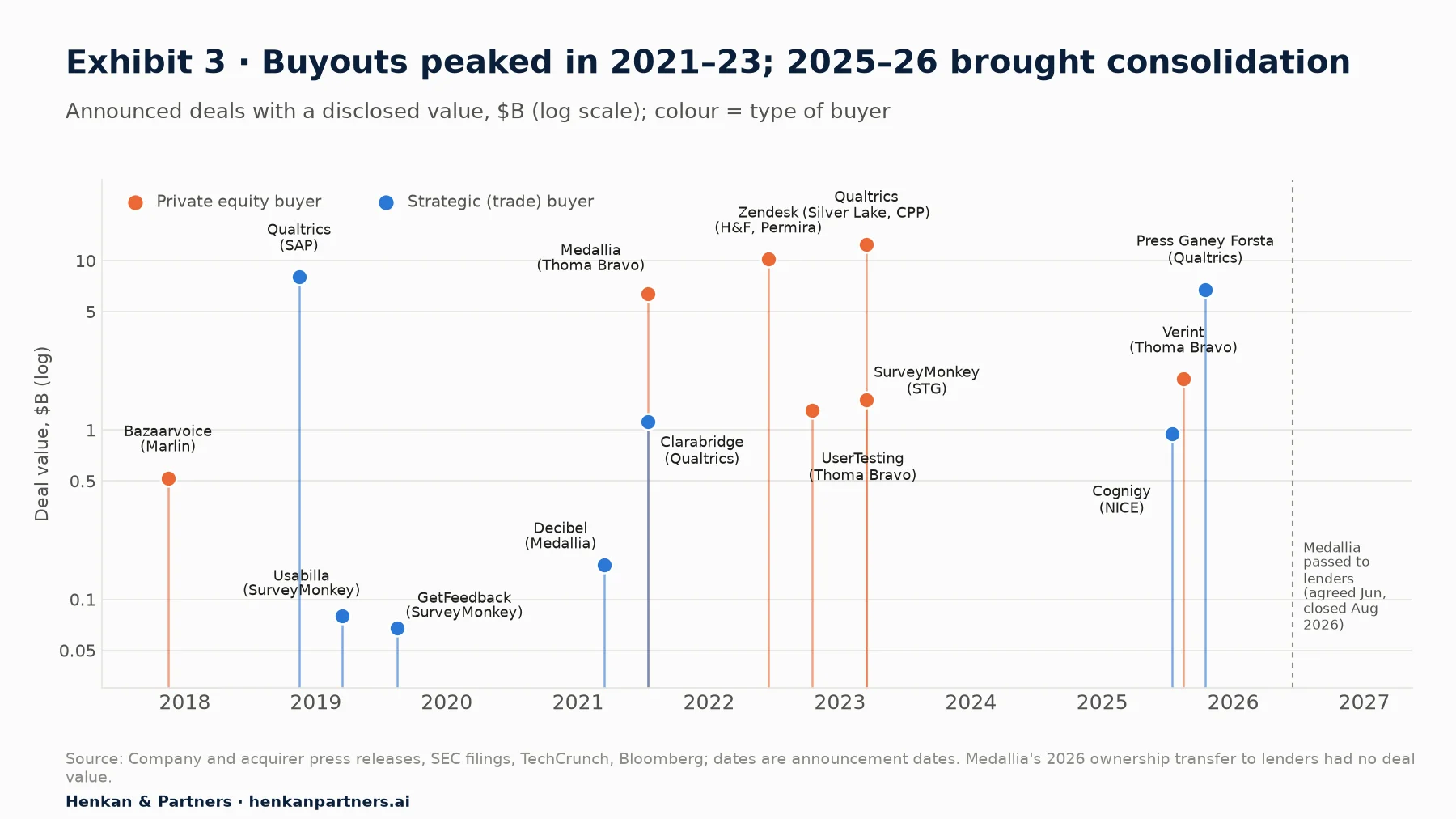
What this shows. The largest deals cluster in 2021–23, when low interest rates and high software valuations made take-privates attractive. After a quiet 2024, deal-making returned in 2025, mostly as consolidation between existing players, alongside one new take-private (Verint).
Why it happened. VoC vendors had recurring revenue, sticky enterprise customers and steady growth, the profile private equity likes. Several buyers, Thoma Bravo at Medallia in particular, used large amounts of debt, betting that growth would continue. Section 5 shows how that bet played out once AI started to change the product.
Section 5 · 2024–2026
Consolidation and debt stress reset the enterprise segment in 2025–26
The enterprise segment consolidated sharply in two years:
- Press Ganey Forsta bought InMoment (May 2025). Press Ganey had already bought Forsta (the combination of Confirmit, FocusVision and Dapresy) in 2022.
- Qualtrics agreed to buy Press Ganey Forsta for $6.75B (October 2025, closed May 2026), adding more than 41,000 healthcare facilities. The financing was difficult: the banks paused a $5.3B debt sale in March 2026 over concerns about AI's impact on software, and Bloomberg reported an expected loss of about $500M for the lending banks.
- Medallia passed to its lenders. In June 2026, Medallia agreed a recapitalisation that transferred ownership from Thoma Bravo to lenders led by Blackstone, Apollo and FS KKR, with $150M of new capital; it closed in August 2026. Credit-research firm Octus estimated Thoma Bravo's equity loss at about $5B.
- Thoma Bravo bought Verint for about $2B (closed November 2025) and merged it with Calabrio, building a contact-centre and conversation-analytics group.
- NICE bought Cognigy for $955M (September 2025) to add AI agents to its contact-centre platform.
Outside the enterprise segment the picture is mixed. Trustpilot keeps growing: 2025 revenue rose 24% to $261M and first-half 2026 revenue rose 23%, although about $6M of one-off costs, including a €4.6M fine from Italy's competition authority over review verification and a US sales-tax provision, pushed it to a $1M net loss. Yotpo, valued at $1.4B in 2021, cut about a third of its staff in August 2025 and exited email and SMS marketing to focus on reviews and loyalty. Gong, valued at $7.25B in 2021, traded at about $4.5B in a secondary sale in November 2025, even though it had passed $300M of annual recurring revenue.
| Company | Earlier valuation or deal | Latest mark or event | What changed |
|---|---|---|---|
| Medallia | $6.4B take-private (2021) | Ownership passed to lenders (Aug 2026) | About $300M a year of debt service against about $200M of earnings (Octus) |
| Qualtrics | $12.5B take-private (2023) | $6.75B Press Ganey Forsta deal; banks expect ~$500M loss on the debt | AI fears made software debt hard to sell |
| Gong | $7.25B (Series E, 2021) | ~$4.5B (secondary sale, Nov 2025) | Lower software multiples despite >$300M ARR |
| Yotpo | $1.4B (Series F, 2021) | ~200 layoffs; exit from email and SMS (Aug 2025) | Refocus on reviews and loyalty |
| Trustpilot | ~£1.1B valuation at IPO (2021) | Revenue +24% in 2025; shares fell 18% after H1 2026 results | Growth continues; regulatory costs rising |
For investors. The 2021–23 buyouts priced VoC as steady, seat-based software. AI changes two things at once: it makes basic survey creation and text analysis cheaper, and it shifts value to whoever owns the richest customer data. Leverage that was sized for the old model has become a problem at the top of the market.
For e-commerce directors. Consolidation brings product risk. Forrester has said it expects InMoment to be sunset within two years, an analyst's opinion rather than an announcement. Ask any vendor for its product roadmap after an acquisition, and build data export into the contract.
Section 6 · From asking to listening
AI is moving value from surveys to the feedback customers already give
Surveys have a structural problem: most customers do not answer them, especially unhappy ones. Qualtrics' own XM Institute found in 2025 that fewer than one in three consumers give feedback to the company after a poor experience, while 34% reduce their spending. Its November 2025 study estimated that bad experiences put nearly $3 trillion of sales at risk in 2026. Meanwhile, Forrester's US CX Index fell for four years in a row to 2025, before a partial rebound in 2026.
The answer the market has converged on is to listen to feedback customers already give: reviews, support chats and calls, social posts, return reasons and open-text answers. In 2022 Gartner predicted that by 2025, 60% of organisations with VoC programmes would supplement surveys with analysis of voice and text interactions. Large language models, widely available since late 2022, have made that analysis far cheaper and more accurate.
Three kinds of vendor are benefiting:
- Conversation analytics and contact-centre AI. NICE's AI annual recurring revenue reached $328M at the end of 2025, up 66%. Zendesk bought Klaus, Ultimate, Local Measure and HyperArc between 2024 and 2025. Cresta says it passed $100M of ARR in 2026.
- AI feedback analytics. Start-ups such as Chattermill (London), Enterpret, Thematic and Unwrap.ai group feedback from every source into themes. Front bought Idiomatic in November 2024. These tools are also likely acquisition targets for platforms that need AI analysis quickly.
- AI-moderated interviews. Listen Labs raised $69M at a $500M valuation in January 2026, after a $27M round led by Sequoia in 2025; Outset raised $47M in 2025 ($51M in total). Qualtrics launched AI "synthetic research panels" at its March 2026 conference. These tools promise qualitative depth at survey scale and speed.
For e-commerce, reviews are the clearest example of feedback that customers already give. Northwestern University's Spiegel Research Center found that a product with five reviews is 270% more likely to be bought than one with none, and that displaying reviews lifted conversion by 190% for lower-priced products and 380% for higher-priced ones. Reviews are now also inputs to AI shopping: Bazaarvoice's 2025 shopper survey found that almost one in four respondents had used a generative-AI tool instead of a search engine to find a product.
For e-commerce directors. Before launching another survey, mine the feedback you already have: reviews, return reasons, support tickets and chat logs. AI analysis tools can turn a year of tickets into ranked themes in days, and those themes are often the best source of test ideas for your conversion programme.
Regulation now shapes how feedback and reviews can be used
| Date | Rule | What it means for e-commerce |
|---|---|---|
| 25 May 2018 | EU GDPR and ePrivacy rules | Joining survey answers to identified behavioural or CRM data needs a valid legal basis under the GDPR, often consent. Separately, the ePrivacy Directive's consent rules for storing or reading data on a device cover many on-site survey and replay tools (EDPB Guidelines 2/2023, final version October 2024). |
| 28 May 2022 | EU Omnibus Directive (review rules) | Traders must say whether and how they check that reviews come from real buyers; fake or misrepresented reviews are banned. |
| 21 Oct 2024 | US FTC rule on fake reviews | Bans fake and AI-generated reviews, buying reviews conditional on sentiment and suppressing negative reviews; civil penalties apply. |
| 6 Apr 2025 | UK DMCC Act | Bans fake and concealed incentivised reviews; publishers must take reasonable steps to prevent them; fines up to 10% of global turnover. |
Section 7 · VoC inside analytics and testing tools
Analytics and testing vendors now offer VoC modules that link answers to behaviour
The most important shift for e-commerce teams is happening outside the traditional VoC market. Analytics, experience-analytics and experimentation vendors have added surveys and feedback to their platforms. Their advantage is context: they can show the answer next to the visitor's session replay, segment and test variant, which the survey specialists cannot do on their own.
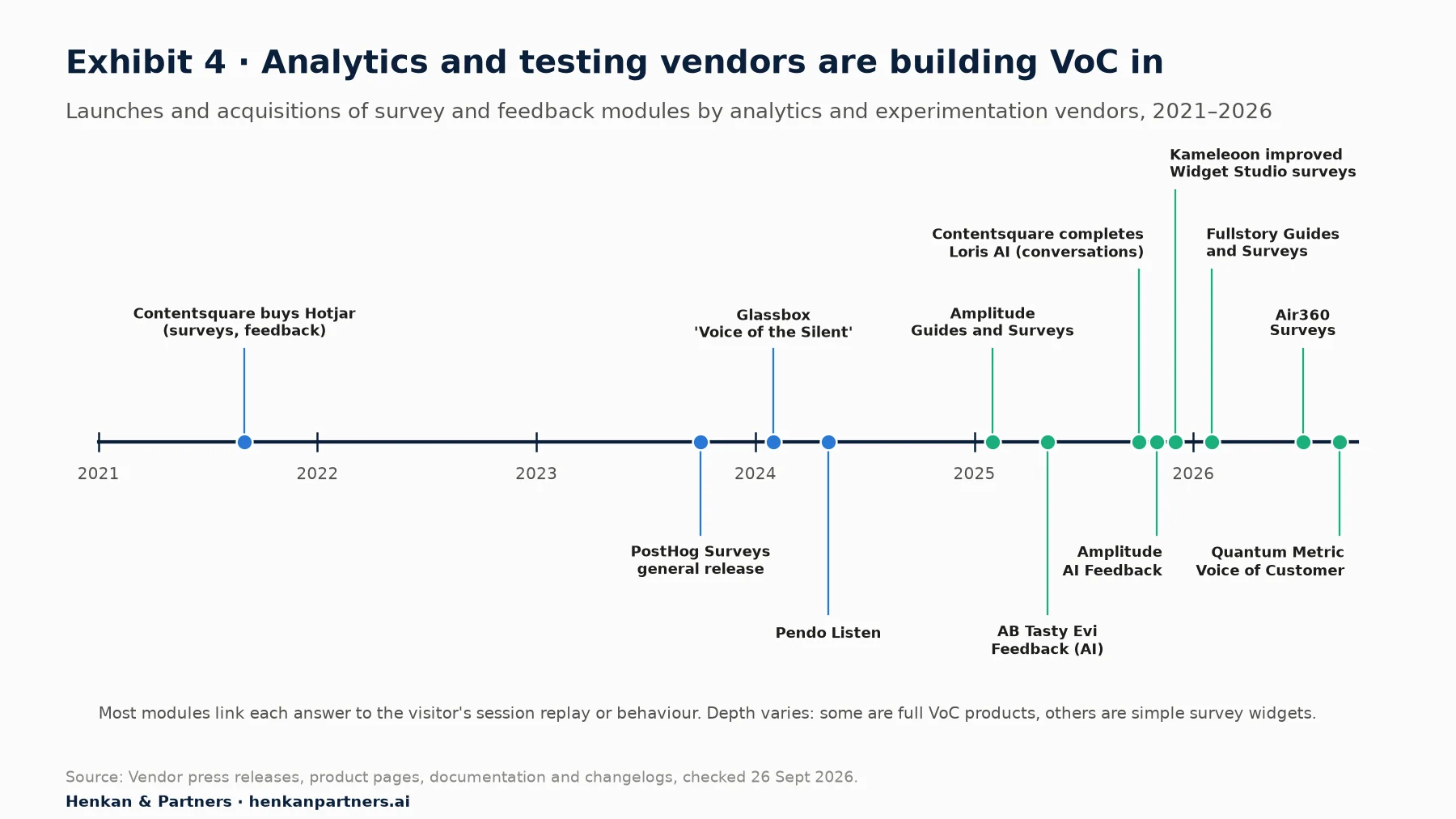
What this shows. The pace has accelerated: most of these launches came in 2025 and 2026. The modules differ widely in depth, from full VoC products with AI analysis and conversation intelligence to simple survey widgets inside a testing tool.
| Vendor | VoC module | What it does | Linked to behaviour? | Free tier or entry price |
|---|---|---|---|---|
| Contentsquare (incl. Hotjar) | Voice of Customer; Conversation Intelligence (ex-Loris AI) | Surveys, feedback button, interviews, AI summaries; analysis of support conversations | Yes: answers link to session replays | Free: 100 responses and 5 interviews a month |
| Amplitude | Guides and Surveys; AI Feedback | In-product surveys and guides; AI themes from reviews, tickets and calls | Yes: analytics, replay, experiments | Free plan includes a limited Guides and Surveys allowance |
| Pendo | Sentiment (NPS, CSAT); Pendo Listen | In-app surveys, feedback portal, AI themes | Yes: usage data and replay | Free: 500 monthly active users with NPS |
| PostHog | Surveys | NPS, CSAT, open text, feedback widget | Yes: replay, flags, experiments | Free: 1,500 responses a month, then from $0.10 per response |
| Fullstory | Guides and Surveys (launched Feb 2026) | In-app guides and behaviour-triggered surveys | Yes: session-linked responses | Not published |
| Quantum Metric | Voice of Customer (launched Sep 2026) | Behaviour-triggered surveys; analysis of surveys, reviews, chats and tickets | Yes: replay, sessions and revenue impact | Not published |
| Glassbox | Native surveys; Voice of the Silent | Surveys; AI that extends NPS or CSAT to non-respondents | Yes: sessions and struggles | Not published |
| Wingify (VWO + AB Tasty) | User Feedback; AB Tasty NPS widget and Evi Feedback | On-page and in-product surveys, AI theme analysis; target visitors by their NPS answer | Yes (vendor claim); NPS used for targeting | Tiers by active surveys; prices not published |
| Air360 | Voice of Customer; Surveys (launched Jul 2026) | Feedback tab triggered by frustration or drop-off; NPS and rating surveys | Yes: responses link to session replays | Quote-based by traffic |
| Kameleoon | Widget Studio survey elements (improved Dec 2025) | NPS, CSAT and survey widgets; export to CSV or an external service | Not documented | Included in platform; not priced separately |
| Mouseflow | Feedback Surveys | Surveys triggered by exit intent, rage clicks or events | Yes: recordings and heatmaps | From $25 a month (Essential plan) |
Two corporate moves matter here. VWO and AB Tasty merged (announced January 2026) and rebranded as Wingify in September 2026, with more than $100M of combined revenue; Everstone Capital is the largest institutional shareholder. And Contentsquare has built one of the broadest VoC offers among analytics vendors, through Hotjar (surveys and feedback, 2021) and Loris AI (conversation analytics, 2025), on top of its analytics platform, which added Heap in 2023. By contrast, we found no native survey module in Microsoft Clarity, Optimizely or Mixpanel, which point users to integrations with survey tools.
For e-commerce directors. Check your existing contracts first. If you already use Contentsquare, Amplitude, Pendo, PostHog or Wingify, you may have a survey module you have never switched on. A short exit survey on the checkout, linked to replays, is often the fastest way to find out why visitors abandon.
For investors. Convergence runs both ways: enterprise platforms want digital behaviour data, and analytics vendors want feedback. The strategic asset is the combined record of what a customer did and said. Vendors that own only one half are likely to be buyers or targets.
Section 8 · Choosing a tool
E-commerce directors should choose a VoC tool from the question they need answered
Most VoC buying mistakes come from starting with a vendor rather than a question. A large platform bought to "listen to customers" often ends up running one annual NPS survey, while the team that needs to know why checkout conversion fell has no way to ask. The framework below starts from four questions e-commerce teams actually ask.
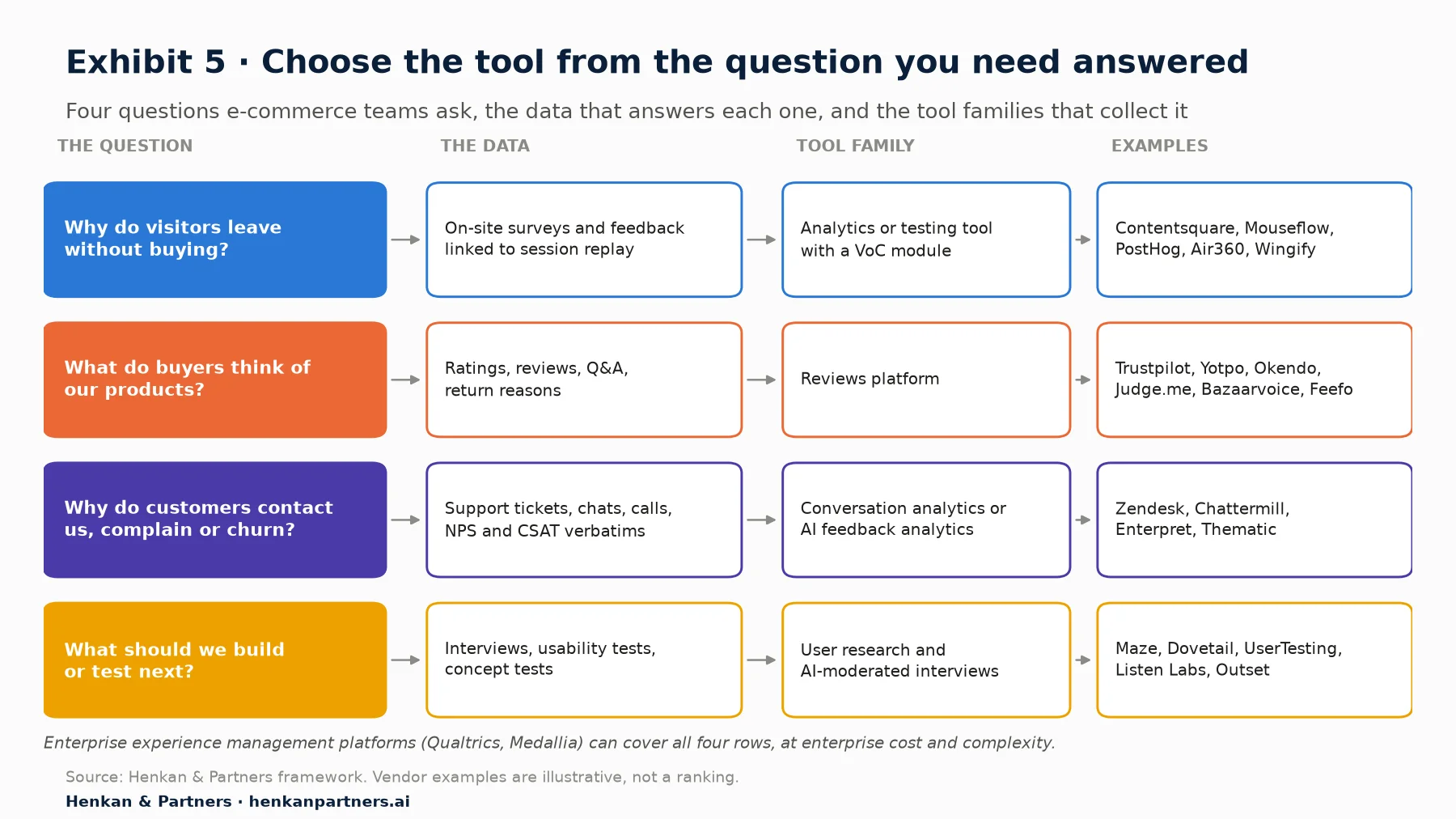
What this shows. Each question maps to a different data source and a different tool family. Most e-commerce businesses need two or three of the four rows, and they rarely need an enterprise platform to cover them until they have multiple brands, markets or a large contact centre.
Step 1: Match the tool to the size of your team and business
| Your situation | What to start with | Typical tools | Budget guide |
|---|---|---|---|
| Small team, one store (a few people, no research function) | Product reviews plus one exit or post-purchase survey | Judge.me, Yotpo or Okendo; the survey module in your analytics tool, or Typeform | Free to about $100 a month |
| Growing brand (a CRO or digital team, regular A/B tests) | On-site feedback linked to replay; reviews; AI analysis of support tickets | Contentsquare, Mouseflow, PostHog or Wingify for feedback; Trustpilot or Okendo for reviews; Survicate or Mopinion for multi-channel surveys | About $100–1,000 a month |
| Multi-brand or international retailer (several markets, a contact centre) | A feedback programme across channels, conversation analytics and a research tool | Chattermill, Enterpret or Thematic for AI analysis; Zendesk or NICE for conversations; Maze, Dovetail or Listen Labs for research | Tens of thousands a year and up |
| Enterprise with CX governance (many touchpoints, stores, regulated data) | An experience-management platform with closed-loop workflows | Qualtrics, Medallia, SurveyMonkey Enterprise, Sprinklr | Quote only |
Step 2: Compare what you will actually pay
Pricing models differ as much as prices. Survey tools charge by responses; reviews platforms by orders or review invitations; enterprise platforms by "experience data records" or modules; analytics vendors by events or sessions, with feedback bundled in. Published entry prices range from free to $25,000 a year, and most enterprise and AI-analysis vendors quote only.
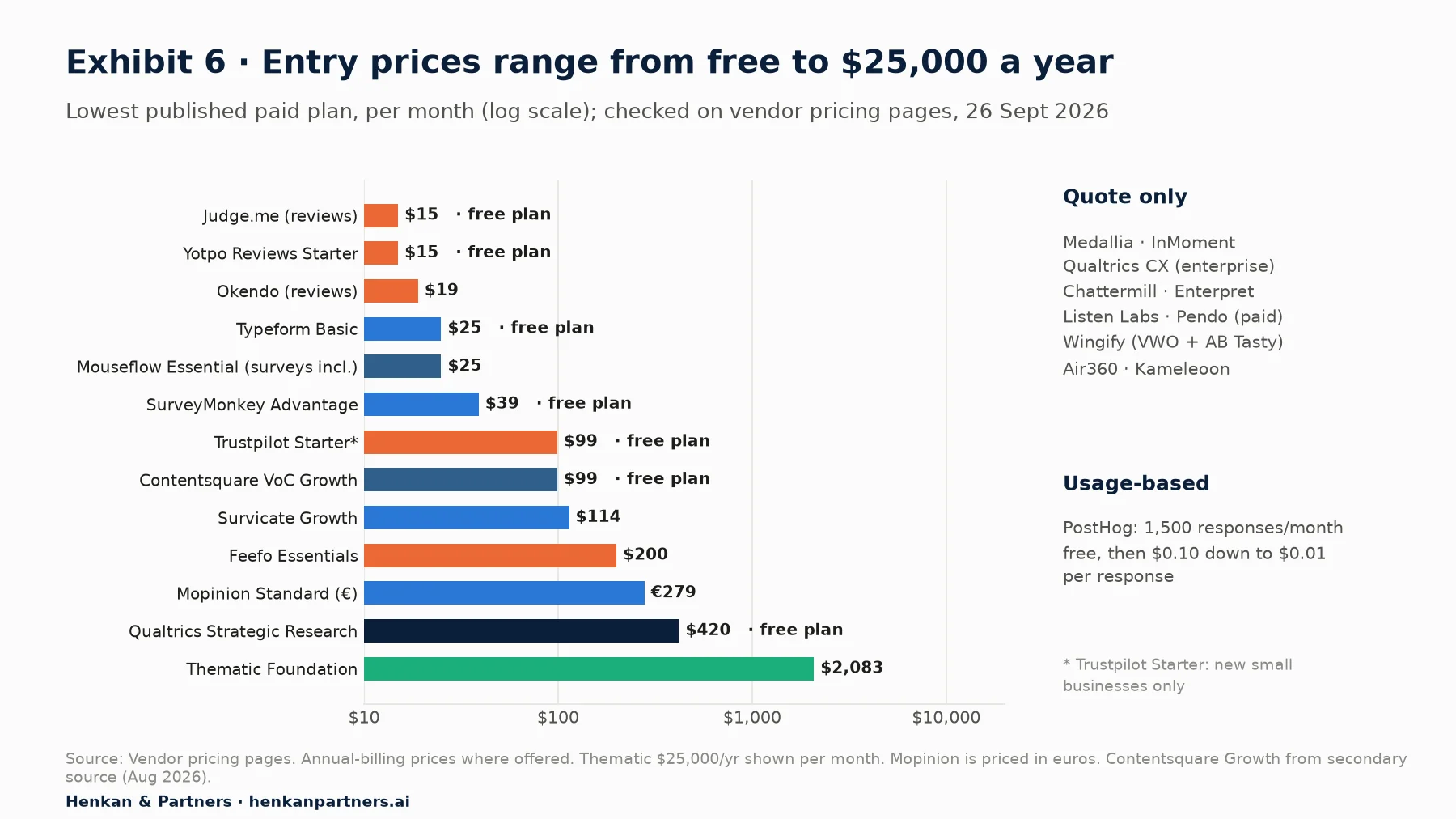
What this shows. A small store can run reviews and a survey for less than $50 a month. The price jump comes with AI analysis across sources and enterprise workflows. Several free tiers are generous enough for a first programme: PostHog (1,500 responses a month), Contentsquare (100 responses), Qualtrics (500 responses in total), Typeform (100 a month) and the reviews tools.
Step 3: Ask ten questions before you sign
- Which question will this tool answer first? Name the decision it should inform in the next 90 days.
- Do we already own a module that does this? Check your analytics, testing, reviews and helpdesk contracts.
- Can we link answers to behaviour? A survey answer next to the session replay or order data is worth far more than a score on its own.
- Does it analyse open text well, in our languages? Test the AI on your own verbatims, not on a demo dataset.
- Where does the data live, and on what legal basis? Check EU hosting, consent handling for on-site widgets and data-processing terms for AI analysis.
- Are our reviews compliant? Verification, incentive disclosure and no suppression of negative reviews under EU, UK and US rules.
- How is it priced as we grow? Model the cost at two and five times today's traffic, orders or responses.
- Can we export everything? Raw responses, verbatims and tags, in a usable format, without a professional-services fee.
- Who owns the vendor, and what is its roadmap? After a merger or recapitalisation, ask which products will be kept.
- Who will act on the insight? A VoC tool without an owner, a weekly review and a link to the test backlog becomes a dashboard nobody reads.
For e-commerce directors. The best first VoC programme is small: one exit survey at checkout, one post-purchase survey, reviews on every product page and a monthly AI summary of support tickets. Link every theme to a number (visitors or revenue affected) and send the top themes to the A/B testing backlog. That is how feedback turns into a better customer experience and more revenue.
Section 9 · The private-equity view
Investors should back data ownership and AI analysis, and be wary of seat-based survey revenue
The VoC market offers four investment theses in 2026, each with a different risk profile:
- Platform consolidation. Buy and combine survey, analytics and industry-specific feedback businesses, as Qualtrics has done with Press Ganey Forsta and InMoment. The upside is scale and cross-selling; the risk is integration and leverage, as the 2026 financing difficulties show.
- Vertical specialists. Own VoC for one industry with regulated or benchmarked data, such as healthcare patient experience. Qualtrics highlighted Press Ganey's healthcare data and benchmarks across more than 41,000 facilities as central to the deal.
- AI-native analysis. Back AI feedback analytics and AI-interview companies that analyse existing feedback rather than collect new surveys. Valuations are high (Listen Labs at $500M), and the risk is that platforms build the same features.
- Behaviour plus feedback. Invest in analytics or experimentation vendors that add VoC, or in VoC vendors that add behaviour data. The combined data set is the strategic asset, and it makes these companies natural targets.
| Due-diligence question | Why it matters |
|---|---|
| What share of revenue comes from seats or survey volume that AI could shrink? | AI makes survey creation and basic analysis cheaper; seat-based pricing is exposed. |
| How much of the data is proprietary (benchmarks, conversations, behaviour)? | Unique data is the defence against general-purpose AI tools. |
| What is net revenue retention by segment and customer size? | Consolidation and budget cuts show up first in retention; Trustpilot's net dollar retention was 101% in H1 2026. |
| How leveraged is the business, and what does debt service look like at lower growth? | At Medallia, about $300M a year of debt service exceeded about $200M of earnings, according to Octus. |
| Which products overlap after the last acquisition, and which will be retired? | Product sunsets cause churn among customers of acquired tools. |
| How exposed is the business to review and privacy regulation? | Trustpilot's 2026 fine in Italy and the UK's 10%-of-turnover penalties show the risk is real. |
For investors. The next wave of value is likely to go to companies that turn unstructured feedback into decisions that move revenue, rather than to those that collect more survey responses. Ask every target to show the link between its insights and a customer's revenue, conversion or retention.
Section 10 · Implications
Start from the decision, link what customers say to what they do, and act on it every week
Voice of Customer software is abundant and increasingly cheap at the entry level, while enterprise platforms consolidate. The winners, for vendors and for retailers, will be those that connect feedback to behaviour and act on it quickly. Our recommendations:
1. Audit what you already have before you buy
List every tool that collects feedback today: reviews, helpdesk, surveys, analytics and testing modules. In our experience, many e-commerce teams find they already own two or three overlapping capabilities, and that the gap is not the tool but the routine for acting on what it collects.
2. Link every answer to behaviour and revenue
Choose tools that connect a survey answer or review to the session, segment or order behind it. Then size each theme by the number of visitors or the revenue affected, so feedback competes for attention on the same terms as analytics.
3. Mine existing feedback with AI before adding surveys
Reviews, support tickets, chat logs and return reasons already hold most of what customers want to tell you. Run an AI theme analysis on a year of this data first; it is faster, cheaper and less intrusive than a new survey programme.
4. Feed VoC into your experimentation programme
Every recurring theme should become a hypothesis and, where possible, an A/B test. This is how VoC moves from reporting to results. Our article on why Voice of Customer is the missing layer in optimisation explains the method, and our guide to A/B testing covers the testing side.
5. Build compliance and portability into every contract
Check review verification and incentive rules in every market you sell in, consent for on-site widgets and data terms for AI analysis. Given how much the market is consolidating, make sure you can export all your data if a product is retired.
Our view. The question for an e-commerce director is not "which VoC platform should we buy?" but "which customer problem do we need to understand this quarter, and what is the smallest tool that links what customers say to what they do?" Answer that, act on it every week, and the customer experience, revenue and lifetime value follow. That applies to a two-person team with a Shopify store as much as to a multi-brand retailer.
FAQ
Frequently asked questions about Voice of Customer tools
Frequently asked questions
What is Voice of Customer (VoC) software?
VoC software collects and analyses what customers say about a business: surveys, reviews, support conversations, interviews and feedback on websites and apps. It explains why customers behave as they do, which behaviour analytics alone cannot show.
What are the main Voice of Customer tools in 2026?
The main enterprise platforms are Qualtrics (which now owns Press Ganey Forsta and InMoment), Medallia, SurveyMonkey and Sprinklr. E-commerce teams also use reviews platforms (Trustpilot, Yotpo, Okendo, Judge.me), AI feedback analytics (Chattermill, Enterpret, Thematic) and the VoC modules in analytics and testing tools such as Contentsquare, Amplitude, PostHog and Wingify.
How big is the Voice of Customer market?
Published estimates range from about $2B for VoC software to $15–19B for broad customer-experience management (2024–2026 reports). Vendor revenues suggest the core software market is a few billion dollars a year.
Which VoC tool is best for an e-commerce business?
It depends on the question. Use a reviews platform for product opinions, on-site surveys linked to session replay for conversion problems, AI feedback analytics for support tickets and user research tools for new ideas. Small stores can start for free or under $50 a month.
Do Contentsquare, Kameleoon or Air360 have Voice of Customer features?
Contentsquare has a full Voice of Customer product (from Hotjar) plus Conversation Intelligence from Loris AI. Air360 has a VoC feedback widget linked to session replays and launched Surveys in July 2026. Kameleoon offers NPS, CSAT and survey elements in its Widget Studio, with answers exported to CSV or an external service.
Why did Qualtrics buy Press Ganey Forsta?
The $6.75B deal, closed in May 2026, gave Qualtrics healthcare patient-experience data and benchmarks from more than 41,000 facilities, plus the Forsta research tools and InMoment's customer base, and further consolidated the enterprise segment.
Are fake or incentivised reviews legal?
No. Fake reviews are banned in the EU (since May 2022), the US (FTC rule effective October 2024) and the UK (DMCC Act, April 2025, with fines up to 10% of global turnover). Incentivised reviews must be disclosed, and negative reviews must not be suppressed.
Key terms
- Voice of Customer (VoC)
- Everything a business learns from what customers say: surveys, reviews, support conversations, interviews. It matters because behaviour data shows what customers do, but only VoC explains why.
- Experience management (XM) / CX management
- The enterprise category that combines VoC with analysis and action workflows, led by Qualtrics and Medallia. It matters because it is the largest and most consolidated part of the market.
- NPS (Net Promoter Score)
- On a 0–10 "would you recommend us?" scale, the percentage of promoters (9–10) minus the percentage of detractors (0–6). Introduced by Fred Reichheld of Bain in 2003; still the most common loyalty metric.
- CSAT and CES
- Customer satisfaction score and customer effort score: short surveys after a purchase or a service contact. They matter because they are cheap to collect at every step of the journey.
- Verbatim
- A customer's free-text answer or comment. Verbatims hold the reasons behind scores, and are what AI analysis now reads at scale.
- Digital feedback
- Surveys and feedback buttons shown on a website or app, often triggered by behaviour such as exit intent. It is the VoC format closest to conversion work.
- Session replay
- A reconstruction of a visitor's session on a site. Linking a survey answer to the replay shows both what the customer said and what happened to them.
- Conversation analytics
- Software that transcribes and analyses calls, chats and tickets to find contact reasons and sentiment. It turns the contact centre into the largest VoC source.
- Text analytics / AI feedback analytics
- Software that groups free-text feedback into themes and sentiment. Large language models, widely available since late 2022, have made this much cheaper and more accurate.
- AI-moderated interview
- An interview run by an AI interviewer that asks follow-up questions, at the scale of a survey. It matters because it brings qualitative depth to large samples.
- Silent churn
- Customers who have a bad experience, say nothing and spend less. It is why survey data alone underestimates problems.
- Take-private
- A private-equity buyout of a listed company that removes it from the stock market. Medallia, Qualtrics, SurveyMonkey, Zendesk and UserTesting all went private this way in 2021–23.
- Recapitalisation (debt-for-equity)
- A restructuring in which lenders swap debt for ownership. It usually means the previous owner's equity has lost most of its value, as at Medallia in 2026.
- Consent (GDPR)
- A 'freely given, specific, informed and unambiguous' agreement to data processing. It matters when survey answers are joined to identified behavioural or CRM data in Europe.
Sources
Market structure, deals and financials come from company press releases, SEC filings and results, cross-checked with reputable outlets (TechCrunch, Bloomberg, CNBC, Research Live). Product features and prices were checked on vendor websites, documentation and pricing pages on 26 September 2026; prices change often and exclude taxes. Market-size estimates are from the named research firms and use different definitions. Valuation marks from secondary sales and credit-research estimates are labelled as such. Henkan & Partners works with several vendors named in this report, including as a certified partner of Contentsquare, Kameleoon, AB Tasty and Air360; this report does not rank vendors.
- Qualtrics, Press Ganey Forsta acquisition completed, May 2026
- Bloomberg, JPMorgan halts Qualtrics $5.3B debt deal, 17 March 2026
- Silver Lake, Qualtrics to be acquired for $12.5B, March 2023
- TechCrunch, SAP agrees to buy Qualtrics for $8B, November 2018
- Qualtrics FY2022 results (SEC)
- Thoma Bravo completes acquisition of Medallia, October 2021
- Medallia, ownership transition agreement with Blackstone, Apollo and FSK, June 2026
- Octus, the Medallia restructuring
- InMoment, acquired by Press Ganey Forsta, May 2025
- Forrester, Qualtrics buys PG Forsta: now what?
- STG, Momentive (SurveyMonkey) to be acquired for $1.5B, March 2023
- Sprinklr, fiscal 2026 results
- Thoma Bravo completes acquisition of Verint, November 2025
- Zendesk, H&F and Permira complete acquisition, November 2022
- NICE, full-year 2025 results
- UserTesting, Thoma Bravo and Sunstone complete acquisition, January 2023
- Trustpilot H1 2026 results coverage, Yahoo Finance
- Globes, Yotpo lays off 200, August 2025
- Calcalist, Gong secondary sale at about $4.5B, November 2025
- VentureBeat, Listen Labs raises $69M, January 2026
- NICE completes Cognigy acquisition, September 2025
- TechCrunch, Gong Series E at $7.25B, June 2021 and Gong passes $300M ARR, March 2025
- TechCrunch, Yotpo Series F at $1.4B, March 2021
- Outset Series A, June 2025 and Series B, December 2025
- Cresta, about us
- Contentsquare completes acquisition of Heap, December 2023
- Wingify, AB Tasty Feedback Copilot (Evi Feedback)
- Kameleoon, improved Widget Studio, December 2025
- Contentsquare completes acquisition of Loris AI, October 2025
- Contentsquare Voice of Customer
- Amplitude launches Guides and Surveys, February 2025
- Pendo introduces Pendo Listen, May 2024
- PostHog Surveys pricing
- Fullstory launches Guides and Surveys, February 2026
- Quantum Metric launches Voice of Customer, September 2026
- Air360 Voice of Customer and Air360 changelog, Surveys, July 2026
- Kameleoon documentation, survey elements in Widget Studio
- VWO and AB Tasty join forces, January 2026
- Wingify User Feedback
- Mouseflow pricing
- Glassbox, Voice of the Silent
- MarketsandMarkets, customer experience management market
- Grand View Research, customer experience management market
- Fortune Business Insights, customer experience management market
- Verified Market Research, VoC software market
- Reichheld, "The One Number You Need to Grow", HBR, 2003
- Qualtrics XM Institute, $3 trillion at risk from bad experiences in 2026
- Qualtrics, fewer than one in three consumers give feedback
- Forrester CX Index 2025 and Forrester, CX quality rebound, 2026
- Gartner, go beyond VoC surveys and Futurum, Gartner's 60% prediction
- Spiegel Research Center, how online reviews influence sales
- Bazaarvoice Shopper Experience Index 2025
- EUR-Lex, Directive (EU) 2019/2161 (Omnibus)
- FTC, final rule banning fake reviews, August 2024 and Federal Register, 22 August 2024
- EDPB Guidelines 2/2023 on the technical scope of Art. 5(3) ePrivacy Directive, October 2024
- CMS, the DMCC Act bans fake reviews
- Vendor pricing pages checked 26 September 2026: Qualtrics, SurveyMonkey, Typeform, Survicate, Mopinion, Trustpilot, Yotpo, Judge.me, Okendo, Feefo, Thematic, Medallia, Amplitude, Pendo