Focus
AI-Moderated User Interviews: What They Replace, and What They Don't
Alexandre Suon · 2026-10-21
An AI interviewer can now run a hundred customer conversations overnight, in a dozen languages, and hand you a coded summary in the morning. AI-moderated interviews are real people answering an AI that asks, listens and follows up. They are not synthetic users. This guide explains how they work, what the published evidence says about their quality, where they fail, what the EU's AI Act and GDPR require, and how to combine them with human researchers and A/B tests.
Executive summary
- AI moderation replaces the interviewer, not the participant. A real customer answers by text, voice or video; an AI asks the questions from your discussion guide, probes, and summarises. That makes it a different tool from synthetic users, where the AI also plays the customer.
- The evidence on quality is better than many researchers expect. In a blind grading by eight sociology PhD students, AI voice interviews scored 3.4 on a scale where 3 is an average human expert, against 3.6 for face-to-face human interviews (Geiecke & Jaravel, 2025). In two academic studies, 43% and 53% of participants said they would choose an AI interviewer next time, against about 20% who preferred a human.
- The evidence on limits is just as clear. Nielsen Norman Group found that current AI interviewers follow the script rather than the insight, praise answers too much and cannot observe; only 3 of 10 experienced participants said the conversation felt natural (Rosala, 2026). Use them for structured questions, not open discovery.
- The strengths are scale, speed and consistency. One study ran 766 AI-led interviews in about ten days (Chopra & Haaland, 2026). Interviews run around the clock, in many languages, with the same guide each time, and answers are longer than in an open survey box: 460 words against 190 in one experiment.
- In the EU, disclosure is now a legal duty. Since 2 August 2026, Article 50 of the AI Act requires AI systems that talk to people to tell them they are talking to an AI. Recordings and transcripts are personal data under GDPR, and emotion inference is banned in workplace research.
- The best set-up is hybrid. A few human interviews to frame the problem, AI moderation for breadth, a researcher for depth on the surprises, people for synthesis, and A/B tests to measure behaviour. In our illustrative cost model, the budget of 12 human interviews buys about 32 AI-moderated ones.
Section 1 · Definition
An AI-moderated interview is a real person talking to an AI interviewer
The term covers a simple set-up. A researcher writes a discussion guide. A participant, recruited from a panel or from the brand's own customers, opens a link at a time that suits them. An AI interviewer greets them, asks the first question, listens to the answer, asks a follow-up when the answer is short or interesting, moves through the guide, and closes the session. The platform then transcribes, tags and summarises every session, and groups the results into themes.
An AI-moderated interview is a one-to-one research session in which a real participant answers questions asked by an AI interviewer, by text, voice or video. The AI follows a discussion guide written by a researcher, asks follow-up questions based on what the participant says, and produces a transcript and summary. The participant is human; only the moderator is automated.
Three neighbouring methods are often confused with it, and the differences decide what you can conclude from the results.
- Synthetic users replace the participant, not the moderator. A language model plays a customer persona and answers questions. Our article on synthetic users in customer research reviews the evidence: useful for drafting questions and hypotheses, risky as a substitute for real answers. Some vendors offer both, so check which one you are buying.
- Unmoderated tests with AI follow-ups add a few AI-generated probes to a task-based usability test or a survey. They are a lighter version of the same idea.
- AI analysis of human interviews keeps a human moderator and uses AI only for transcription, coding and synthesis. Our guide to analysing surveys with LLMs covers that step, which also applies to AI-moderated transcripts.
| Method | Who asks | Who answers | Adapts to answers? | Typical scale | What you can conclude |
|---|---|---|---|---|---|
| Human-moderated interview | Researcher | Real person | Fully: reframes, skips, observes | 5–20 sessions | Deep understanding of a few people |
| AI-moderated interview | AI interviewer | Real person | Partly: probes within guide rules | 20–1,000+ sessions | Reasons and language across many people |
| Survey with open questions | Fixed form | Real person | No (or simple logic) | Hundreds to thousands | How many, which segment; short reasons |
| Synthetic users | Researcher or AI | Language model | Yes, but answers are simulated | Unlimited | Hypotheses to check with real people |
Section 2 · How it works
Five stages, and the human owns the first and the last
Every AI-moderated study runs through the same five stages. The AI does most of the work in the middle; the quality of the result is decided at the ends.
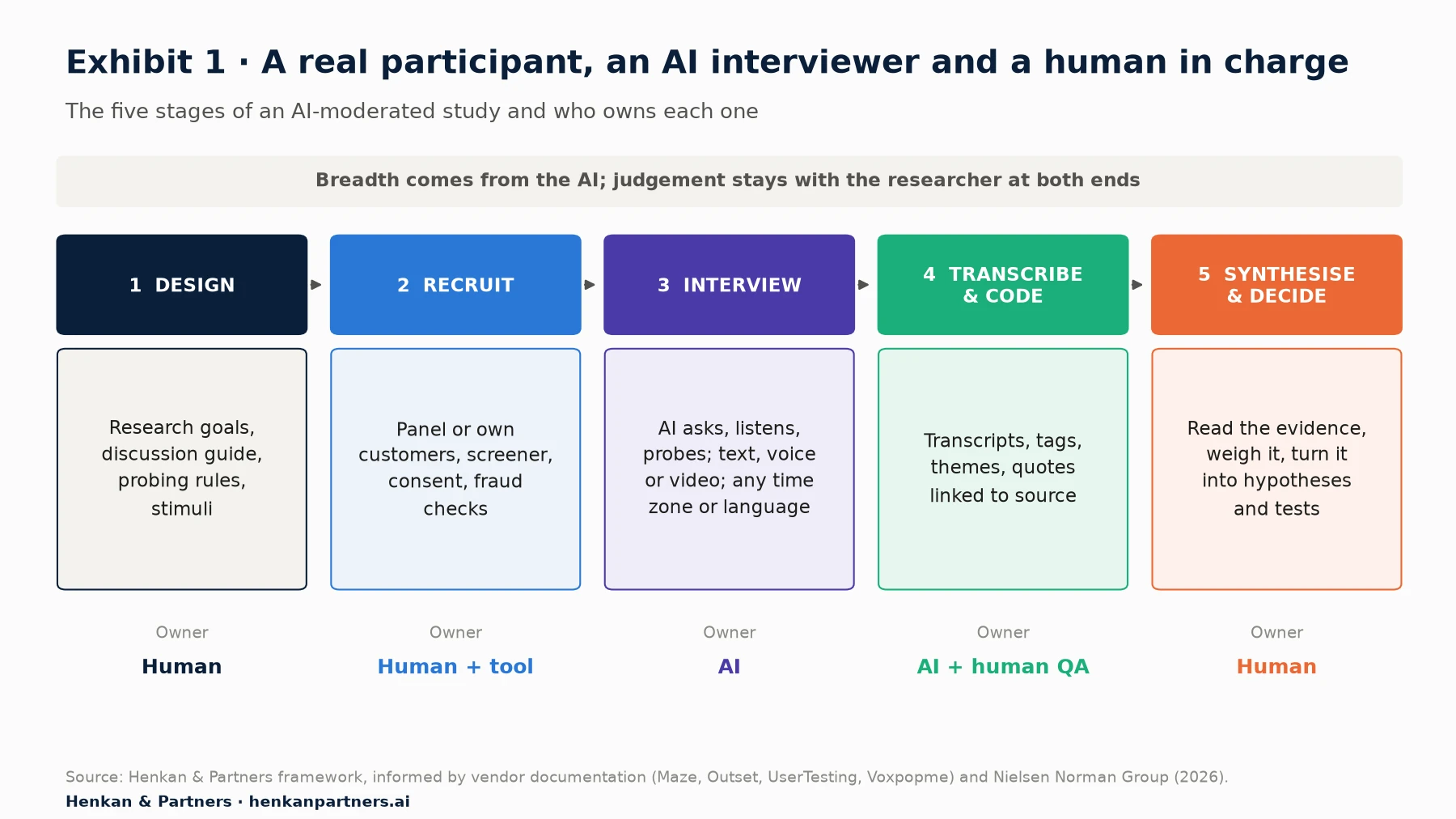
What this shows. The AI owns one stage fully, the interview itself, and shares the coding stage. Design and synthesis stay human. Teams that let the tool draft the guide and write the conclusions get fast output with no one accountable for the questions or the answers.
The settings that change the result
Vendors expose broadly the same controls. Each one is a research decision, not a technical detail.
- Modality. Text chat, voice, or video with the participant on camera. Maze's AI moderator shows questions as both text and voice (Maze, 2025); Conveo runs video, voice and text interviews (Research Live, 2026). In the Geiecke and Jaravel study, voice interviews were graded higher than text ones (Exhibit 3).
- Probing depth. How many follow-ups the AI may ask, and when. Voxpopme lets researchers set probing from none to in-depth and define topics, keywords or emotions that trigger a probe (MrWeb, 2025). UserTesting's AI Moderation, in limited early access, generates follow-ups from each participant's answers and can be steered with context on what the team wants to learn (UserTesting, 2026).
- Stimuli. Images, concepts, ads or web pages shown during the session, so the AI can ask for reactions.
- Language. Most platforms run interviews in several languages and translate transcripts. NN/g saw an AI interviewer switch to Spanish on request without loss of understanding (Rosala, 2026).
- Length. AI sessions in the published studies run from about 13 to 56 minutes (NN/g) and lasted about 25 to 33 minutes on average in the Chopra and Haaland studies. Shorter guides mean fewer drop-outs and lower incentives.
Section 3 · The market
Specialist start-ups and established research platforms both now sell AI interviewers
The category is young and moving fast. Specialist vendors have raised large rounds since mid-2025, while established research platforms have added AI moderators to products many teams already pay for.
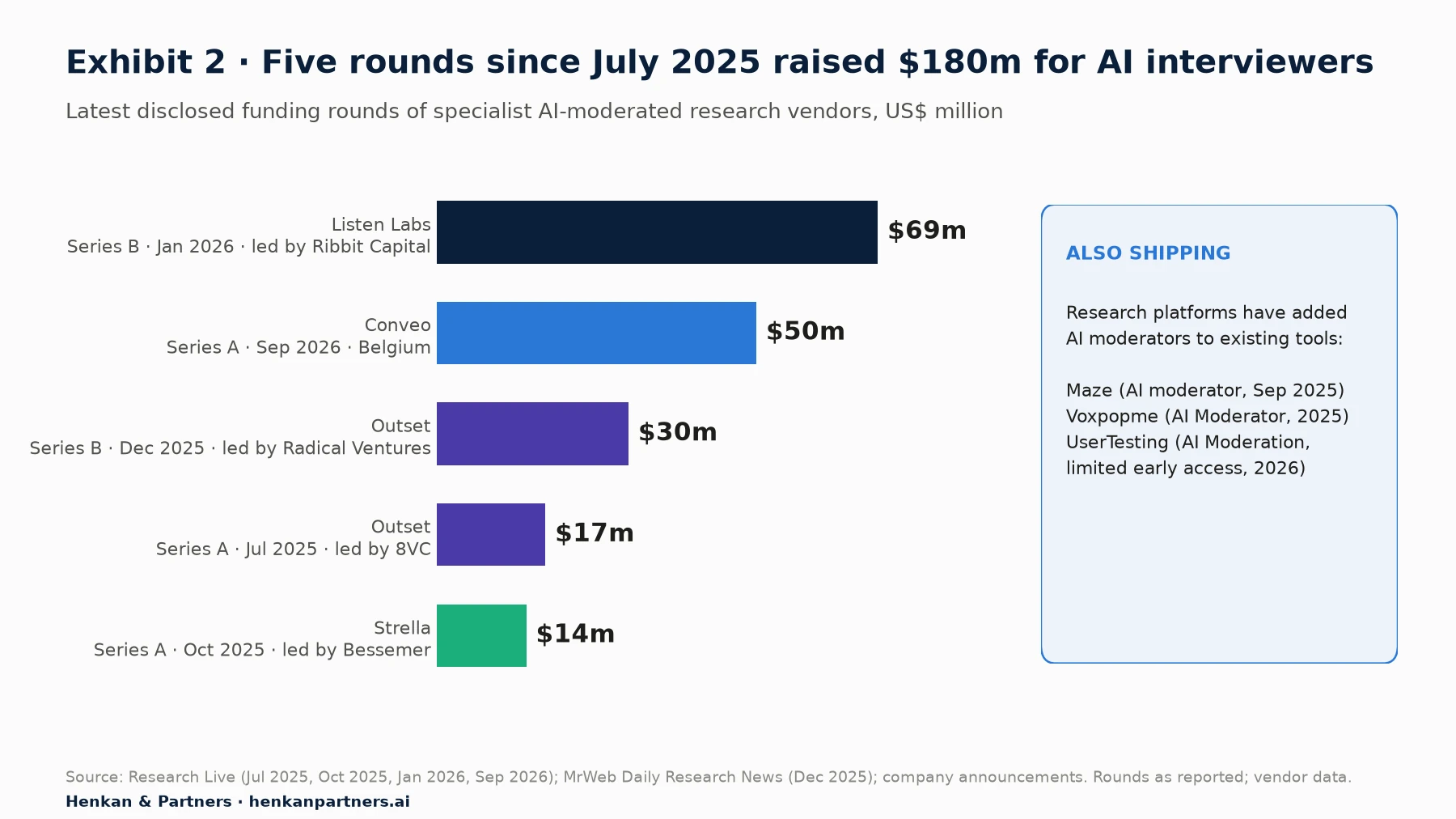
What this shows. Investors are betting that AI moderation becomes a standard research method, not a niche feature. For buyers, money is not proof of quality: the published validation behind these products is mostly vendor case studies. The independent evidence comes from academic studies and NN/g, which we review in the next section.
| Tool | Type | What it offers (vendor description) | Notable facts |
|---|---|---|---|
| Listen Labs | Specialist | AI interviewer that runs studies and produces reports, themes, highlight reels and decks | $69m Series B led by Ribbit Capital (Jan 2026); says it has interviewed over one million people |
| Outset | Specialist | AI-moderated video interviews, synthesis, recruitment, fraud detection, multilingual studies | $17m Series A (Jul 2025) and $30m Series B (Dec 2025); lists GDPR, SOC 2 and HIPAA compliance |
| Conveo | Specialist | AI-moderated video, voice and text interviews for market research | Belgian; $50m Series A (Sep 2026), $55.8m raised in total |
| Strella | Specialist | AI-moderated interviews for researchers, product managers, marketers and designers | $14m Series A led by Bessemer (Oct 2025) |
| Maze | Research platform | AI moderator that drafts the guide, runs text-and-voice interviews and maps themes to goals | Launched September 2025 |
| Voxpopme | Research platform | Asynchronous AI-moderated video interviews with adjustable probing and stimulus testing | Smart Probing added September 2025 |
| UserTesting | Research platform | AI Moderation: follow-up questions inside unmoderated studies | Limited early access (2026) |
Two practical points for selection. First, separate the interviewer from the panel: some vendors bundle recruitment, which is convenient but makes it harder to reuse your own customer lists and consent. Second, ask each vendor whether participants are told they are talking to an AI, where data is processed, and how long recordings are kept. Section 6 explains why these are legal questions in the EU, not just good practice. Our vendor-neutral selection scorecard gives a method for comparing tools on the same criteria.
Section 4 · The evidence
On quality, AI interviewers come close to human ones on structured topics
The question every research team asks is whether an AI interviewer produces data as good as a human's. Four strands of evidence give a fair answer: expert grading of transcripts, participant preferences, comparisons with open survey questions, and studies of disclosure.
Blind expert grading: AI voice close to face-to-face
Friedrich Geiecke and Xavier Jaravel at the London School of Economics asked eight sociology PhD students from Cambridge, Harvard, Johns Hopkins, LSE and Oxford to grade 30-minute interview transcripts without knowing how each was produced. The scale ran from 1 (worst human expert) to 5 (best human expert), with 3 as an average expert. Against a face-to-face benchmark, face-to-face human interviews scored 3.6, AI voice interviews 3.4, AI text interviews 2.8 and human interviews by online text chat 2.3. In an earlier test of AI text interviews, the average grade was 2.95, close to an average human expert working in the same chat format.
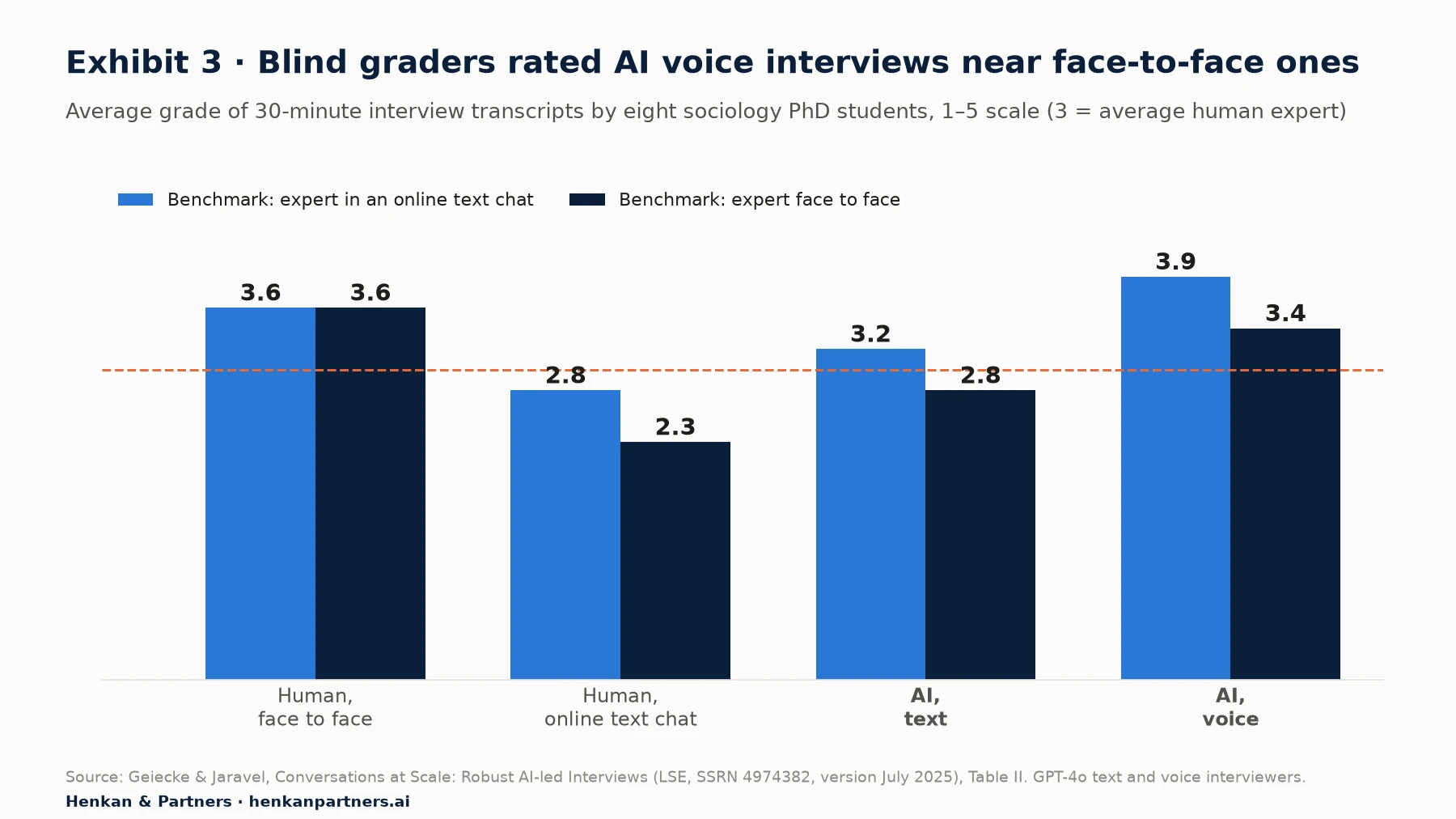
What this shows. The mode matters as much as who asks. Typed conversations scored lower for humans and AI alike; speaking produced richer interviews. The topics were social-science questions such as meaning in life, housing and career choices, and the graders were academics. Treat it as strong evidence for structured, opinion-type interviews, not for every research question.
Participants: many say they would choose the AI next time
Felix Chopra and Ingar Haaland ran 766 AI-led interviews with US adults on why people do not invest in the stock market and on views of 2025 import tariffs, about 400 hours of conversation in total. In the stock-market study, 53% of participants said they would prefer an AI interviewer in future and 21% a human; 96% to 97% across the two studies said they would take part in another AI-led interview, and 99% of stock-market participants approved the AI's summary of their views. Research assistants coding the AI's behaviour found 95% to 100% adherence to open, neutral and relevant questioning, and hallucination rates of 0.1% and 0.4% (Chopra & Haaland, 2026). In Geiecke and Jaravel's meaning-in-life study, 43% preferred an AI interviewer, 19% a human and 38% did not mind.
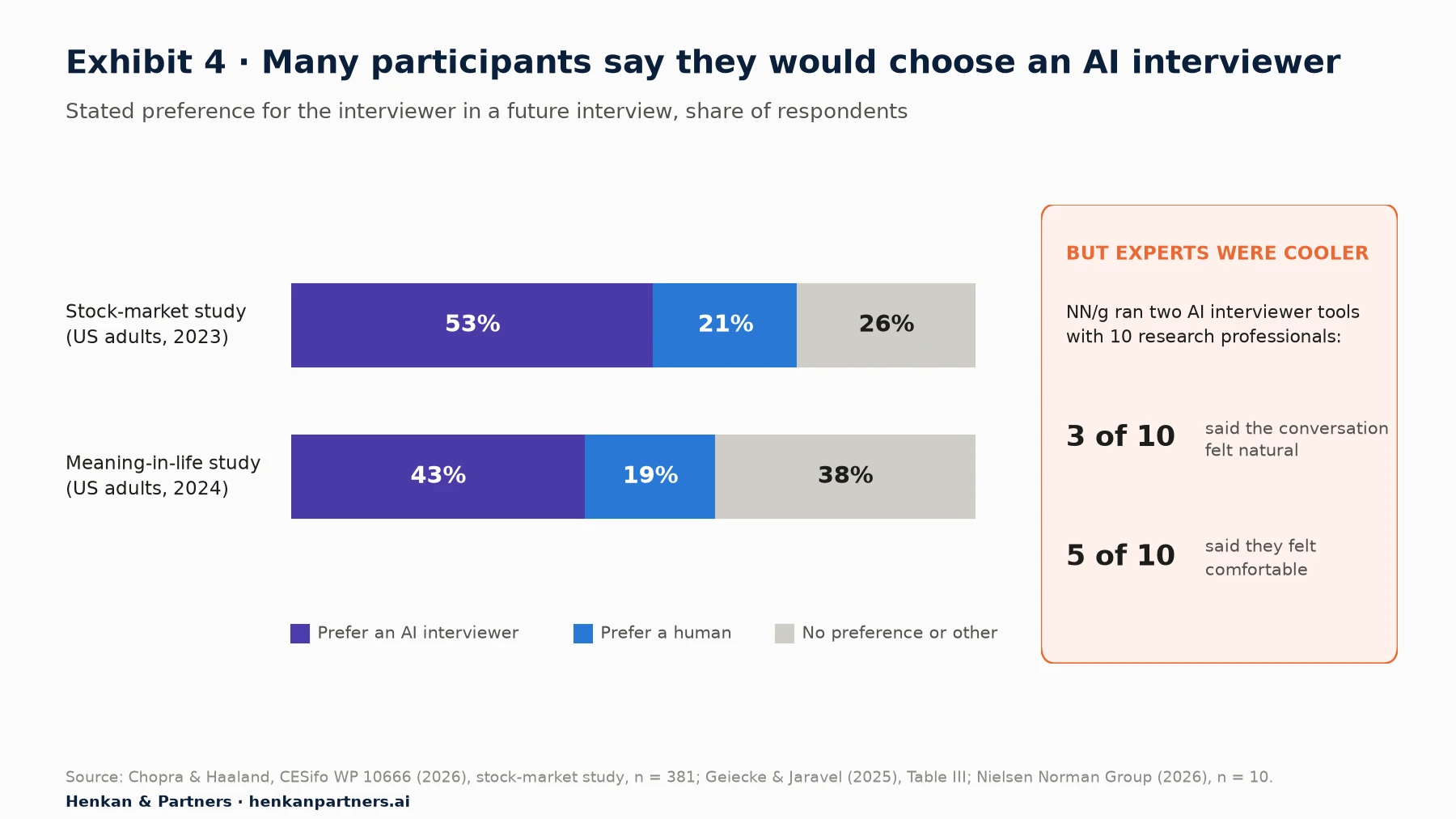
What this shows. Ordinary participants recruited online are comfortable with AI interviewers and often prefer them, perhaps because they can answer when they like and feel less judged. Research professionals, who know what a good interview feels like, were far less impressed. Both groups are telling you something: the format is acceptable to customers, and the craft of interviewing is not yet fully automated.
Depth: longer answers than a survey box, and more candour
- Against open survey questions. In Geiecke and Jaravel's experiment, participants randomly assigned to an AI interview wrote 460 words against 190 for those given open text fields, and experts judged the AI transcript more informative in 75% of paired comparisons (open text won in 2.5%). An earlier study of about 600 participants found that a conversational chatbot produced more informative, relevant, specific and clear answers than the same questions in a Qualtrics survey (Xiao et al., 2020).
- Against human interviewers. A small pre-registered pilot with university students (11 interviews) found that AI and human interviews were of comparable quality and participants were equally satisfied (3.8 of 5 in both). The failures differed: the AI accounted for 88% of missed follow-up questions, while human interviewers were the ones who sometimes steered respondents towards answers, and they committed 94% of active-listening errors (Wuttke et al., 2024).
- On sensitive disclosure. In a laboratory study of 239 adults interviewed by a virtual human, participants who believed no person was watching reported less fear of being judged and disclosed more, including embarrassing symptoms (Lucas et al., 2014). Removing the human observer can reduce social-desirability bias.
Our view. The honest summary of the evidence is: comparable to an average human interviewer on structured, opinion-type questions, clearly better than an open survey box, and weaker than a skilled researcher on discovery. Most published studies used academic topics and online panels, and none tested e-commerce journeys with screen sharing. Run your own side-by-side pilot before replacing any human research.
Section 5 · Strengths
Scale, speed and consistency are the real gains, not just lower cost
The case for AI moderation is not that it is a cheaper human. It is that it makes possible studies that were never run because they needed too many interviews.
- Scale. Dozens or hundreds of interviews per study instead of eight or twelve. That lets you compare segments, markets and customer types, which a handful of interviews cannot do. Saturation research shows that 9 to 17 interviews usually surface the main themes in a homogeneous group (Hennink & Kaiser, 2022); AI moderation lets you reach that number in each segment rather than across all of them.
- Speed. Chopra and Haaland collected 766 interviews in about ten days. Participants take part at any time, in parallel, without scheduling. The bottleneck moves from fieldwork to analysis.
- Around the clock and across time zones. Customers in Casablanca, Montreal and Singapore can take part in the same study, in their own hours.
- Many languages. One guide, many languages, without hiring a native moderator for each market. Translation quality still needs a native check on a sample.
- Consistency. Every participant gets the same questions in the same order with the same neutral wording, which reduces moderator effects across a large study. Humans drift; a well-configured AI does not, although NN/g warns that the same script produced different experiences while products were being updated.
- Candour. As the disclosure research above suggests, some participants say more to a machine than to a person, which helps on topics such as price sensitivity or why they abandoned a basket.
- Cost per interview. Variable costs fall sharply once the guide is designed (Section 11). The LLM itself is cheap: Chopra and Haaland report model costs below $0.10 per interview hour.
Section 6 · Limits and obligations
The limits are rapport, judgement and observation, plus new legal duties in the EU
NN/g's study is the most useful catalogue of what goes wrong in practice. Maria Rosala tested two AI interviewers with ten research leaders and ResearchOps professionals from eight countries and concluded that current tools 'are not yet capable of conducting semistructured interviews' (Rosala, 2026).
Research limits
- They follow the script, not the insight. The AI probes when told to or when an answer is short, but does not chase an unexpected thread, reframe a weak question or recognise when a topic is exhausted.
- Weak rapport and turn-taking. Without nods or facial expressions, participants could not tell whether the AI was listening. Tools interrupted, left long pauses or moved on too fast. Only 3 of 10 participants said the conversation felt natural, and 5 of 10 felt comfortable.
- Sycophancy. Both tools praised answers excessively ('too much, too reactive, too thankful', said one participant). Praise can bias later answers.
- Unchecked summaries. Neither tool asked participants to confirm its summaries, a basic step for human interviewers.
- No observation. An AI interviewer hears what people say they do. It does not watch them struggle with a filter, hesitate at the delivery cost or compare tabs. For behaviour, you still need session replay, analytics and moderated usability testing.
- No physical context. In-store journeys, unboxing, returns at a counter or product use at home need a researcher on site or a diary study.
- Sensitive and high-stakes moments. Cancellation, complaints, bereavement, health or money troubles need judgement about when to stop, comfort or escalate. Candour helps, but an AI cannot repair a relationship, and a distressed customer deserves a human.
- Fraud and AI-written answers. Online participants can paste model-generated text. In one study, an estimated 33% to 46% of crowd workers used language models to complete a summarisation task (Veselovsky et al., 2023). Voice and video reduce the risk; text interviews need checks.
- Bias in the interviewer. The model's choice of what to probe, and its tone across accents, languages and dialects, can differ by group. Check coverage by segment rather than assume neutrality.
Legal obligations in the EU: AI Act transparency and GDPR
European teams also have to meet specific legal duties. This is not legal advice; check with your data protection officer.
- Tell participants they are talking to an AI. Article 50(1) of the AI Act requires providers to design AI systems that interact directly with people so that those people 'are informed that they are interacting with an AI system', unless that is obvious. The information must be given 'at the latest at the time of the first interaction' (Article 50(5)). These transparency rules have applied since 2 August 2026; the 2026 Digital Omnibus postponed high-risk deadlines and gave systems already on the market until 2 December 2026 to watermark generated content, but did not delay the duty to disclose (FEDIL, 2026). Fines for breaching Article 50 reach €15 million or 3% of worldwide turnover.
- Disclose any emotion analysis. If the platform infers emotions from voice or video, Article 50(3) requires the deployer to inform the people exposed. In research with employees or students, emotion inference is prohibited altogether under Article 5(1)(f), outside medical or safety uses.
- Treat recordings and transcripts as personal data. Under GDPR you need a lawful basis (Article 6), clear information at collection (Article 13), a processor contract with the vendor (Article 28) and safeguards for transfers outside the EU (Chapter V). If the conversation may reveal health or other special-category data, Article 9 applies.
- Limit retention and model training. Ask whether the vendor or its model provider trains on your transcripts, and set deletion periods for audio and video.
Our guide to user consent in e-commerce covers the wider consent landscape. In practice, a short verbatim introduction read by the AI solves most of the problem: who is running the study, that the interviewer is an AI, how recordings are used and kept, and how long the session will take. NN/g found that abrupt starts without such an introduction made participants hold back.
Section 7 · When to use it
Use AI moderation for structured 'why' questions at scale, and a human for discovery
The choice between methods is mostly a function of two things: how much the conversation has to adapt, and how many people you need to hear from.
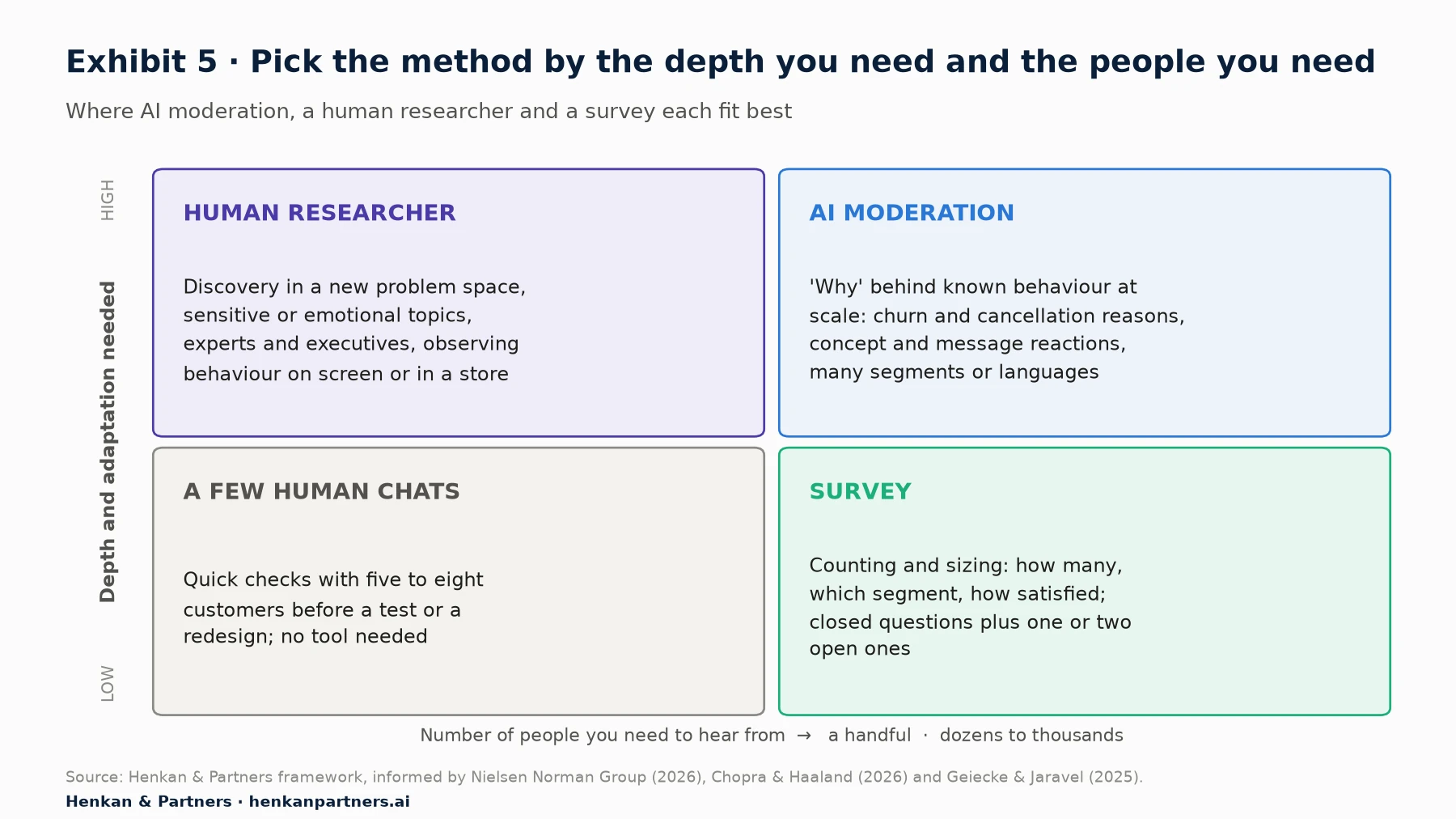
What this shows. AI moderation fills a gap that used to be empty: questions that need follow-ups, asked of more people than a research team can interview. It does not take over the top-left corner, where a researcher's judgement is the point, or the bottom-right one, where a survey is cheaper and easier to count.
| Research situation | Best fit | Why |
|---|---|---|
| Exploring a new market, category or problem you do not yet understand | Human researcher | Needs reframing, unexpected threads and judgement about what matters |
| Understanding why customers cancel a subscription or abandon a basket, across segments | AI moderation | Known topic, many people, follow-ups on reasons; human follow-up for distressed customers |
| Reactions to three concepts, messages or landing pages in five markets | AI moderation | Same stimuli, many languages, comparable answers |
| Post-purchase or post-launch feedback with set questions | AI moderation | Structured guide; NN/g lists product feedback as a good fit |
| Interviews with senior B2B buyers, experts or executives | Human researcher | Domain knowledge, credibility and rapport matter; AI struggles with jargon |
| Watching people use the site, app or product | Human (moderated usability test) | Requires observation of behaviour and screen |
| Measuring satisfaction or the share of customers with a given problem | Survey | Counting needs closed questions and a large sample; see our on-site survey guide |
| Screening participants for a later study | AI moderation | NN/g lists recruitment screening as a good fit |
| Topics involving health, money troubles or complaints | Human researcher | Duty of care and escalation; special-category data under GDPR |
Section 8 · The hybrid model
The hybrid model uses AI for breadth, a consultant for depth and people for synthesis
The most productive use of AI moderation is not as a replacement for a research team but as a new layer between qualitative and quantitative work. We use a five-step loop.
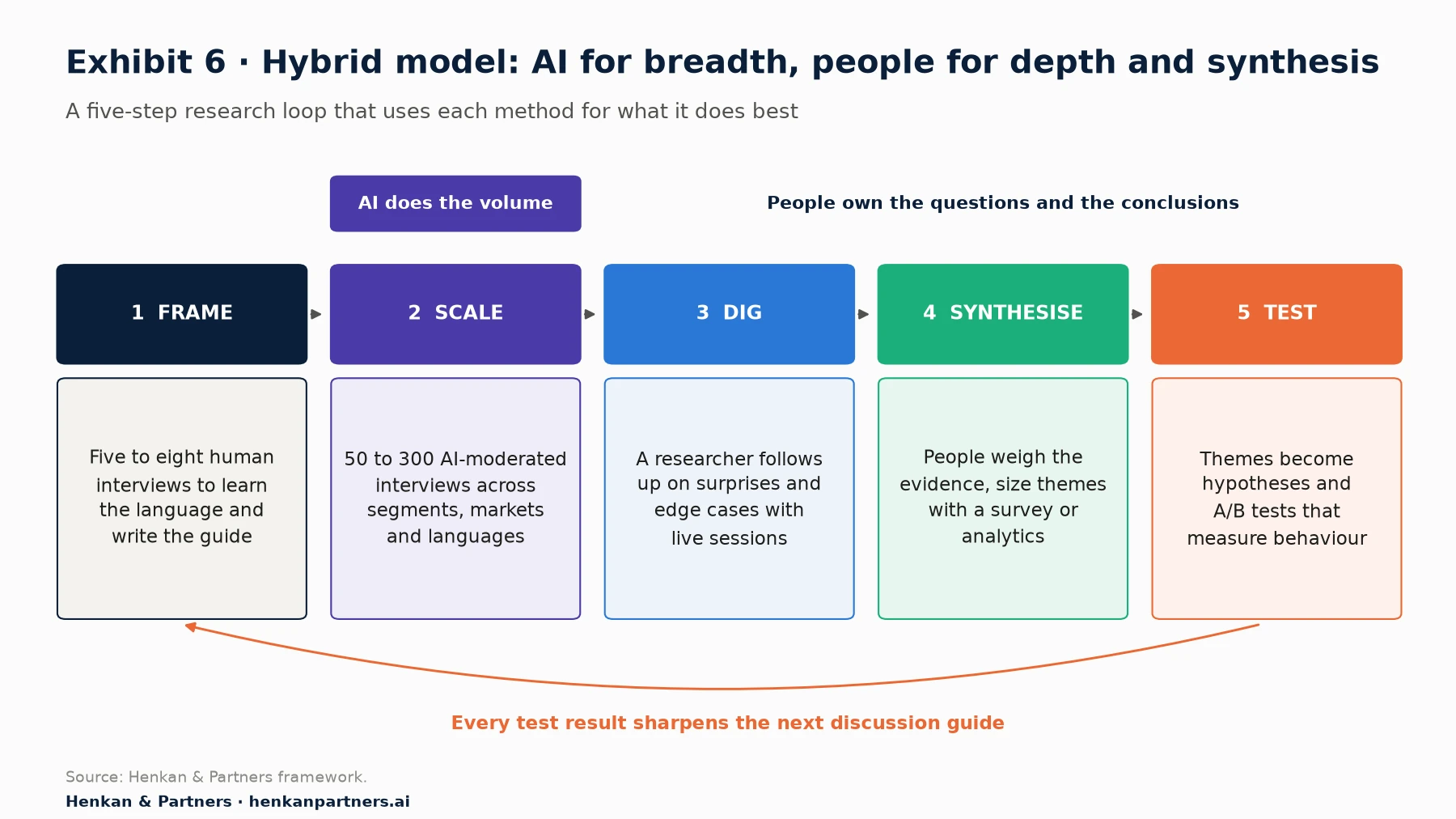
- Frame. Five to eight human interviews teach you the customer's words, surface the themes you did not expect and give you the material for a good guide. Skipping this step is the most common reason AI studies produce bland answers.
- Scale. Run 50 to 300 AI-moderated interviews across the segments, markets and languages that matter. Aim for at least 10 to 15 completed interviews per segment you want to compare, in line with saturation research.
- Dig. A researcher reads the transcripts, picks the surprises, contradictions and edge cases, and follows up live with a handful of those participants (with their consent).
- Synthesise. People decide what the evidence means. Size the main themes with a survey or analytics before you rank them; our guide on turning customer insight into a test backlog explains the method.
- Test. Turn themes into hypotheses and A/B tests that measure behaviour. Interviews tell you what people say and why; only an experiment tells you what a change does to conversion and revenue.
For marketers. The hybrid model gives you numbers you can defend (to take an illustrative example, '31 of 120 customers raised delivery cost unprompted') and the quotes that make them memorable, in weeks rather than a quarter.
For leaders. Do not measure an AI research tool by cost per interview. Measure it by how many decisions now get customer evidence that did not before, and by how many of the resulting tests win.
Section 9 · Designing the guide
An AI moderator needs a tighter guide than a human one
A human moderator fills the gaps in a loose guide with judgement. An AI fills them with generic probes and praise. The guide has to carry more of the method.
- State the research goal and the decision. One paragraph the AI can read: what you need to learn and what you will do with it. Maze and UserTesting both use this context to focus follow-ups.
- Write a verbatim introduction. Who is running the study, that the interviewer is an AI, how the recording is used and kept, how long it takes, and that the participant can skip any question.
- Ask about past behaviour, not intentions. 'Tell me about the last time you…' gives better data than 'Would you…?'. This rule matters more with an AI, which will not notice when an answer is hypothetical.
- Write probing rules per question. For each question: when to probe (answer under two sentences, a mention of price, a competitor, a problem), how many times at most, and when to move on.
- Ban leading and praise. Tell the AI not to suggest answers, not to judge, and to acknowledge neutrally ('Thanks, that's clear') instead of praising.
- Ask the AI to check its understanding. Add a step where it summarises each section and asks the participant to confirm or correct, which NN/g found missing.
- Keep it to 15 to 25 minutes. Six to eight main questions with probes is usually enough. Long guides raise drop-outs and incentive costs.
- Pilot with five people, then read every transcript. Fix questions the AI misread, probes that looped and places where participants hesitated.
Discussion guide skeleton for an AI moderator (Henkan & Partners template)

GOAL: Understand why first-time customers do not place a second order within 90 days. Decision: which retention tests to run next quarter.
INTRO (read verbatim): "Hi, I'm an AI interviewer running this study for [brand]. It takes about 20 minutes. Your answers are recorded and used only for research. You can skip any question."
Q1: Tell me about your first order with us: what were you buying, and why from us?
   PROBE IF: under two sentences, or mentions a competitor. MAX PROBES: 2.
Q2: Since then, when did you last buy something similar, and where?
   PROBE IF: names another retailer → ask what made them choose it. MAX PROBES: 2.
CHECK: Summarise Q1–Q2 in one sentence and ask the participant to confirm or correct.
RULES: one question per turn; no suggested answers; no praise; move on after two probes; if the participant is upset, offer to stop.
Section 10 · Quality assurance
Check the transcripts before you trust the summary
The summary is the most convenient output and the least reliable one. Build quality assurance into every study, on the transcripts themselves.
| Check | What to look for | How | Our starting threshold |
|---|---|---|---|
| Guide adherence | Questions skipped, reordered or reworded | Human review of a sample of transcripts | Read at least 10% of sessions, and all pilot sessions |
| Leading and judging | Suggested answers, praise, opinions | Keyword scan plus human review | Fewer than 1 in 20 AI turns |
| Probing quality | Missed follow-ups on short or important answers; loops | Compare answer length with probes asked | Every answer under two sentences gets a probe |
| Summary accuracy | Claims not supported by the transcript | Check each summary statement against quotes | Zero unsupported claims in the sample |
| Participant validity | Pasted or AI-written text, duplicate people, speeders | Timing, paste detection, voice or video, duplicate checks | Exclude and replace flagged sessions |
| Segment coverage | Groups under-represented or probed less | Count sessions and probes by segment and language | At least 10 completed sessions per segment compared |
| Translation | Meaning lost across languages | Native speaker reviews a sample | Five sessions per language |
Coding and theme counts need the same discipline as any language-model analysis: a codebook, a human-coded validation sample and an agreement score. Our guide to analysing surveys with LLMs describes the method step by step.
Section 11 · Cost
Illustrative cost: the saving grows with volume, but design and synthesis do not shrink
Vendor pricing is rarely public and varies by contract, so we built an illustrative model with transparent assumptions. Researcher time is valued at €100 an hour. A human interview lasts 45 minutes and uses 2.75 hours of researcher time in total (moderation, scheduling, notes and analysis), with a €55 incentive, in line with the $80 an hour that User Interviews recommends for remote consumer interviews (User Interviews, 2025). An AI interview lasts 20 minutes, with a €20 incentive, €30 of platform cost and 0.35 hours of human quality checks and analysis. Recruitment costs €40 per participant in both cases. Fixed design and synthesis time is 24 hours for a human study and 28 hours for an AI study, because the AI guide needs more work.
| Study design | Completed interviews | Total cost | Cost per interview |
|---|---|---|---|
| Human-moderated | 12 | €6,840 | €570 |
| AI-moderated | 12 | €4,300 | €358 |
| AI-moderated | 100 | €15,300 | €153 |
| Human-moderated | 100 | €39,400 | €394 |
| Hybrid (6 human + 100 AI, shared synthesis) | 106 | €19,120 | €180 |
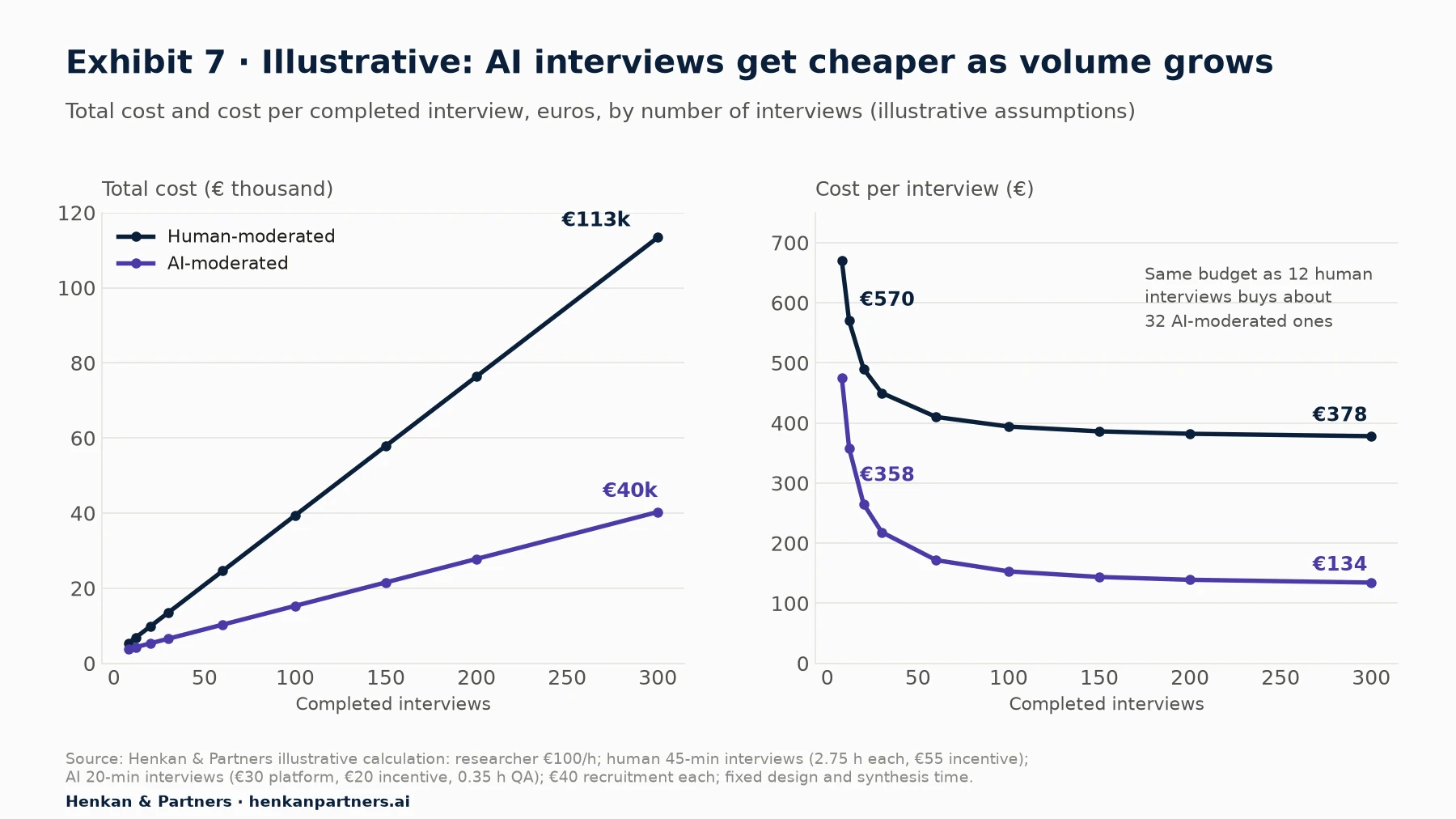
What this shows. At equal volume, the AI study costs about 40% less at 12 interviews and about 60% less at 100, because researcher time per session falls from 2.75 hours to about 20 minutes. But the comparison that matters is rarely 12 against 12. The budget of 12 human interviews buys about 32 AI-moderated ones, and the hybrid design (six human interviews plus 100 AI-moderated ones) costs about €19,000, roughly half of 100 human interviews. Fixed costs do not fall: someone still has to design the study and decide what it means.
Section 12 · Mistakes
Seven mistakes that waste an AI-moderated study
- Starting with the tool instead of the question. If you cannot name the decision the study will inform, a hundred interviews will produce a hundred pages of nothing.
- Skipping the human framing interviews. Without them, the guide uses your vocabulary, not the customer's, and the AI probes in the wrong places.
- Using it for discovery in an unknown space. NN/g is explicit: early discovery and studies where every path differs still need a human.
- Trusting the auto-summary. Read transcripts, check quotes and count themes against a codebook before anything reaches a slide.
- Treating interview counts as survey statistics. 'Forty per cent of interviewees mentioned price' is a signal, not a population estimate. Size it with a survey or analytics.
- Forgetting the disclosure and the data contract. In the EU, telling people they are talking to an AI is a legal duty, and recordings are personal data.
- Stopping at insight. Interview themes are hypotheses. The value comes when they become A/B tests; see our list of common A/B testing mistakes to keep those tests honest.
Section 13 · What to do next
What to do next
1. Pick one structured question that has been waiting for evidence
Good first candidates are cancellation reasons, post-purchase feedback, or reactions to two or three concepts. Write the decision it will inform in one sentence.
2. Run a side-by-side pilot
Interview six customers yourself and run 20 to 30 AI-moderated sessions on the same guide. Compare themes, depth and surprises. This is the evidence your organisation needs, more than any vendor case study.
3. Settle disclosure and data protection once
Agree a standard AI introduction, a processor contract template, retention periods and a rule on emotion analysis with your data protection officer, so every later study starts compliant.
4. Build quality checks into the workflow
Adopt the checks in Table 4, assign a reviewer per study, and record what the AI got wrong to improve the next guide.
5. Connect the research to your tests
Henkan & Partners helps e-commerce teams design hybrid research programmes, set up and audit AI-moderated studies, and turn the results into prioritised A/B tests. Talk to us.
FAQ
Frequently asked questions about AI-moderated interviews
Frequently asked questions
What is an AI-moderated interview?
It is a one-to-one research session in which a real participant answers questions asked by an AI interviewer, by text, voice or video. The AI follows a researcher's discussion guide, asks follow-up questions based on the answers, and produces a transcript and summary.
Are AI-moderated interviews the same as synthetic users?
No. In an AI-moderated interview the participant is a real person and only the interviewer is automated. With synthetic users, a language model plays the customer and the answers are simulated. AI-moderated interviews produce real customer evidence; synthetic users produce hypotheses to check.
Are AI interviewers as good as human researchers?
On structured, opinion-type topics, published studies find them close to an average human interviewer: blind expert graders rated AI voice interviews 3.4 against 3.6 for face-to-face human ones on a 1–5 scale. Skilled researchers remain better at discovery, rapport and following unexpected threads, and Nielsen Norman Group found current tools cannot yet run semi-structured interviews.
Do participants accept being interviewed by an AI?
In two academic studies, 53% and 43% of participants said they would prefer an AI interviewer next time, against 21% and 19% who preferred a human. Experienced research professionals tested by Nielsen Norman Group were more critical: only 3 of 10 found the conversation natural.
When should I not use an AI moderator?
For early discovery in an unfamiliar problem space, interviews with experts or executives, studies that require observing behaviour or physical context, and sensitive topics such as health, money troubles or distressed customers. Use a human researcher for these.
Do I have to tell participants they are talking to an AI?
In the EU, yes. Since 2 August 2026, Article 50 of the AI Act requires AI systems that interact with people to inform them they are interacting with an AI, at the latest at the first interaction, unless it is obvious. Any emotion recognition must also be disclosed, and it is banned in workplace and education settings except for medical or safety reasons.
How many AI-moderated interviews do I need?
Saturation research suggests 9 to 17 interviews usually surface the main themes in a homogeneous group. With AI moderation, aim for at least 10 to 15 completed interviews in each segment you want to compare, then size the themes with a survey or analytics.
How much do AI-moderated interviews cost compared with human ones?
Vendor pricing varies. In our illustrative model, an AI-moderated interview costs about €358 each at 12 interviews and €153 each at 100, against €570 and €394 for human-moderated interviews. Design and synthesis costs do not fall, so the saving grows with volume.
Key terms
- AI-moderated interview
- A research session in which a real participant answers an AI interviewer. It matters because it adds follow-up questions to research at survey scale.
- AI interviewer (AI moderator)
- The software agent that asks questions, probes and summarises in an AI-moderated interview. It matters because its configuration, not the model alone, decides interview quality.
- Synthetic users
- Language-model personas that simulate customer answers. They matter because they are often confused with AI moderation but produce simulated, not real, evidence.
- Discussion guide
- The script of goals, questions, probes and rules for an interview. It matters more for an AI, which cannot fill gaps with judgement.
- Probe (follow-up question)
- A question that asks a participant to expand or clarify an answer. It matters because probing is what separates an interview from a survey.
- Semi-structured interview
- An interview with a guide but freedom to reorder, skip and follow new threads. It matters because current AI interviewers handle structured interviews better than semi-structured ones.
- Asynchronous interview
- An interview the participant completes at a time of their choosing, without a live moderator. It matters because it removes scheduling and enables scale.
- Sycophancy
- The tendency of language models to praise or agree with the user. It matters because excessive praise can bias participants' later answers.
- Saturation
- The point at which new interviews stop producing new themes. It matters because it sets how many interviews each segment needs.
- Social-desirability bias
- Participants' tendency to give answers they think will be judged favourably. It matters because removing a human observer can reduce it.
- Article 50 (AI Act)
- The EU AI Act's transparency article, which requires people to be told when they interact with an AI system. It matters because it applies to AI interviewers in the EU since 2 August 2026.
- Emotion recognition system
- An AI system that infers emotions from voice, face or other biometric data. It matters because the AI Act requires disclosure and bans it in workplace and education settings.
- Processor contract (GDPR Article 28)
- The contract between a data controller and a vendor processing personal data on its behalf. It matters because recordings and transcripts are personal data.
- Hybrid research model
- A design that combines human interviews for depth, AI moderation for breadth and A/B tests for measurement. It matters because each method covers the others' blind spots.
Sources
All sources were checked in October 2026. Vendor descriptions, funding figures and customer claims come from company announcements and trade press and are vendor data. The academic studies used online panels of US adults (Chopra & Haaland; Geiecke & Jaravel), students (Wuttke et al.) or research professionals (Nielsen Norman Group) and mostly non-commerce topics. Exhibits 1, 5 and 6 and Tables 1, 3 and 4 are Henkan & Partners frameworks; Exhibit 7 and Table 5 are illustrative calculations.
- Rosala, M. (2026). AI-Moderated Interviews: If, When, and How to Use Them. Nielsen Norman Group, 30 January 2026.
- Geiecke, F. & Jaravel, X. (2024, revised 2026). Conversations at Scale: Robust AI-led Interviews. SSRN 4974382; conference version (July 2025).
- Chopra, F. & Haaland, I. (2023, revised 2026). Conducting Qualitative Interviews with AI. CESifo Working Paper No. 10666.
- Wuttke, A., Aßenmacher, M., Klamm, C., Lang, M. M., Würschinger, Q. & Kreuter, F. (2024). AI Conversational Interviewing: Transforming Surveys with LLMs as Adaptive Interviewers. arXiv 2410.01824.
- Xiao, Z., Zhou, M. X., Liao, Q. V., Mark, G., Chi, C., Chen, W. & Yang, H. (2020). Tell Me About Yourself: Using an AI-Powered Chatbot to Conduct Conversational Surveys with Open-ended Questions. ACM Transactions on Computer-Human Interaction.
- Lucas, G. M., Gratch, J., King, A. & Morency, L.-P. (2014). It's only a computer: Virtual humans increase willingness to disclose. Computers in Human Behavior, 37.
- Hennink, M. & Kaiser, B. N. (2022). Sample sizes for saturation in qualitative research: A systematic review of empirical tests. Social Science & Medicine, 292, 114523.
- Veselovsky, V., Horta Ribeiro, M. & West, R. (2023). Artificial Artificial Artificial Intelligence: Crowd Workers Widely Use Large Language Models for Text Production Tasks. arXiv 2306.07899.
- Regulation (EU) 2024/1689 (Artificial Intelligence Act), Article 50 and Article 5.
- FEDIL (2026). AI Act update: enforcement begins as the Digital Omnibus reshapes the timeline.
- Regulation (EU) 2016/679 (General Data Protection Regulation), Articles 6, 9, 13, 28 and Chapter V.
- User Interviews (2025). Research Incentives Report.
- Research Live: Series A funding for AI-moderated research startup Outset (July 2025); Strella secures $14m investment (October 2025); Listen Labs raises $69m (January 2026); Conveo secures $50m funding (September 2026).
- MrWeb Daily Research News: Outset Series B (December 2025); Voxpopme upgrades AI Moderator (September 2025). Outset, Series B announcement.
- Maze (2025). Introducing Maze's AI moderator. UserTesting (2026). AI Moderation.