Market Report
The AI Search Visibility Market, 2023–2026: GEO Tools, Funding, Deals and Where Value Goes Next
Alexandre Suon · 2026-09-28
AI visibility tools, also sold as GEO tools or LLM tracking tools, measure how often ChatGPT, Google AI Overviews and AI Mode, Perplexity and other assistants name and cite a brand. In under three years the AI search market has produced a unicorn, more than $500M of venture funding, a $1.9B acquisition and dozens of trackers. This report maps the segments, the verified rounds and deals, how the tools measure, what they cost, and where we expect value to move next.
Executive summary
- A new software category grew out of a new interface. ChatGPT launched on 30 November 2022; Bing added cited AI answers in February 2023; Google moved from its Search Generative Experience (May 2023) to AI Overviews for all US users (May 2024) and AI Mode (May 2025). ChatGPT grew from 100 million weekly users in November 2023 to 900 million in February 2026, and brands started asking what these answers say about them.
- Four kinds of company now sell AI visibility. AI-native trackers such as Profound, Peec AI, Otterly.AI and AthenaHQ; SEO suites such as Semrush, Ahrefs, Similarweb, Conductor, BrightEdge, seoClarity and Botify; data providers such as DataForSEO that sell answers and mentions by the call; and agencies that turn the numbers into changes.
- Venture money arrived fast and concentrated in one leader. We verified more than $500M of disclosed rounds for AI visibility start-ups between August 2024 and September 2026. Profound alone raised $334.5M in five rounds and was valued at $1.8B in September 2026. Peec AI reached $10M of annual recurring revenue (ARR) 16 months after launch.
- The first exits went to platforms, not to the stock market. Adobe agreed to buy Semrush for about $1.9B in November 2025 and closed in April 2026. HubSpot bought XFunnel (October 2025) and Sitecore bought Scrunch (June 2026, reported at about $225M). Revenues are still small: Semrush's AI products reached $38M of ARR at the end of 2025.
- The numbers are estimates, not facts. AI answers change from run to run. SparkToro found under a 1 in 100 chance that ChatGPT or Google's AI gives the same list of brands twice; an April 2026 study recommends at least seven runs per prompt per day. Buyers should judge tools on sampling method first and dashboard second.
- Value is moving from tracking to action and to the platforms. Google and Microsoft now give free AI citation and impression reports, OpenAI now shows ads in ChatGPT in several countries, and trackers are adding agents that rewrite content. We expect monitoring to commoditise and value to concentrate in tools that change what the engines see, sit inside a content or commerce workflow, or own proprietary data.
Section 1 · The basics
AI visibility tools measure how often AI answers name and cite you, a job rank trackers were not built for
AI visibility tools (also called GEO tools, AEO tools or LLM tracking tools) are software that repeatedly asks AI assistants and AI search engines a defined set of questions, records the answers, and reports how often a brand is mentioned, how it is described, which web pages are cited as sources and how this compares with competitors.
Classic SEO software answers one question: where does my page rank for a keyword? AI answers work differently. The assistant writes a paragraph, names a few brands and cites a handful of sources. What matters is whether you are in the answer at all, how you are described and who is cited next to you.
The discipline of improving that presence is called generative engine optimization (GEO), a term coined in a 2023 paper by researchers at Princeton and IIT Delhi and presented at KDD 2024. Vendors also use answer engine optimization (AEO) and AI search optimisation. Our guide to generative engine optimization covers the practice. This report covers the market for the tools and services that support it.
Almost every tool in this market works the same way at its core. It builds a prompt panel, a list of questions a buyer might ask ("best running shoes for flat feet", "is brand X good for sensitive skin"). It sends those prompts to several engines, through an API or by simulating a user in a browser, on a schedule. It parses each answer for brand names, sentiment and citations. Then it aggregates the results into a few metrics.
| Metric | What it counts | Why it matters | Main weakness |
|---|---|---|---|
| Mention rate or visibility | Share of answers on your prompt panel that name your brand | The closest thing to a ranking in AI answers | Depends entirely on which prompts you choose |
| Share of voice | Your mentions as a share of all brand mentions in the category | Shows position against named competitors | Moves with the competitor list you define |
| Citations | How often your URLs are linked as sources | Citations are what drive clicks and can be influenced by content | Different engines cite very differently |
| Position | Where your brand appears in a list inside the answer | Earlier mentions are more prominent | Highly unstable between runs (Section 7) |
| Sentiment and accuracy | Whether the answer describes you positively and correctly | Catches errors about prices, features or policies | Automated scoring of tone is itself a model's judgement |
| AI referrals and bot visits | Sessions from AI assistants and visits from AI crawlers | Links visibility to traffic and revenue | Needs analytics or server logs, not just prompts |
Section 2 · The shift
Three years of launches turned AI answers into a front door to search, and created the demand for tracking
The market exists because the interface changed. Each launch below moved more questions from a list of links to a written answer, and each one widened the gap between what rank trackers could see and what customers actually read.
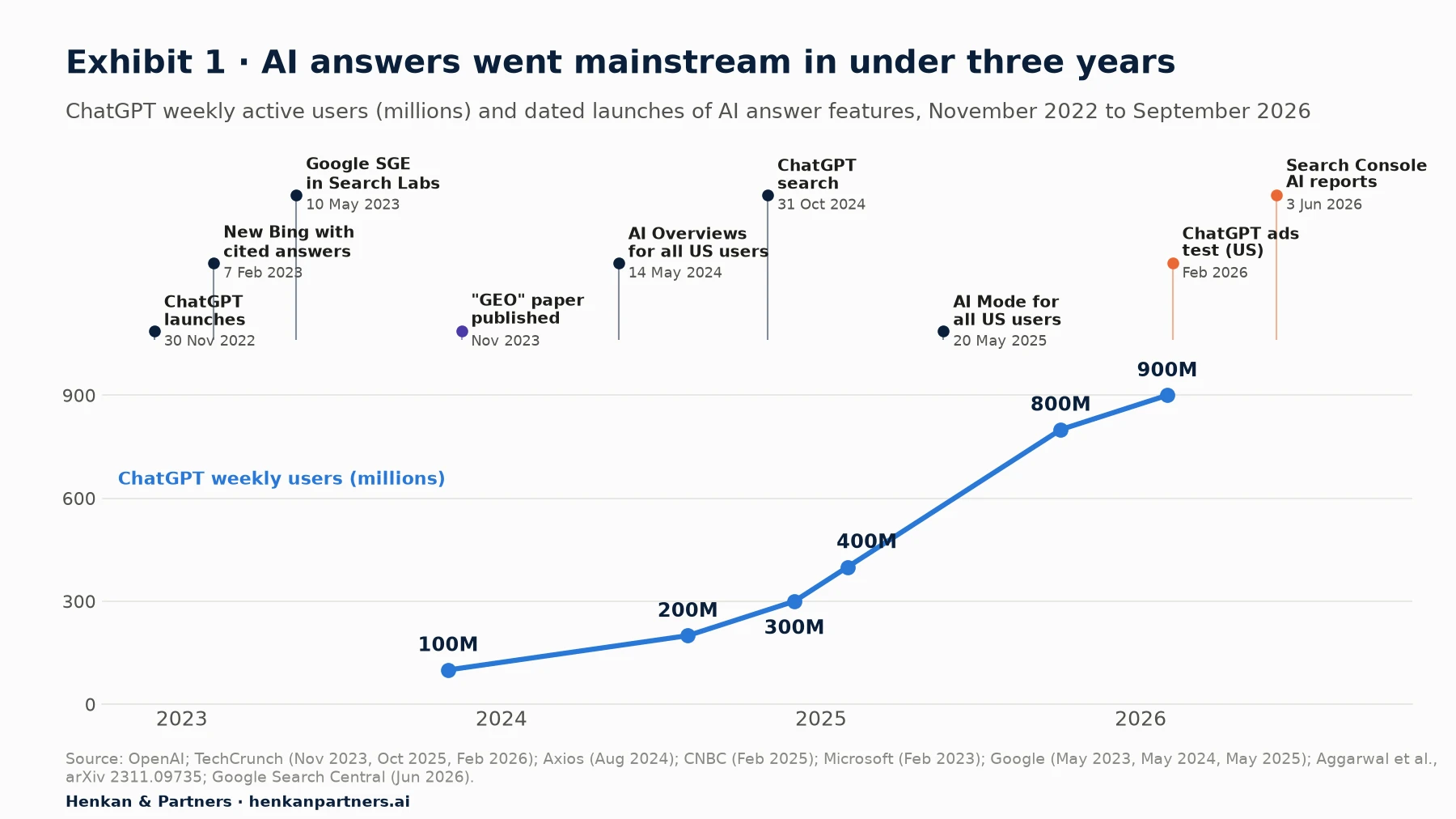
What this shows. Usage grew ninefold in just over two years while every major search provider shipped an AI answer layer: first as experiments in 2023, then as the default for US Google users and in ChatGPT between May 2024 and May 2025. The orange markers show the newest phase, in which platforms monetise and measure the answer layer themselves.
- 30 November 2022. OpenAI released ChatGPT as a research preview.
- 7 February 2023. Microsoft launched the new Bing and Edge with a chat mode that "cites all its sources".
- 10 May 2023. Google opened its Search Generative Experience (SGE) in Search Labs, in English in the US.
- 14 May 2024. Google rolled out AI Overviews to all US users and said it expected to reach more than one billion people by the end of 2024.
- 31 October 2024. OpenAI launched ChatGPT search, with links to sources; it reached all users in supported regions in February 2025.
- 20 May 2025. Google rolled out AI Mode to everyone in the US after a Labs test earlier that year. Google said AI Overviews drove over 10% more usage for the queries that show them in the US and India. On its July 2026 earnings call, Alphabet said AI Mode had passed one billion monthly users.
- June 2025. Perplexity's chief executive said the service handled 780 million queries in May 2025, growing about 20% a month, compared with 3,000 on its first day in 2022.
Gartner predicted in February 2024 that traditional search engine volume would drop 25% by 2026. McKinsey reported in October 2025 that half of US consumers already use AI-powered search and that brands' traditional search traffic could fall by 20% to 50%. It also found that only 16% of brands systematically tracked their AI search performance, from a small survey of about 30 chief marketing officers. That gap is the market this report describes. For the wider effect on traffic and channel mix, see our guide to acquisition and retention channels.
Section 3 · The segments
Four kinds of company sell AI visibility, and the lines between them are already blurring
The AI visibility market looks crowded because companies arrived from four directions, each bringing different data and a different buyer.
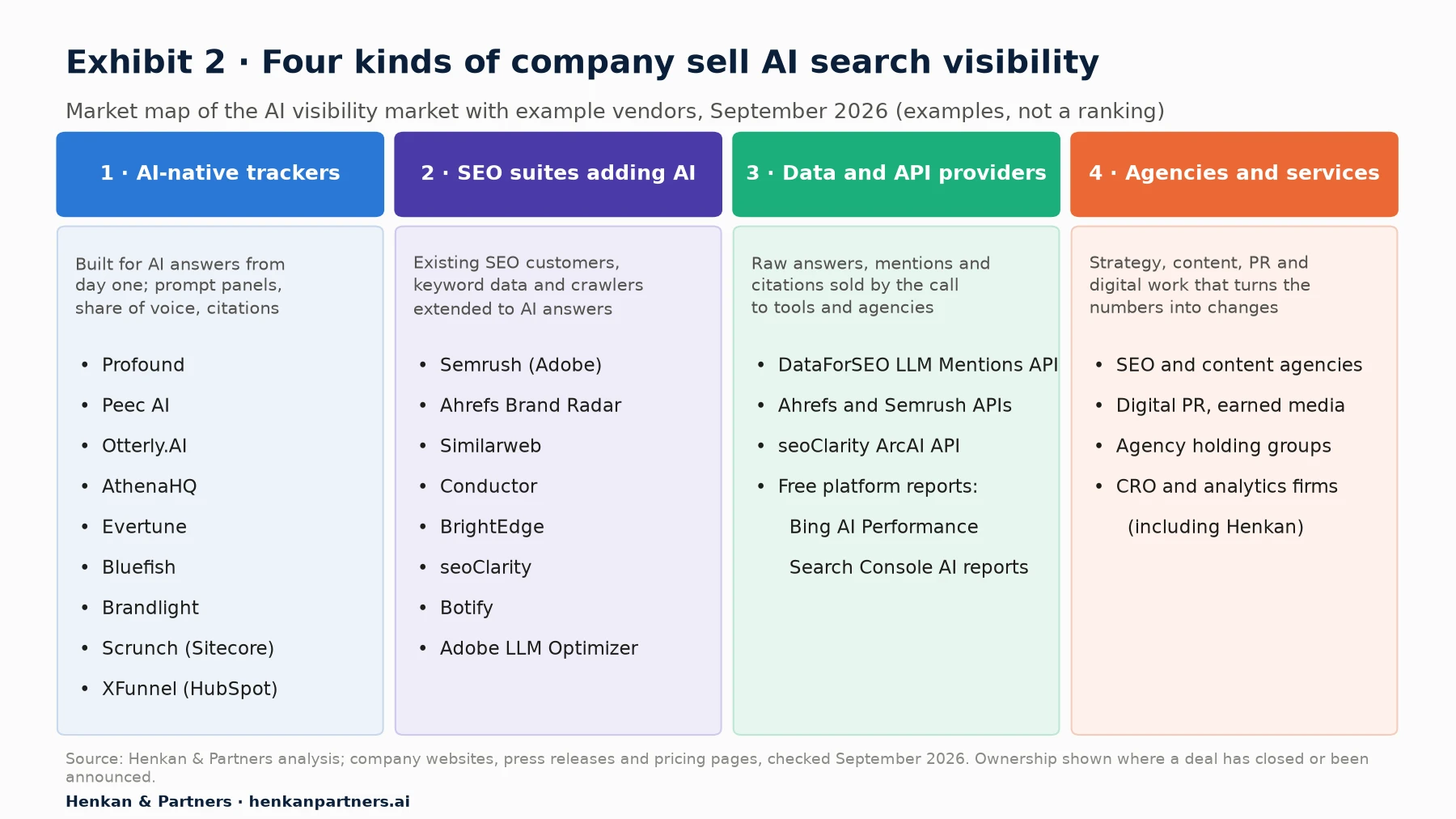
What this shows. AI-native trackers move fastest but have no historical search data. SEO suites own customer relationships and keyword databases. Data providers sell the raw material to everyone else. Agencies are paid for changes, not dashboards. Two of the nine AI-native names in the first column have already been bought.
Disclosure: Henkan & Partners sells SEO and GEO services, so we sit in segment 4. We use DataForSEO data, including its LLM Mentions API, in our own SEO and GEO work. We have no commercial relationship with the other vendors named in this report.
Section 4 · Market size
Analysts size GEO at under $1B today; disclosed revenues confirm the software is still small
No reliable census of AI visibility spending exists yet. The published estimates below come from market-research firms whose methods are not public. Treat them as orders of magnitude, not facts.
| Source | What it measures | Estimate |
|---|---|---|
| MarketsandMarkets | Generative engine optimization market: tracking platforms, AI content tools, schema and entity tools, analytics and services | $390M in 2025, rising to $4.25B by 2032 (41% a year) |
| Valuates Reports (July 2025) | GEO services market | $886M in 2024, rising to $7.32B by 2031 (34% a year) |
| McKinsey (October 2025) | Not a market size: US consumer revenue that will pass through AI-powered search | $750B by 2028 |
Company disclosures give a firmer, if partial, picture. Semrush, a listed company until Adobe bought it, reported $443.6M of revenue for 2025 and $471.4M of ARR, of which its AI products accounted for more than $38M, up from $4M a year earlier. Peec AI announced $4M of ARR in November 2025 and $10M in May 2026. Promptwatch, an Amsterdam start-up, said it reached €2M of ARR within 12 months of its April 2025 launch. Profound, the best-funded player, has not disclosed revenue.
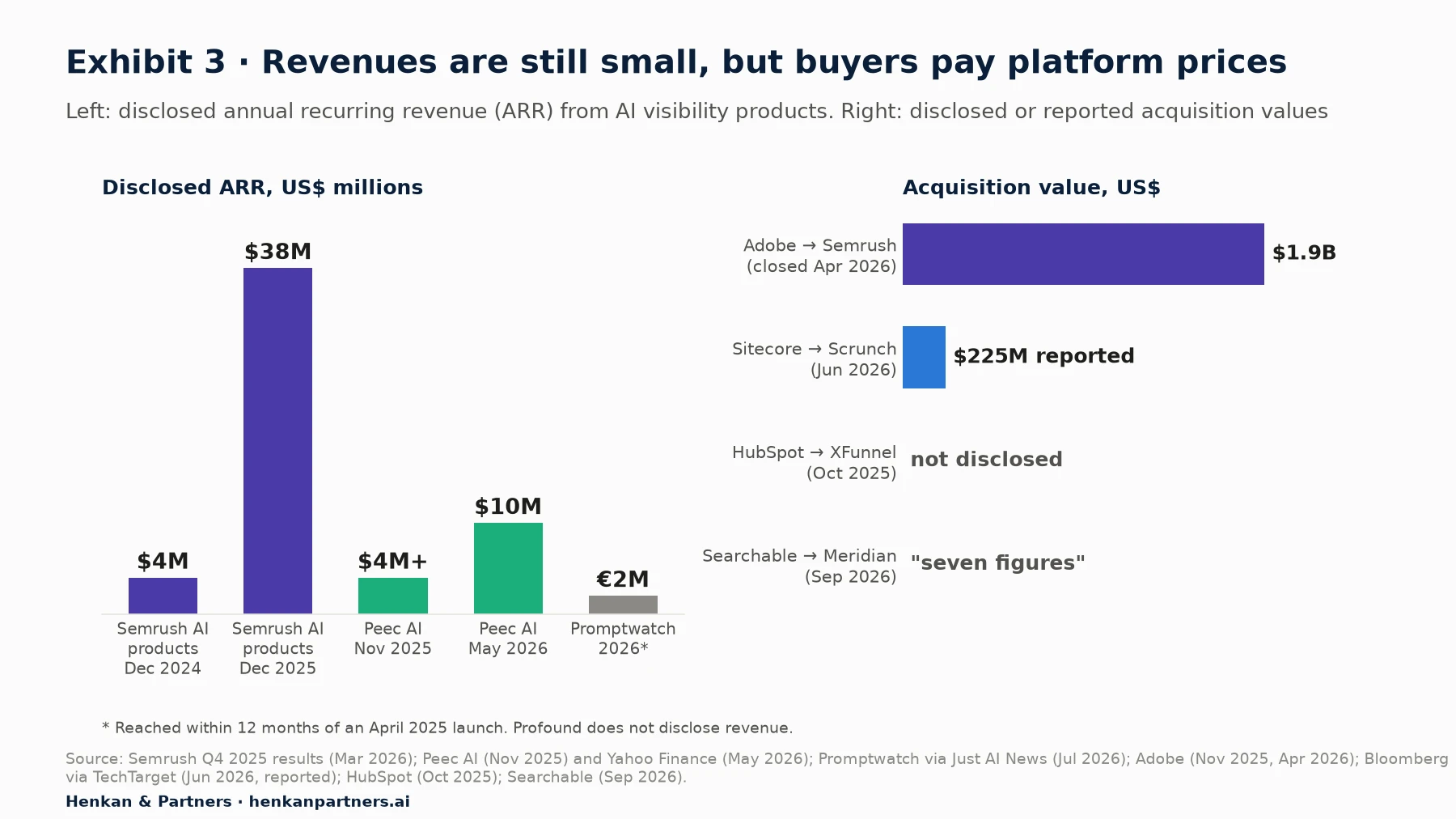
What this shows. The largest AI visibility revenue line we could verify, Semrush's, is under $40M, roughly a tenth of the lowest analyst estimate of the market. Yet buyers have paid up to $1.9B for companies that sell it. The gap tells you that acquirers are paying for distribution, data and a position in the next interface, not for today's AI revenue.
For marketing leaders. Budget for AI visibility as measurement plus content work, funded from the SEO line rather than a new silo.
For investors. Market-size reports are not a basis for valuation here. Anchor on disclosed ARR, growth, net revenue retention and the share of customers who would keep paying if Google or OpenAI gave the same numbers away.
Section 5 · 2023–2026
The market moved from academic idea to funded category in three waves
Wave 1, 2023 to mid-2024: the idea and the first start-ups
In 2023 AI answers were experiments and GEO was an academic term. The Princeton and IIT Delhi paper appeared in November 2023 and showed that adding statistics, quotations and cited sources to a page raised its visibility in generated answers. Scrunch was founded in 2023 by Chris Andrew. Profound, founded by James Cadwallader and Dylan Babbs, announced a $3.5M seed round led by Khosla Ventures in August 2024, three months after AI Overviews reached all US users.
Wave 2, 2025: the SEO suites respond
Once AI Overviews were in front of every US searcher, the incumbents moved. Most of the major SEO platforms launched an AI visibility product within about eight months:
| Date | Vendor | Launch | What it covers (as announced) |
|---|---|---|---|
| 6 Mar 2025 | Semrush | AI Optimization (AIO) for Semrush Enterprise | Brand mentions, accuracy and messaging in ChatGPT, Perplexity, Claude, Gemini and DeepSeek |
| 9 Apr 2025 | BrightEdge | AI Catalyst | Visibility across AI Overviews, ChatGPT, Perplexity, Gemini and Claude |
| Apr 2025 | Ahrefs | Brand Radar (beta, on all paid plans) | Brand mentions in AI answers against competitors; now an AI Visibility Index of 449M+ prompts |
| Jun 2025 | seoClarity | Clarity ArcAI | Now tracks nine engines including AI Mode and AI Overviews; version 3.0 (April 2026) adds an MCP server |
| 28 Jul 2025 | Similarweb | GenAI Intelligence toolkit | AI brand visibility plus AI referral traffic across ChatGPT, Gemini, Perplexity, Grok and Copilot |
| 14 Oct 2025 | Adobe | LLM Optimizer (general availability) | AI traffic measurement, content gaps and fixes for AI chat services and browsers |
| 22 Oct 2025 | Botify | AI Visibility (beta) | AI Mode, ChatGPT and Perplexity, linked to Botify's automation |
| 11 Nov 2025 | DataForSEO | LLM Mentions API | Mentions and citations from Google AI Overviews and ChatGPT, sold per request |
| 20 Apr 2026 | Conductor | AgentStack | Agents, APIs and an MCP server for answer engine optimization, with apps inside ChatGPT, Claude and Copilot |
Semrush also launched a self-serve AI Visibility Toolkit at $99 a month, and the ARR of its AI products grew from $4M to more than $38M during 2025. Meanwhile the AI-native players found their buyers. Peec AI, founded in Berlin's Antler programme, launched in February 2025. Profound introduced a $499-a-month self-serve plan, Profound Lite, alongside its June 2025 Series A.
Wave 3, mid-2025 to 2026: the funding boom and the first consolidation
From June 2025 the category attracted top-tier venture capital, and from October 2025 the first acquisitions followed (Section 6). By September 2026 the market had one company valued at $1.8B, several Series A companies, new seed rounds in Europe and the US, and a first deal between two AI-native start-ups.
The pattern echoes the A/B testing tool market and the digital analytics market: a new interface creates specialists, the suites respond within a year or two, and most specialists end up inside larger platforms. This market is running the same script, faster.
Section 6 · Funding and M&A
Venture money concentrated in one leader, and the first exits went to platform buyers
We only include rounds confirmed by a company press release or a named news report. Several frequently repeated figures could not be confirmed and are left out.
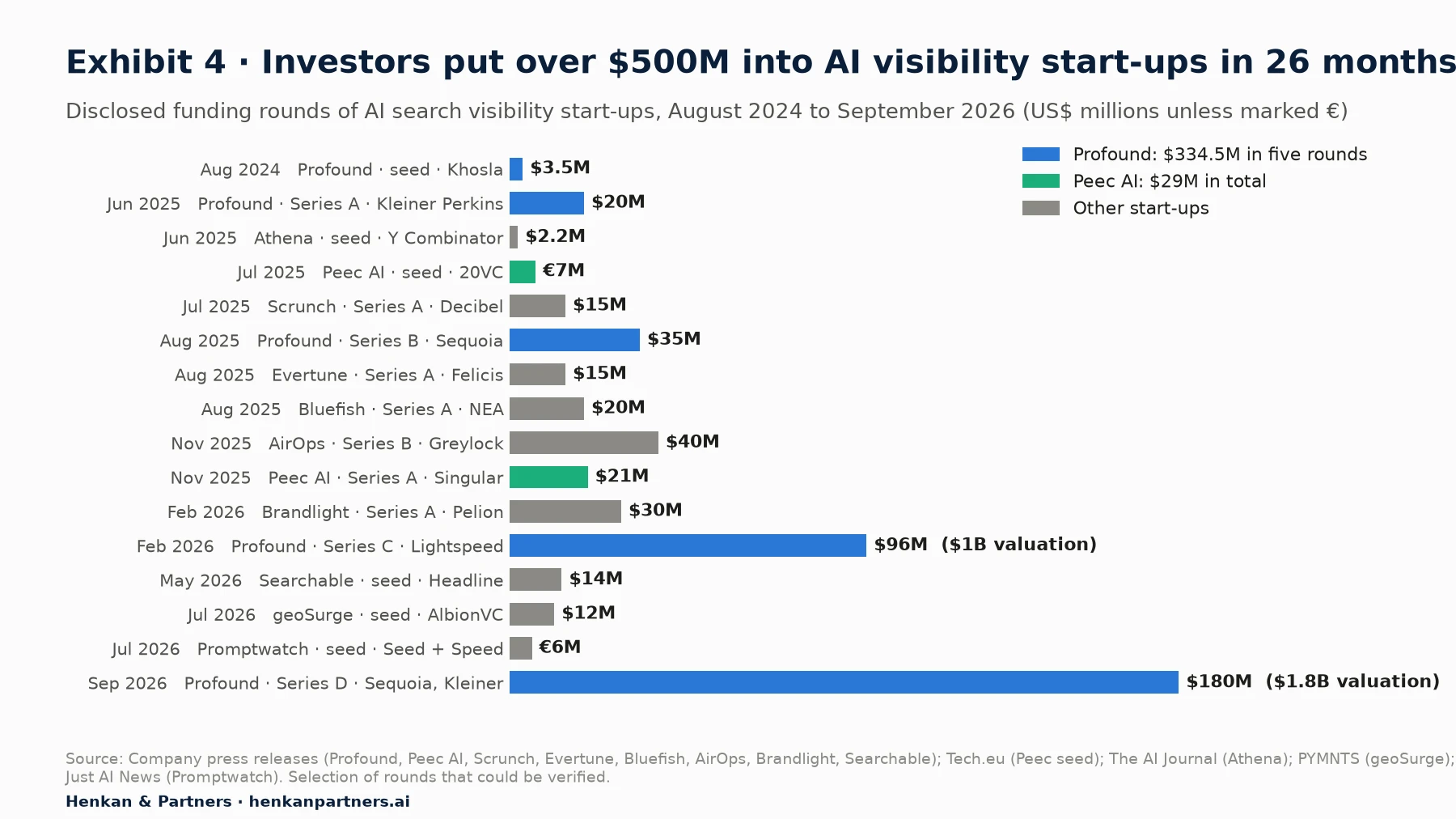
What this shows. The sixteen rounds add up to about $504M plus €13M. Profound took two-thirds of it: its Series D came seven months after its Series C and valued the company 80% higher. Below the leader, rounds cluster between $12M and $40M.
The leader: Profound
Profound's Series A included NVIDIA's venture arm, NVentures, and its Series D was co-led by its earlier leads, Sequoia and Kleiner Perkins. By its own account it serves more than 1,000 enterprise brands, including a third of the Fortune 100. Its product has moved from monitoring towards an "AI Marketer" agent platform and an Ads Studio for AI search campaigns.
The challengers
| Company | Round | Lead investor | Note (company-reported) |
|---|---|---|---|
| Peec AI (Berlin) | €7M seed (Jul 2025); $21M Series A (Nov 2025) | 20VC; Singular | $10M ARR and 2,500+ customers by May 2026; entry plan €89 a month |
| Bluefish | $20M Series A (Aug 2025) | NEA, with Salesforce Ventures | $24M raised in total; over 80% of customers in the Fortune 500 |
| Evertune | $15M Series A (Aug 2025) | Felicis | Runs 100,000+ prompts per report through model APIs |
| Scrunch | $15M Series A (Jul 2025) | Decibel | $19M raised; bought by Sitecore in June 2026 |
| Brandlight | $30M Series A (Feb 2026) | Pelion Venture Partners | Founded October 2024; positions on AI visibility and AI-native ads |
| AirOps | $40M Series B (Nov 2025) | Greylock | Content engineering for AI search rather than pure tracking |
| Athena (AthenaHQ) | $2.2M seed (Jun 2025) | Y Combinator and others | Co-founded by a former Google Search engineer |
| Searchable (London, New York) | $14M seed (May 2026) | Headline | $85M valuation; bought Meridian in September 2026 |
| geoSurge | $12M seed (Jul 2026) | AlbionVC | Monitoring plus "corpus engineering" |
| Promptwatch (Amsterdam) | €6M seed (Jul 2026) | Seed + Speed Ventures | €2M ARR within 12 months; 1,800+ brands and agencies |
Mergers and acquisitions
| Announced | Acquirer | Target | Value | Status and rationale |
|---|---|---|---|---|
| 31 Oct 2025 | HubSpot | XFunnel | Not disclosed | AI visibility inside HubSpot's marketing products |
| 19 Nov 2025 | Adobe | Semrush | About $1.9B, $12.00 a share, all cash | Completed 28 April 2026; combined with Adobe Experience Manager and LLM Optimizer for SEO, GEO and "agentic search optimisation" |
| 3 Jun 2026 | Sitecore | Scrunch | Not disclosed; Bloomberg reported about $225M | Scrunch's monitoring and Agent Experience Platform to be built into SitecoreAI |
| 21 Sep 2026 | Searchable | Meridian | "Seven figures" | One of the first deals between two AI-native start-ups |
Adobe's deal sets the tone. At announcement Semrush was growing enterprise ARR 33% a year, and Adobe framed the purchase around "brand visibility" across owned channels, LLMs, traditional search and the wider web. Sitecore and HubSpot followed the same logic: a content or CRM platform buys AI visibility so that insight turns into action inside its own product. None of the AI-native companies has gone public.
Our view. The buyers so far are digital experience and marketing platforms (Adobe, Sitecore, HubSpot). The logical next buyers are the remaining SEO suites, customer experience platforms and possibly advertising technology companies, as AI answers start to carry ads. Watch for private-equity roll-ups of the smaller trackers, which is how the personalisation market consolidated.
Section 7 · How the tools measure
LLM tracking tools sample answers that change on every run, so their numbers are estimates with wide error bars
A rank tracker checks a result page that is fairly stable from hour to hour. An AI visibility tool samples a system that is non-deterministic: ask the same question twice and you often get a different answer. The answer also varies with the model version, the user's location, their chat history and whether the tool uses the public interface or the developer API. Two independent studies put numbers on the problem.
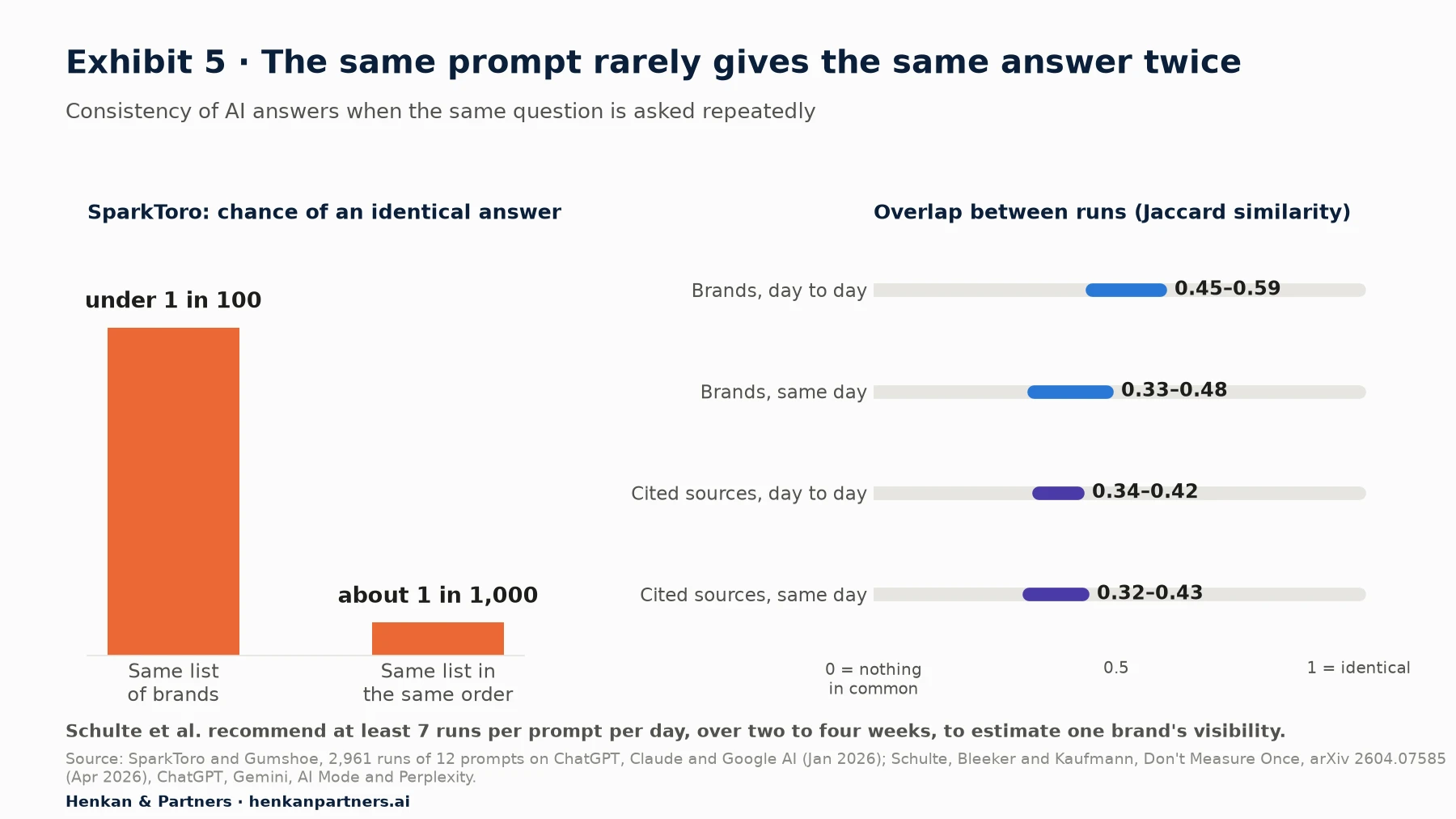
What this shows. Exact answers almost never repeat, and even the set of brands and sources overlaps by only about a third to a half between runs. A single check, or a weekly screenshot, tells you almost nothing. Visibility has to be measured as a frequency across many runs, with a confidence interval, and trends need weeks of data before they mean anything.
- SparkToro and Gumshoe (January 2026). 600 volunteers ran 12 prompts 2,961 times. Brands in narrow categories appeared in 90% to 100% of runs; in broad categories, 30% to 40%. The authors advise buyers to ignore "ranking position" and to measure visibility across 60 to 100 or more runs.
- Schulte, Bleeker and Kaufmann (April 2026). They tracked four engines across four industries for about 45 days, and derived the minimum of seven runs per prompt per day.
- Citations are not always right. The Tow Center at Columbia Journalism Review tested eight AI search tools on 1,600 queries in 2025: they gave incorrect answers about the source of news articles more than 60% of the time, from 37% for Perplexity to 94% for Grok 3. A cited URL is not proof that the engine used, or correctly represented, your page.
These findings do not make the tools useless; they define how to use them. A tool that runs a large prompt panel many times and shows sample sizes and confidence intervals is measuring something real. A tool that reports "you rank #2 in ChatGPT" from one run is not. As in experimentation, statistical rigour is becoming a buying criterion.
For marketers. Before reporting an AI visibility number, ask the vendor how many runs sit behind it and what the margin of error is. If they cannot answer, report the monthly trend.
For leaders. Do not set targets on AI share of voice without at least a month of baseline data, or you will reward noise.
Section 8 · How to choose
Choose generative engine optimization tools on method, coverage and what you will do with the data, not on the dashboard
Most AI visibility tools look alike in a demo. The differences that matter are underneath. Start with price, which ranges widely for similar-looking products.
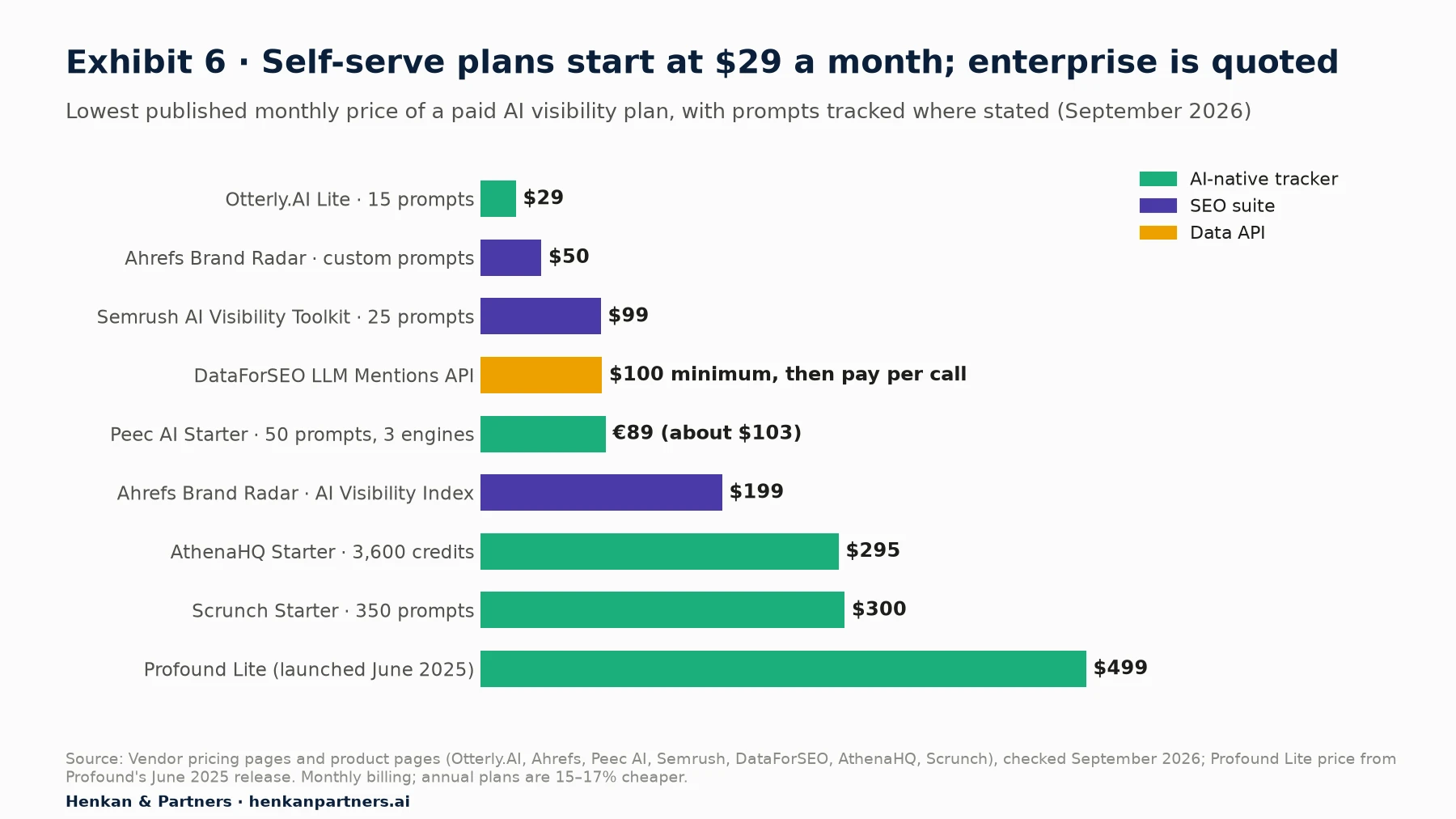
What this shows. Self-serve plans cost from $29 to about $500 a month, and the unit of value differs: prompts, credits, engines or API calls. A 15-prompt plan is enough to learn; it is not enough to measure a category with the precision Section 7 describes. Enterprise plans from Profound, Peec AI, Scrunch, Bluefish, Evertune and the suites are quoted individually.
| Criterion | What to ask | Why it matters |
|---|---|---|
| Sampling method | How many runs per prompt, how often, through the API or the consumer interface, with which locations and personas? | Determines whether the numbers are signal or noise (Section 7) |
| Engine coverage | Which engines are included in your plan, and which cost extra? Is Google AI Mode covered, not just AI Overviews? | Many entry plans track three or four engines; shoppers use more |
| Prompt panel quality | Who writes the prompts? Are they linked to real search demand? Can you segment by market, language and funnel stage? | Visibility is only as meaningful as the questions asked |
| Citations and sources | Does it show which pages and third-party sites are cited, for you and for competitors? | Sources tell you what to fix or whom to pitch |
| Link to outcomes | Can it connect visibility to AI referral traffic, conversions and revenue in your analytics? | Without it, you cannot prove value |
| Data access | Is there an export, an API or an MCP server so your own analysts and AI agents can use the data? | Avoids lock-in and lets you combine sources |
| Action layer | Does it recommend or make changes, and can you control and audit what agents do? | This is where the market is moving (Section 10) |
| Vendor durability | Who owns the vendor, how much has it raised, and what happens to your data if it is acquired? | Two AI-native trackers were bought within a year |
Match the tool to the team
- Small teams and single brands. Start with a low-cost tracker or the AI module of the SEO suite you already pay for, plus the free Bing and Google reports.
- E-commerce and multi-market brands. You need many prompts across categories, markets and languages, and a link to revenue. In our experience, that usually means a mid-market tracker (such as Peec AI, Otterly.AI, AthenaHQ or Scrunch) or an enterprise plan. Test two tools on the same prompt panel for a month before signing.
- Enterprises and agencies. Consider an enterprise tracker plus raw data from an API such as DataForSEO, so that your analysts can build their own panels, check the vendor's numbers and feed internal dashboards and AI agents.
For how AI visibility fits with the rest of an e-commerce optimisation programme, see our guide to AI search optimisation for e-commerce.
Section 9 · The investor view
Investors are betting on workflow and data ownership; commoditisation and platform risk are the threats
For investors, the question is not whether AI answers matter; they plainly do. It is whether a stand-alone company can keep the value it creates when the underlying data is easy to collect and the platforms that produce the answers can measure them for free.
Where moats can form
- Proprietary demand data. The hard part is not running prompts; it is knowing which prompts real people ask and how often. Suites with keyword and clickstream databases (Semrush, Ahrefs, Similarweb) and trackers that build prompt-volume estimates (Profound markets "Prompt Volumes") have an edge.
- Workflow ownership. A tool that is used every day to brief, write, publish and fix content is harder to remove than a dashboard checked monthly. This is the logic behind Adobe, Sitecore and HubSpot buying rather than building.
- Enterprise distribution and credibility. Large customer lists buy time, and vendors that publish their methods and error rates can win the trust of analysts and finance teams.
Risks investors will price in
- Commoditisation. Raw mentions and citations already cost fractions of a cent per row through APIs, dozens of trackers offer similar dashboards, and entry prices start at $29 a month.
- Platform risk. Microsoft launched a free AI Performance report in Bing Webmaster Tools in February 2026, showing citations in Copilot and Bing AI answers. Google added generative AI performance reports to Search Console in June 2026, showing impressions in AI Overviews and AI Mode, though without clicks or queries. Each step makes first-party data cheaper and third-party estimates less unique.
- Access risk. Many tools rely on querying consumer interfaces or APIs whose terms, rate limits and outputs the platforms control. A change in access can break a product overnight.
- Advertising. OpenAI announced in January 2026 that it would test ads in ChatGPT and began in the US in February; by August 2026 ads had reached further markets. OpenAI says ads do not influence answers. Paid placement next to answers could pull budget from "organic" AI visibility work, or turn visibility tools into ad-buying tools, as Profound's Ads Studio and Brandlight's AI-native ads positioning suggest.
- Proof of return. Most published results are vendor case studies. Until buyers can link AI visibility to incremental revenue, spending is exposed in a downturn.
What to check in due diligence
- Net revenue retention and churn by customer size, and the share of revenue from monitoring versus action features.
- Methodology and unit costs: runs per prompt, reliance on consumer interfaces versus APIs, cost per tracked prompt.
- Platform exposure and proprietary data: what breaks if one engine blocks access, and what data competitors cannot buy.
For investors. Treat pure monitoring as a feature that will be bundled. Underwrite companies whose value survives a free Google or OpenAI report: those that own demand data, sit inside a content or commerce workflow, or are credible acquisition targets for a suite.
Section 10 · Where value goes next
Value is moving from measuring AI answers to changing them, and towards the platforms that sell inside them
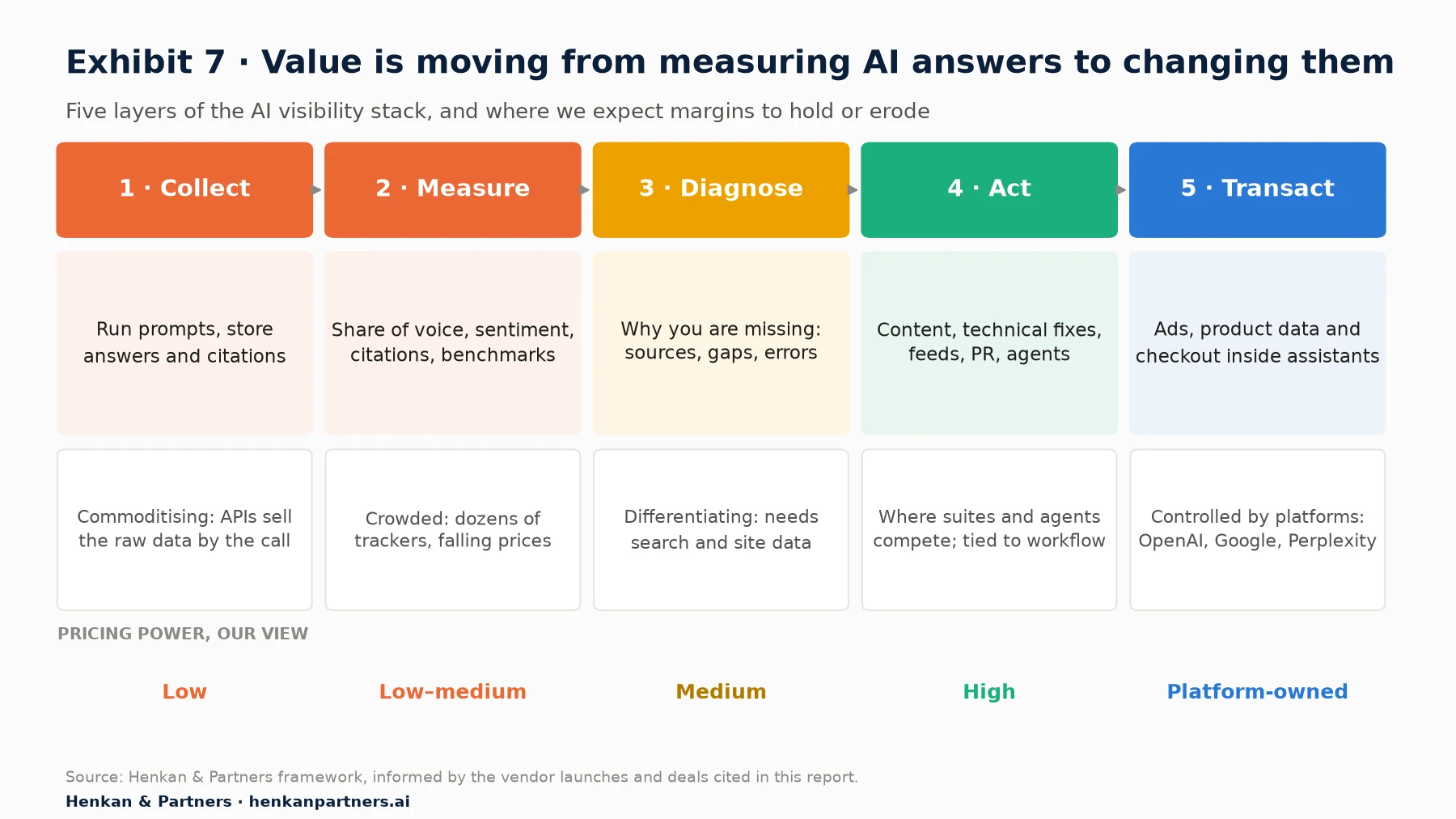
What this shows. Most tools started in the first two layers, where prices are falling. Value is shifting towards diagnosing why a brand is missing and changing the content, data and sources engines use. The final layer belongs to the platforms, and every other layer will have to plug into it.
1. From tracking to action
The 2026 product launches are about acting, not measuring. Profound launched an "AI Marketer" agent platform with its Series D. Conductor's AgentStack offers agents, APIs and an MCP server (Model Context Protocol, the open standard that lets AI assistants call outside tools and data). seoClarity's ArcAI 3.0 added an MCP server and agentic content workflows. Otterly.AI includes MCP access on its mid-tier plan. Scrunch's Agent Experience Platform serves a machine-readable version of a website to AI crawlers. Monitoring data is becoming an input for agents that brief, write and publish, ideally with a human approving each change.
2. Agentic commerce: from being mentioned to being bought
For e-commerce, the next battleground is not the answer but the purchase. OpenAI launched Instant Checkout in ChatGPT in September 2025 with the Agentic Commerce Protocol, then in March 2026 refocused on product discovery, with purchases completed on the merchant's site. Google announced the Universal Commerce Protocol in January 2026 with Shopify, Etsy, Wayfair, Target and Walmart. Perplexity and PayPal launched Instant Buy in November 2025. Product feeds, stock and prices then become the main visibility lever, and tools that fix product data in assistants will matter more than tools that count mentions. Our GEO guide explains what retailers should do now.
3. SEO and GEO merge back into one discipline
Google says there are no extra requirements to appear in AI Overviews or AI Mode beyond being indexed and eligible for a snippet. The skills and data overlap, and the largest acquisition in the market was of an SEO company. We expect "GEO tool" to stop being a separate category within two to three years: search platforms will measure classic and AI results together, and buyers will stop paying twice.
Our view. The durable winners will be platforms that combine demand data, AI answer data and a workflow that changes content and product data, plus a few independents with genuinely proprietary data. Pure monitoring will be priced like rank tracking: useful, cheap and bundled.
Section 11 · What to do next
Five steps to buy and use AI visibility tools well
1. Take a baseline before you buy
Write 50 to 100 buyer questions across your main categories and markets and run them on the main engines for two weeks, by hand or with a low-cost plan. You will learn what you need before a vendor tells you.
2. Switch on the free platform data
Verify your sites in Bing Webmaster Tools and use its AI Performance report. Use the generative AI reports in Google Search Console. Set up an AI assistant channel in your analytics so that AI referrals, conversions and revenue are visible, as described in our digital analytics market report.
3. Trial two tools on the same prompt panel
Run the same prompts for a month in two tools, ideally an AI-native tracker and your SEO suite's AI module. Compare the numbers, the variance and the sources, and ask each vendor the questions in Exhibit F.
4. Budget for action, not only for dashboards
Plan at least as much for content, product data, technical fixes and digital PR as for tracking. Visibility moves when the sources engines rely on change, not when you watch them more often.
5. Review the stack every year
Recheck ownership, pricing and platform features once a year, and keep your prompt panel and data exportable so that you can switch. Want help setting a baseline or choosing tools? Talk to us.
FAQ
Frequently asked questions about the AI search visibility market
Frequently asked questions
What is the AI search visibility market?
It is the market for software and services that measure and improve how brands appear in answers from AI assistants and AI search engines such as ChatGPT, Google AI Overviews and AI Mode, Perplexity, Gemini, Copilot and Claude. It includes AI-native trackers, SEO suites with AI modules, data providers and agencies. It grew from almost nothing in 2023 to a category with more than $500M of venture funding by 2026.
What are GEO tools?
GEO tools, or generative engine optimization tools, are platforms that track and help improve a brand's presence in AI-generated answers. They send a fixed set of prompts to several AI engines, record which brands and sources appear, and report visibility, share of voice, citations and sentiment. Examples include Profound, Peec AI, Otterly.AI, AthenaHQ, Semrush's AI Visibility Toolkit and Ahrefs Brand Radar.
What are the best AI visibility tools?
There is no single best tool; it depends on your team and budget. Small teams can start with the AI features of the SEO suite they already use or a low-cost tracker. Multi-market e-commerce brands usually need a tracker with many prompts, markets and engines, linked to analytics. Enterprises and agencies often combine an enterprise tracker with raw data from an API. Choose on sampling method, engine coverage and data access before interface.
How much do LLM tracking tools cost?
In September 2026, published entry prices ranged from $29 a month (Otterly.AI Lite, 15 prompts) through $99 (Semrush AI Visibility Toolkit) and €89 (Peec AI Starter) to about $300 (Scrunch Starter). Profound launched a $499-a-month Lite plan in 2025. Enterprise plans are quoted individually. Data providers such as DataForSEO charge per request with a $100 minimum.
How accurate are AI visibility tools?
They are estimates. AI answers change between runs: SparkToro found under a 1 in 100 chance of getting the same list of brands twice, and an April 2026 study found only a third to a half of brands and sources overlap between runs. Numbers become reliable only with many runs per prompt (the study recommends at least seven a day) over several weeks. Ask vendors for sample sizes and margins of error.
Did Adobe buy Semrush?
Yes. Adobe announced on 19 November 2025 that it would buy Semrush for $12.00 a share in cash, about $1.9B, and completed the acquisition on 28 April 2026. Adobe is combining Semrush with its Experience Manager and LLM Optimizer products for SEO and generative engine optimization.
Will Google and OpenAI make AI visibility tools obsolete?
They will make basic monitoring cheaper. Bing Webmaster Tools added a free AI Performance report in February 2026, and Google Search Console added generative AI impression reports in June 2026, though without clicks or queries. Tools that only count mentions face pressure; tools that cover many engines, add demand data or help change content and product data should keep their value.
How big is the AI search market?
Estimates vary. MarketsandMarkets puts the generative engine optimization market at $390M in 2025, rising to $4.25B by 2032; Valuates Reports sizes GEO services at $886M in 2024. These are analyst estimates with undisclosed methods. The largest disclosed AI visibility revenue line we found, Semrush's AI products, was $38M of ARR at the end of 2025.
Key terms
- AI visibility
- How often and how favourably a brand appears in answers from AI assistants and AI search. It matters because these answers increasingly shape which brands buyers consider.
- Generative engine optimization (GEO)
- The practice of making a brand, pages and products more likely to be cited and recommended in AI-generated answers. It matters because it extends SEO to the answer layer.
- Prompt panel
- The fixed set of questions a tool sends to AI engines to measure visibility. It matters because the results depend entirely on which prompts are chosen.
- Share of voice
- Your brand's mentions as a share of all brand mentions across a prompt panel. It matters as the main competitive metric, but moves with the competitor list you define.
- Citation
- A link to a source page shown with an AI answer. It matters because citations drive clicks and point to the pages and sites that shape the answer.
- Non-deterministic output
- The property of AI models that the same input can produce different outputs. It matters because single measurements of AI visibility are unreliable.
- Jaccard similarity
- A measure of overlap between two sets, from 0 (nothing in common) to 1 (identical). It matters because research uses it to show how much AI answers change between runs.
- AI Overviews and AI Mode
- Google's AI summaries at the top of results and its conversational AI search experience. They matter because they bring AI answers to most Google users.
- Annual recurring revenue (ARR)
- The yearly value of a company's subscription contracts. It matters because it is the most comparable measure of size for software companies in this market.
- Model Context Protocol (MCP)
- An open standard that lets AI assistants and agents call outside tools and data. It matters because visibility data exposed through MCP can be used directly by AI agents that act on it.
- Agentic commerce
- Shopping in which an AI assistant finds, compares and sometimes buys products for the user. It matters because product data and checkout protocols then decide which retailers the assistant can sell.
- Platform risk
- The risk that a platform owner changes access, terms or launches a free competing feature. It matters because AI visibility tools depend on engines owned by Google, OpenAI, Microsoft and others.
Sources
All sources were checked in September 2026. Funding rounds, customer counts, ARR and product claims come from the companies themselves or from news reports based on them, and were not independently audited; we treat them as vendor data. Market-size figures in Exhibit B are analyst estimates with undisclosed methods. Figures from SparkToro and Gumshoe are from a volunteer-run study; Schulte et al. is an arXiv preprint. Exhibits 2 and 7 and Exhibits A and F are Henkan & Partners frameworks; the totals in Exhibit 4 and the text are our sums of the rounds shown. Rounds and deals we could not confirm from a primary or named news source were left out. Prices change often. Disclosure: Henkan & Partners sells SEO and GEO services and uses DataForSEO data in its own work.
- OpenAI (2022). Introducing ChatGPT.
- Microsoft (2023). Reinventing search with a new AI-powered Microsoft Bing and Edge.
- Google (2023). Supercharging Search with generative AI.
- Google (2024). Generative AI in Search: let Google do the searching for you.
- Google (2025). AI Mode in Google Search: updates from Google I/O 2025.
- Alphabet (2026). Q2 2026 earnings call: remarks from Sundar Pichai.
- OpenAI (2024). Introducing ChatGPT search.
- TechCrunch (2023). OpenAI's ChatGPT now has 100 million weekly active users.
- Axios (2024). OpenAI says ChatGPT usage has doubled in the last year.
- CNBC (2025). OpenAI tops 400 million users despite DeepSeek's emergence.
- TechCrunch (2025). Sam Altman says ChatGPT has hit 800M weekly active users.
- TechCrunch (2026). ChatGPT reaches 900M weekly active users.
- TechCrunch (2025). Perplexity received 780 million queries last month, CEO says.
- Aggarwal et al. (2024). GEO: Generative Engine Optimization, KDD 2024, arXiv 2311.09735.
- Gartner (2024). Gartner predicts search engine volume will drop 25% by 2026.
- McKinsey (2025). New front door to the internet: winning in the age of AI search.
- MarketsandMarkets (2026). Generative Engine Optimization (GEO) Market. Analyst estimate.
- Valuates Reports via Yahoo Finance (2025). GEO Services Market to hit $7.3B by 2031. Analyst estimate.
- Profound (2024). Profound closes $3.5 million seed round.
- Profound via PR Newswire (2025). Profound raises $20M as brands race from blue links to AI answers.
- Profound via PR Newswire (2025). Profound raises $35M Series B.
- Profound via GlobeNewswire (2026). Profound raises Series C at $1B valuation.
- Profound via GlobeNewswire (2026). Profound raises $180M Series D at $1.8B valuation.
- Tech.eu (2025). Peec AI raises €7M.
- Peec AI (2025). We raised $21M Series A to help brands win in AI search.
- Yahoo Finance (2026). Peec AI hits $10M ARR 16 months after launch.
- Scrunch via PR Newswire (2025). Scrunch AI raises $15 million Series A.
- Evertune (2025). Our $15M Series A raise.
- Bluefish via PR Newswire (2025). Bluefish raises $20M to power AI marketing for the Fortune 500.
- AirOps (2025). We raised $40 million.
- Brandlight via PR Newswire (2026). Brandlight raises $30M.
- The AI Journal (2025). Athena raises $2.2M.
- PYMNTS (2026). geoSurge raises $12 million to help brands secure AI visibility.
- Just AI News (2026). Promptwatch raises €6 million.
- Searchable via PR Newswire (2026). Searchable acquires Meridian in seven-figure deal.
- Adobe (2025). Adobe to acquire Semrush; Adobe (2026). Adobe completes Semrush acquisition.
- Semrush (2026). Fourth quarter and full year 2025 financial results.
- HubSpot (2025). HubSpot to acquire XFunnel.
- Sitecore via PR Newswire (2026). Sitecore acquires Scrunch; TechTarget (2026). Sitecore acquires Scrunch for answer engine optimization.
- Semrush via Business Wire (2025). Semrush Enterprise unveils AI Optimization; Semrush (2026). AI Visibility Toolkit.
- Ahrefs (2025). Brand Radar, Ahrefs certification, and more; Ahrefs (2026). Brand Radar.
- BrightEdge via GlobeNewswire (2025). BrightEdge AI Catalyst.
- seoClarity (2025–2026). seoClarity launches Clarity ArcAI.
- Similarweb (2025). Similarweb launches GenAI Intelligence toolkit.
- Adobe (2025). Adobe delivers LLM Optimizer.
- Botify via Business Wire (2025). Botify launches AI Visibility.
- CMSWire (2026). Conductor builds an AEO stack for AI search visibility.
- DataForSEO (2025). Introducing LLM Mentions API and pricing.
- Otterly.AI (2026). Pricing; Peec AI (2026). Peec AI vs Profound; AthenaHQ (2026). Pricing; Scrunch (2026). Pricing; Profound (2026). Pricing.
- SparkToro (2026). AIs are highly inconsistent when recommending brands or products.
- Schulte, Bleeker and Kaufmann (2026). Don't Measure Once: Measuring Visibility in AI Search (GEO), arXiv 2604.07585.
- Columbia Journalism Review, Tow Center (2025). AI search has a citation problem.
- Search Engine Land (2026). Bing Webmaster Tools officially adds AI Performance report.
- Google Search Central (2026). Introducing Search generative AI performance reports in Search Console; Search Engine Journal (2026). Google now reports AI search impressions.
- OpenAI (2026). Testing ads in ChatGPT; CNBC (2026). OpenAI to begin testing ads on ChatGPT in the U.S..
- OpenAI (2025). Buy it in ChatGPT: Instant Checkout and the Agentic Commerce Protocol; OpenAI (2026). Powering product discovery in ChatGPT.
- Google (2026). New tech and tools for retailers to succeed in an agentic shopping era; PayPal (2025). PayPal and Perplexity launch Instant Buy.
- Google Search Central (2026). AI features and your website.
- Henkan & Partners. The Essential Guide to Generative Engine Optimization, AI Search Optimisation for E-commerce, The A/B Testing Tool Market, 2006–2026, The Digital Analytics Market, 1995–2026, The Personalisation Market, 2000–2026 and E-commerce Acquisition and Retention Channels.