Focus
AI Search Optimisation for E-commerce Brands: How to Get Your Products Found and Recommended by AI Assistants
Alexandre Suon · 2026-09-28
AI search optimisation for e-commerce is the work of making your products the ones that ChatGPT, Google's AI Mode, Gemini, Perplexity, Copilot and Amazon's shopping assistant find, describe correctly and recommend. This deep dive explains how these assistants now handle shopping queries, what product data they read, how to track the traffic and sales they send, and what agentic checkout means for conversion.
Executive summary
- Every major AI assistant now answers shopping questions with product cards built from merchant data. ChatGPT, Google AI Mode and Gemini, Perplexity, Microsoft Copilot and Amazon all show products, prices and reviews inside the answer. Google's Shopping Graph alone holds more than 50 billion listings, 2 billion of them refreshed every hour.
- AI-referred shoppers are still few, but they now convert better than other visitors. Adobe's data on US retail sites shows AI referrals converting 38% worse than other traffic in March 2025 and 60% better in July 2026, with 53% more revenue per visit (vendor data). Salesforce estimates AI and agents influenced $262 billion, or 20%, of global online holiday sales in 2025 (vendor data).
- Assistants recommend what they can read, so product data is the main lever. Complete feeds (Google Merchant Center, the ChatGPT product feed, Microsoft Merchant Center), Product and Offer structured data, server-rendered specifications, reviews, and clear return and shipping policies decide whether a product is eligible and how it is described. Adobe found only 66% of product-page content readable by AI (vendor data).
- Checkout inside the assistant is being tried, and partly abandoned. OpenAI launched Instant Checkout in September 2025 and dropped it in March 2026 to focus on discovery; Google, Microsoft and Perplexity still offer checkout with the merchant as seller of record. New protocols (ACP, UCP, AP2, Web Bot Auth) aim to make agent purchases safe, but volumes are small and standards are still moving.
- Measure four things: named, accurate, visited, bought. Track share of voice on a fixed set of shopping prompts, audit the accuracy of what assistants say, and report AI-referred sessions and revenue in GA4, which added an AI Assistant channel in 2026. Accuracy matters: in one September 2026 test, assistants made costly product or price errors in 14% to 56% of answers (vendor data).
- Start with the feed, the product page and the prompts that matter. Fix data completeness and consistency first, then content and reviews, then agent readiness. Treat agents as a new customer segment for conversion work: machine-readable pages and bot rules that let good agents in are now part of CRO.
Section 1 · The basics
AI search optimisation for e-commerce means being the product an assistant picks, not just the page it cites
AI search optimisation for e-commerce is the practice of making a brand's products more likely to be retrieved, accurately described, recommended and, increasingly, bought through AI assistants such as ChatGPT, Google AI Mode and Gemini, Perplexity, Microsoft Copilot and Amazon's shopping assistant.
If you have read our Essential Guide to Generative Engine Optimization, you know how AI answers are built: the system retrieves pages, grounds a written answer in them and cites a few sources. That guide covers the general mechanics, the research on what gets cited, AI crawler settings and content writing. This deep dive does not repeat it. It focuses on one question that matters to every online retailer and brand: when a shopper asks an assistant what to buy, how do you make sure your product is on the shortlist, described correctly, and easy to buy?
Shopping answers differ from informational answers in three ways. First, they are built from structured product data as much as from web pages: prices, stock, variants, ratings and policies come from merchant feeds and markup. Second, they end in a transaction, so accuracy has a direct cost: a wrong price or an out-of-stock item loses the sale or creates a complaint. Third, the assistant is starting to act, not just advise. Some can now place the order, which turns software agents into a new kind of visitor to your site.
| General GEO (content) | AI search optimisation for products | |
|---|---|---|
| Unit of visibility | A page or passage that is cited | A product that is named, compared and linked |
| Main inputs | Articles, guides, brand mentions | Product feeds, structured data, product pages, reviews, policies |
| Freshness need | Weeks or months | Hours: price and stock change daily |
| Cost of an error | A misattributed fact | A wrong price, a lost sale or a return |
| End point | A click or a citation | A click, or a purchase inside the assistant |
| Owner in the business | SEO and content | E-commerce, merchandising, feed management, SEO and CRO together |
The consequence is organisational. In most retailers we work with, the feed belongs to paid media, structured data to SEO, product copy to merchandising and reviews to CRM. AI assistants read all of it at once, so someone needs to own the whole picture.
Section 2 · The landscape
Every major assistant now shops, but most have stepped back from owning the checkout
In under three years, shopping moved from a side feature to a core use of AI assistants. The timeline below shows the main launches and one important retreat.
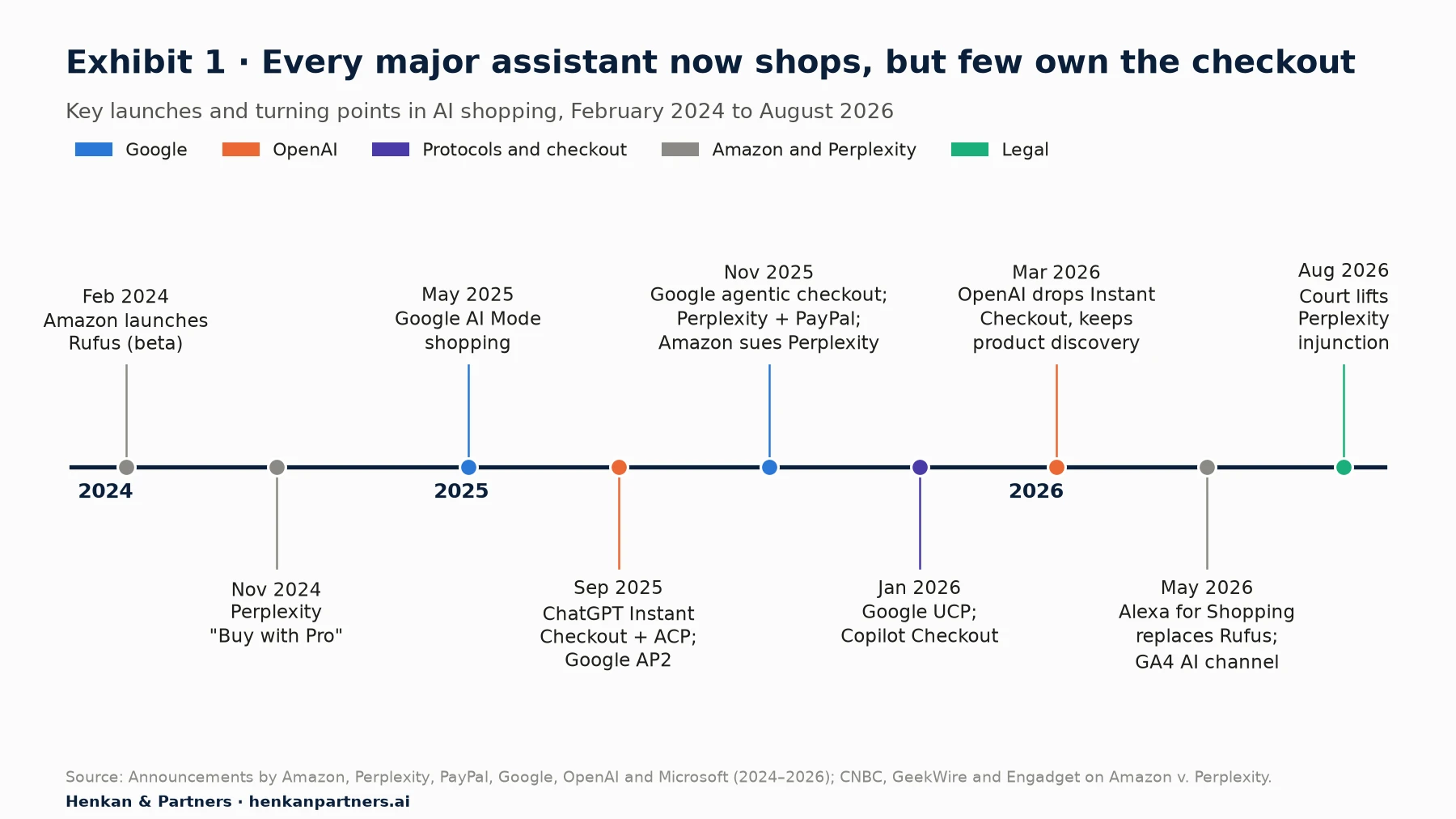
What this shows. The pace has been fast, but the direction is not a straight line. Every major assistant now builds shopping answers from merchant product data. The attempt to keep the whole purchase inside the chat has had mixed results: OpenAI stepped back from its own checkout after six months, while Google, Microsoft and Perplexity continue with the merchant as seller of record. Plan for discovery in AI as a certainty and for in-chat checkout as an option.
ChatGPT shopping: discovery first, checkout on your site
OpenAI launched Instant Checkout and the open-source Agentic Commerce Protocol (ACP), co-developed with Stripe, on 29 September 2025, starting with Etsy sellers and announcing Shopify merchants to follow; merchants paid a fee on completed purchases. In November 2025 OpenAI added shopping research, which asks about budget and needs and returns a buyer's guide with trade-offs.
On 24 March 2026 OpenAI changed course. It said "the initial version of Instant Checkout did not offer the level of flexibility that we aspire to provide", and shoppers now complete purchases on the merchant's own site or app. ACP became the layer for discovery: merchants share product feeds and promotions, directly or through providers such as Salesforce and Stripe. Target, Sephora, Best Buy and Wayfair are among those integrated, Shopify merchants appear automatically through Shopify Catalog, and Walmart runs its own app inside ChatGPT.
Google AI Mode shopping and Gemini: the Shopping Graph plus agentic checkout
Google announced shopping in AI Mode at I/O in May 2025. It runs several searches in parallel to understand a need (Google calls this query fan-out) and draws on the Shopping Graph, which Google says holds more than 50 billion product listings, more than 2 billion of them refreshed every hour. In November 2025 Google brought conversational shopping to AI Mode and the Gemini app in the US, and began rolling out agentic checkout with merchants such as Wayfair, Chewy, Quince and select Shopify stores.
In January 2026 Google announced the Universal Commerce Protocol (UCP), co-developed with Shopify, Etsy, Wayfair, Target and Walmart, plus a Business Agent that answers product questions in a brand's voice on Search, and "dozens of new data attributes" in Merchant Center for conversational commerce. Merchant Center Help says UCP checkout appears on eligible listings in AI Mode and Gemini for products eligible in the US, Canada and Australia, with the merchant remaining seller of record; it is in early access for select merchants.
Perplexity, Microsoft Copilot and Amazon
Perplexity launched "Buy with Pro" for US Pro subscribers in November 2024. In November 2025 it rolled out a free shopping experience to US users and, with PayPal, Instant Buy, where the retailer stays merchant of record. Microsoft launched Copilot Checkout in the US on 8 January 2026 with PayPal, Stripe, Shopify and Etsy; Shopify merchants are enrolled automatically with an opt-out, others apply, and Microsoft Merchant Center feeds help inform results.
Amazon introduced Rufus in beta in February 2024, trained on its catalogue, customer reviews, community Q&A and information from across the web. Amazon says Rufus was used by more than 300 million customers in 2025 and helped deliver nearly $12 billion in incremental annualised sales; its agentic Buy for Me feature can purchase from other online stores. In May 2026 Amazon merged Rufus with Alexa+ into Alexa for Shopping, retiring the Rufus name while the technology continues behind the scenes.
| Assistant | How products get in | Buying in the assistant (September 2026) | What you control |
|---|---|---|---|
| ChatGPT | ACP product feeds, direct or via Shopify, Salesforce, Stripe; web search via OAI-SearchBot | No native checkout since March 2026; purchase on merchant site or merchant app | Feed quality, crawler access, site content |
| Google AI Mode and Gemini | Merchant Center feeds and the Shopping Graph; structured data; web index | Agentic and UCP checkout with Google Pay for eligible merchants; seller of record is the merchant | Merchant Center data, conversational attributes, markup, policies |
| Perplexity | Web retrieval and merchant integrations, including PayPal merchants | Instant Buy with PayPal (US); retailer is merchant of record | Site content, PayPal integration, crawler access |
| Microsoft Copilot | Web (Bing) plus Microsoft Merchant Center; Shopify auto-enrolment | Copilot Checkout (US) via PayPal, Stripe, Shopify, Etsy | Bing indexing, Merchant Center feed, opt-in or opt-out |
| Amazon (Alexa for Shopping) | Amazon catalogue, reviews, Q&A; web for Buy for Me | Native on Amazon; Buy for Me on other sites | Listing content, reviews, Q&A for marketplace sellers |
For marketers. Do not pick one assistant. A complete Merchant Center feed, a ChatGPT-compatible feed and a crawlable, well-marked-up site cover most of the surface.
For leaders. In-chat checkout is not yet a volume channel for most brands. Invest first in being found and described correctly, and keep agent checkout as a tracked option.
Section 3 · The numbers
AI shoppers are still a small channel, but they now convert better than other visitors
Public data on AI shopping comes from analytics vendors and from the platforms themselves. Both have an interest in the story, so read them together.
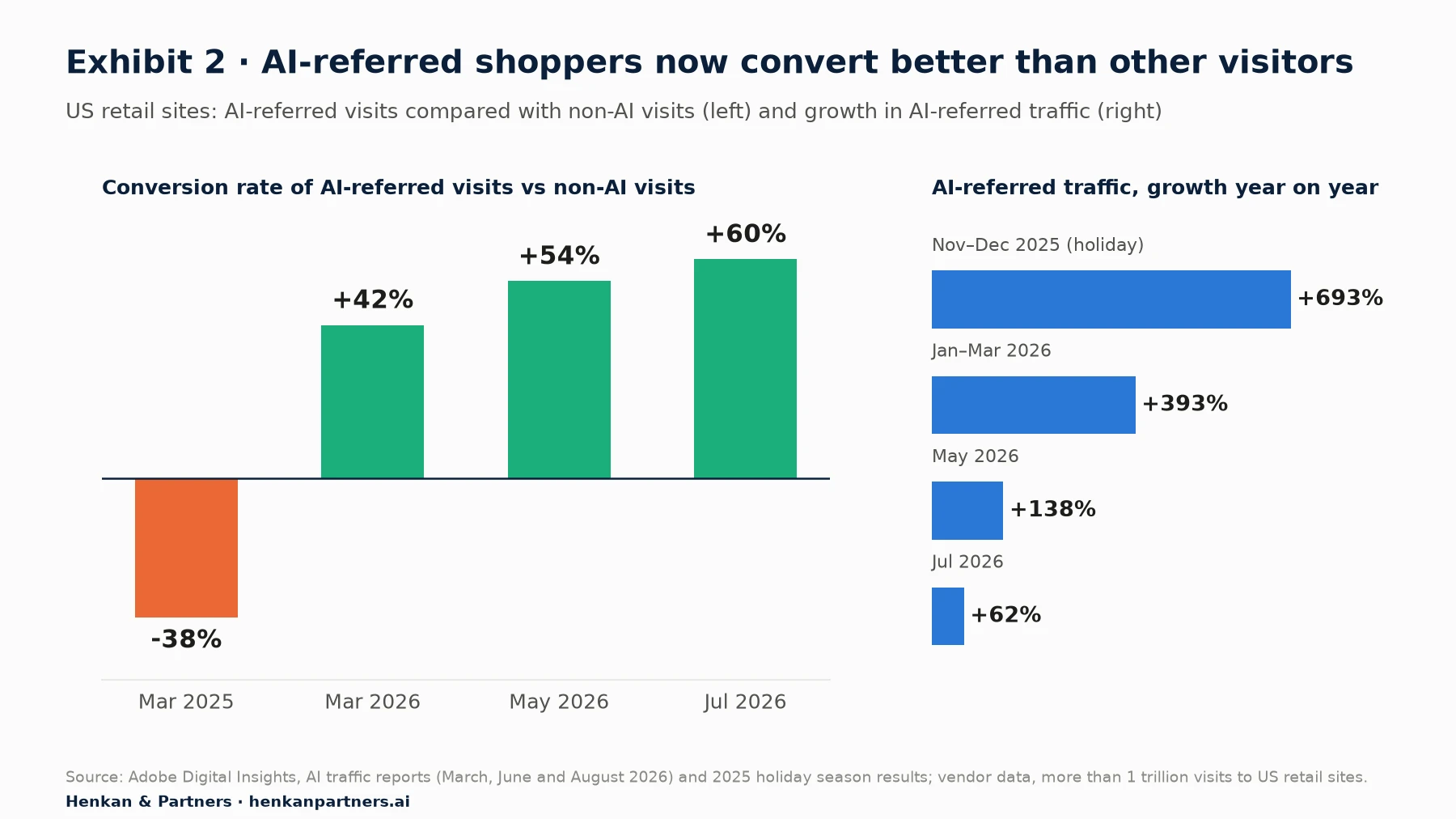
What this shows. In a year, AI referrals went from converting worse than other traffic to converting better, and from being worth less per visit to more: in July 2026 Adobe measured 53% more revenue per visit from AI referrals, against a period a year earlier when non-AI visits were worth 128% more. Growth rates are falling mostly because the base is larger each year. Adobe itself noted during the 2025 holiday season that "the base of users remains modest".
Other data points confirm the direction, with caveats:
- Salesforce (vendor data). Across more than 1.5 billion shoppers, Salesforce estimates that AI and agents influenced $262 billion, or 20%, of global online holiday sales in 2025, out of $1.29 trillion. Shoppers from AI search tools such as ChatGPT and Perplexity converted nine times more often than those from social media. "Influenced" includes on-site chatbots, not only external assistants.
- Amazon (company data). Rufus was used by more than 300 million customers in 2025 and, Amazon says, delivered nearly $12 billion in incremental annualised sales.
- Microsoft (company data). Microsoft says journeys that included Copilot led to 53% more purchases within 30 minutes, and were 194% more likely to end in a purchase when shopping intent was present. These are Microsoft's own attribution figures, published to promote Copilot Checkout.
- Adobe consumer survey (vendor data). Of more than 5,000 US consumers surveyed, 39% said they use AI for online shopping.
- McKinsey forecast. McKinsey estimates that by 2030 agentic commerce could orchestrate up to $1 trillion of US B2C retail revenue and $3 trillion to $5 trillion globally. Treat this as a scenario, not a measurement.
Why do AI-referred shoppers convert well? The most likely reason is selection: people who click through after a conversation have already compared options and narrowed their choice, so they arrive further down the funnel. In our experience, they often skip the category page and land deep on a product page. If that page contradicts what the assistant said about price, stock or delivery, the sale is lost. The e-commerce market equation is a useful way to see why conversion and order value matter as much as the traffic source, and where AI fits among your acquisition and retention channels.
Our view. Two numbers from the same dataset are easy to confuse. AI referrals convert better per visit, but they are still a small share of visits for most retailers. Do not rebuild your acquisition budget around them yet. Do fix the product data and landing pages they depend on, because those fixes also help Google Shopping, marketplaces and your own site search.
Section 4 · Product data
Assistants recommend what they can read: feeds, structured data and policies decide eligibility
An AI shopping answer is assembled from several inputs. Some you control completely, some you influence, and some belong to other people. The diagram below maps them.
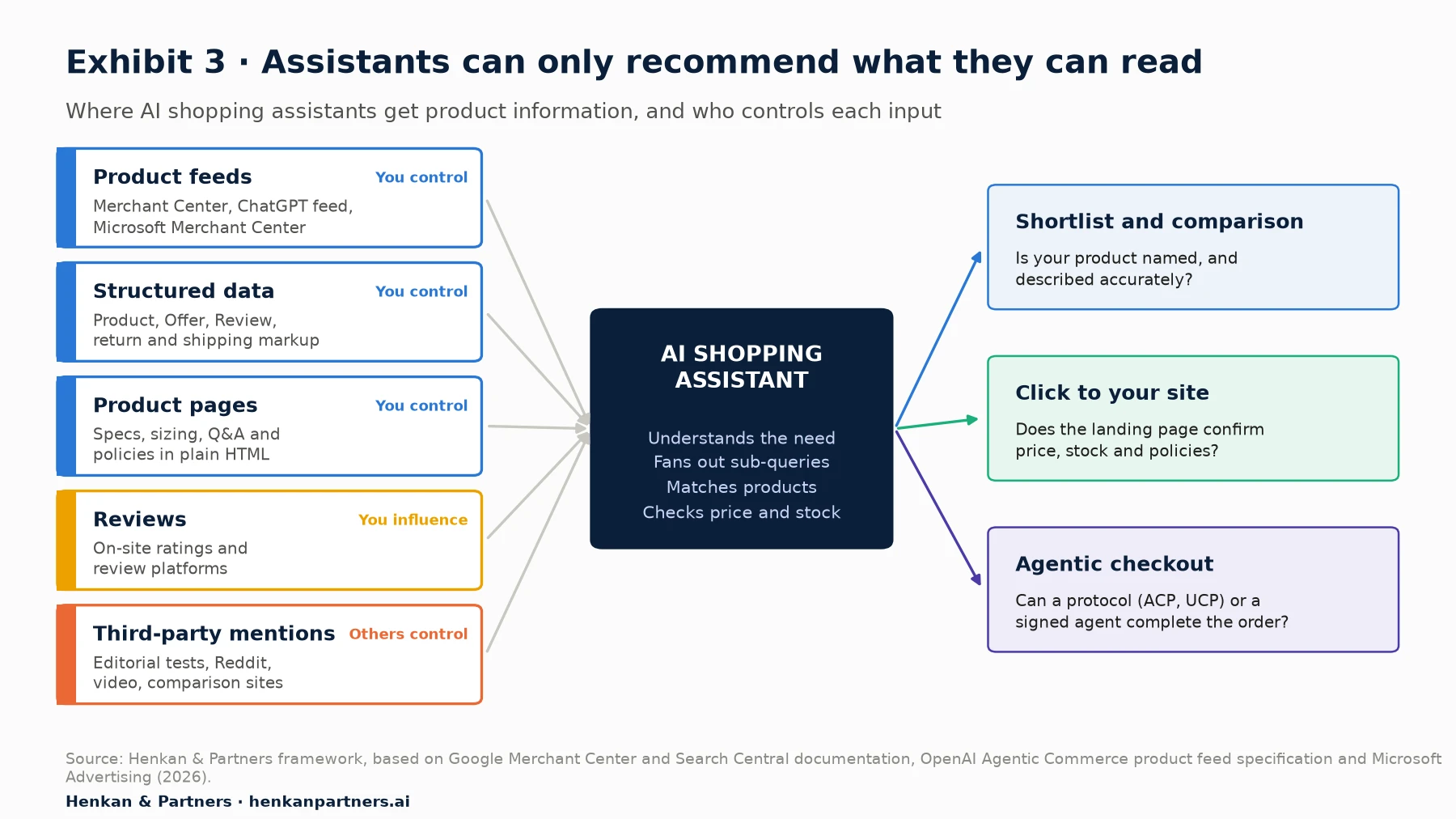
What this shows. Three of the five inputs are fully in your hands, and they are the ones assistants rely on for hard facts: price, stock, variants and policies. Reviews and third-party mentions shape the judgement in the answer: whether your product is "best for" a given need. Start where you have control, and make sure the three controlled sources agree with each other.
Merchant feeds are now the primary interface
Google's and OpenAI's shopping features both take structured feeds. Google Merchant Center feeds the Shopping Graph and, through the new conversational attributes, can now carry product questions and answers, related documents such as PDF manuals, related products (accessories and substitutes), item group titles, variant options and a popularity rank. Google says these help "AI systems and conversational agents better understand your products' specific nuances" on surfaces such as AI Mode.
OpenAI's product feed specification for ChatGPT requires nine fields: `item_id`, `title`, `description`, `url`, `brand`, `seller_name`, `image_url`, `availability` and `price`. Optional fields include aggregate reviews (`review_count`, `star_rating`), returns (`accepts_returns`, `return_deadline_in_days`, `return_policy`) and shipping price. Feeds can be JSONL, CSV or TSV, and the documentation asks merchants to "keep current price and availability up to date" and to update the feed when a sale starts or ends.
Structured data on the page backs up the feed
On your own site, schema.org markup tells machines what a page is about. For products, Google's merchant listing documentation requires `name`, `image` and an `Offer` with `price` and `priceCurrency`, and recommends `availability`, `brand`, `description`, `gtin` or `sku`, `itemCondition`, `aggregateRating`, `review`, `shippingDetails` and `hasMerchantReturnPolicy`. Only pages where a shopper can actually buy the product are eligible. Assistants that browse the web rather than read a feed see the same markup, and, just as importantly, the visible text beside it.
| Information | Google Merchant Center | ChatGPT product feed | On-page (schema.org and HTML) |
|---|---|---|---|
| Identity | id, title, brand, GTIN | item_id, title, brand, seller_name | Product name, brand, gtin or sku |
| Price | price, sale price | price (update when a sale starts or ends) | Offer price and priceCurrency |
| Stock | availability | availability: in_stock, out_of_stock, pre_order, backorder, unknown | Offer availability |
| Reviews | Product ratings programme | review_count, star_rating | aggregateRating, review |
| Returns | Return policy settings | accepts_returns, return_deadline_in_days, return_policy | hasMerchantReturnPolicy |
| Shipping | Shipping settings | shipping_price | shippingDetails |
| Buyer questions | Question and answer, related product, document link | description | Visible Q&A and specifications |
The table makes the core rule visible: the same fact lives in three places, and they must agree. A product that is "in stock" in the feed, "out of stock" on the page and shows last week's price in the markup gives an assistant three versions of the truth.
Section 5 · Product pages and feeds
A product page that answers the buyer's questions in plain HTML is your best AI shopping asset
Adobe's analysis of US retail sites is one of the few public measures of how ready product content is for AI. The results are sobering.
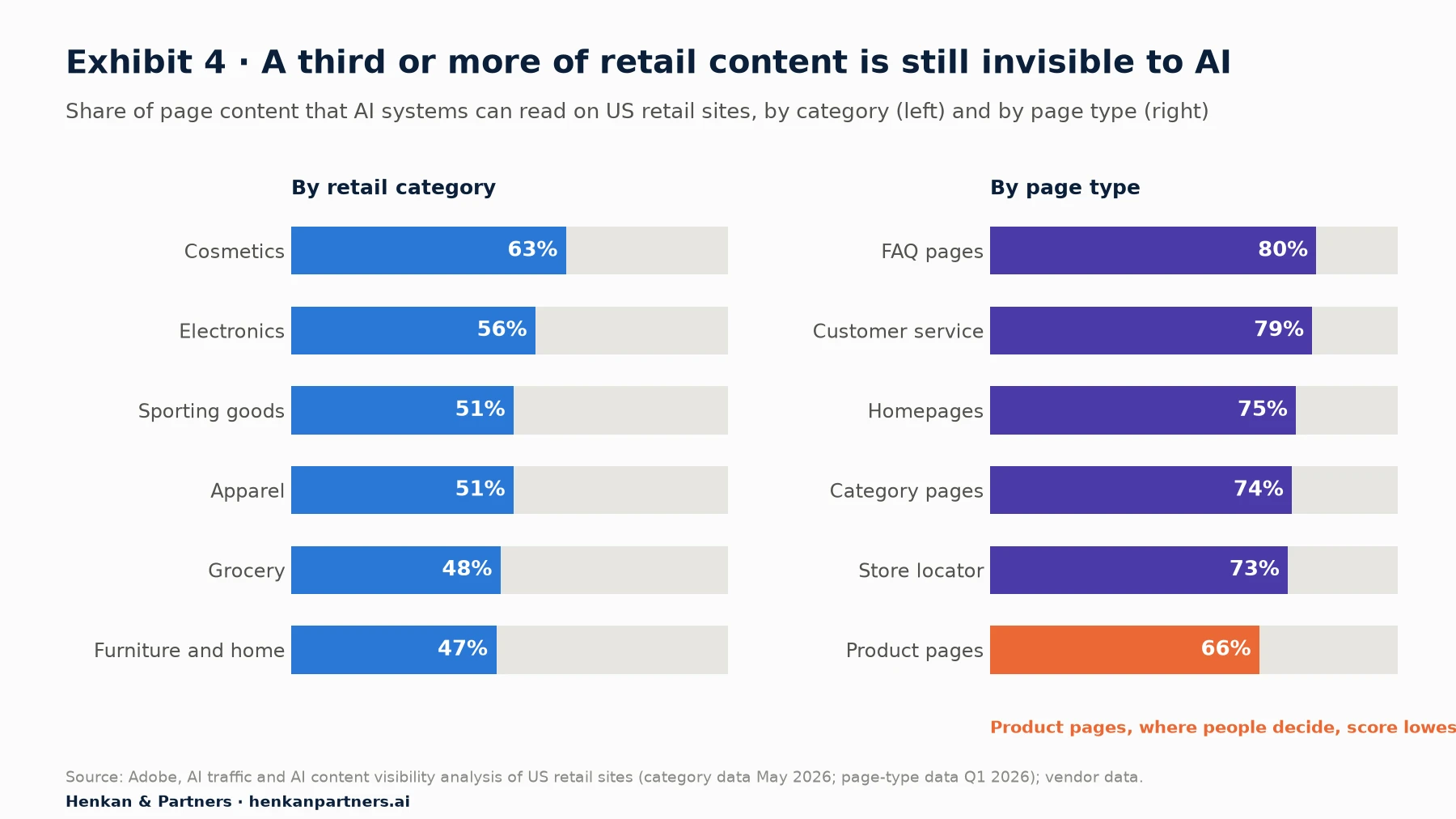
What this shows. Even in the best category, more than a third of content is not captured by AI. And product pages, where the buying decision is made, are the least readable page type. In our audits, the usual culprits are specifications loaded by JavaScript after the page renders, reviews in third-party widgets, size guides in images or pop-ups, and prices that change client-side. Fixing these is unglamorous engineering work with a clear payoff.
The product page and feed checklist
The checklist below is a Henkan & Partners framework built from the platform documentation cited above and our audit work. Use it on your top 50 products first.
- Complete every feed attribute that applies, not just the required ones. Material, dimensions, compatibility, care, age range, use case. Assistants match on attributes when a shopper says "waterproof", "for wide feet" or "fits a 2019 Golf".
- Keep price and stock in sync everywhere, within hours. Site, Merchant Center, ChatGPT feed, Microsoft Merchant Center and marketplaces. Google refreshes 2 billion listings an hour; stale data is a reason to be dropped or, worse, to be quoted wrongly.
- Write titles and descriptions for a question, not a keyword. State what the product is, who it is for and what makes it different in the first two sentences. Avoid superlatives an assistant cannot verify.
- Mark up Product, Offer, AggregateRating, shipping and return policy. Validate with Google's Rich Results Test and keep the markup identical to the visible values.
- Serve specifications, reviews and Q&A in the initial HTML. Many AI crawlers do not run JavaScript, as our GEO guide explains. Test by loading the page with JavaScript switched off.
- State policies in plain words on the page. Returns window, delivery times and costs, warranty. Assistants are often asked "can I return it?" and will answer from whatever they find, including an outdated third-party page.
- Add real product Q&A. Use customer service logs and voice of customer research to answer the ten questions buyers actually ask; publish them on the page and in Merchant Center's question-and-answer attribute.
Worked example: rewriting a product description (illustrative)
Before: "The ultimate running shoe for athletes who demand the best. Premium comfort meets cutting-edge style."
After: "A neutral road-running shoe for daily training and half-marathons. 8 mm heel-to-toe drop, 265 g in a UK 9, wide fit available in sizes 7 to 12. Breathable knit upper; not waterproof. Free returns within 30 days, unworn."
The second version answers the questions a shopper asks an assistant ("best neutral running shoe with a wide fit under 300 g"), gives attributes that can be matched and states the limits honestly. The figures are illustrative; use your own product data.
For marketers. Pick the 20 products that make most of your revenue and check what each assistant says about them today: price, stock, key features, returns. Every error you find points to a data source to fix.
For leaders. Product data quality is now a revenue issue in more channels than search. Give one person ownership of feed, markup and product content together, with a service level for price and stock freshness.
Section 6 · Content
Buying guides, honest comparisons and original data earn the recommendation
Product data gets you into the candidate set. Content decides whether an assistant says your product is the right one for this shopper. When someone asks "which espresso machine for a small kitchen under €500?", the assistant needs more than a spec sheet: it needs judgement about fit, trade-offs and who each option suits. It takes that judgement from pages that express it clearly.
In our experience, four kinds of brand and category content get used in AI shopping answers:
- Buying guides by need, not by product line. "How to choose a mattress if you sleep hot" or "what to look for in a first road bike". Structure them around the questions and constraints shoppers state, and link to the products that fit each case.
- Honest comparisons, including competitors. "X vs Y" pages that say plainly where your product is better and where it is not. Assistants are asked to compare; a page that already does it fairly is easy to use, and one that only praises you is easy to discount.
- "Best for" statements. Say explicitly who each product is for: "best for narrow feet", "best for renters with no drilling". Assistants recommend by fit, so give them the sentence.
- Original data. Test results, durability data, size and fit statistics from returns, lab measurements, anonymised customer usage. If ten sites say the same thing, the assistant needs only one; if only you publish a number, it has a reason to use yours.
Category pages deserve attention too. Adobe scored them at 74% readable, better than product pages, and they are often the natural answer to a broad question. A short introduction that explains how the range differs, followed by filters that work without JavaScript, gives an assistant something to quote and a structure to follow.
The general writing rules are in our GEO guide. The shopping rule is simpler: write the sentence you want the assistant to say about your product, and make sure it is true.
Section 7 · Reviews and reputation
Assistants trust what others say about you, so reviews, Reddit and editorial tests shape the verdict
An assistant asked for a recommendation weighs your claims against what other people say. That is why reviews and third-party mentions carry so much weight in shopping answers, and why they are the hardest part to control.
The sources assistants cite are dominated by community and editorial sites. Peec AI's analysis of 30 million sources cited across ChatGPT, Google AI Mode, Gemini, Perplexity and AI Overviews, published in March 2026, found Reddit the most-cited domain, followed by YouTube, LinkedIn, Wikipedia and Forbes, with review platforms appearing often in recommendation queries (vendor data). For consumer products, that usually means Reddit threads, YouTube reviews, specialist review sites and editorial "best of" lists.
Reviews that help an assistant decide
- Volume and recency. Encourage reviews after delivery and after use, not only at purchase. A product with 12 reviews from 2023 gives little to work with.
- Substance. Prompt customers to mention use case, size, fit and durability. "Great!" does not help an assistant match a product to a need; "true to size, I have wide feet" does.
- Crawlable and marked up. Render reviews in the HTML, add aggregate rating markup, and send ratings to Merchant Center and the ChatGPT feed.
Earning mentions beyond your site
Plan product seeding, expert reviews and creator content around the needs you want to own. Monitor which third-party pages assistants cite for your category, and aim to be on them with accurate information. On Reddit and forums, the only approach that works over time is genuine participation: answer questions as the brand, disclose who you are, and never post fake testimonials.
That last point is a legal matter as well as an ethical one. In August 2024 the US Federal Trade Commission finalised a rule banning fake reviews, including "AI-generated fake reviews", buying reviews conditioned on a particular sentiment and suppressing negative reviews, with civil penalties for knowing violations. Inflating your reputation to influence AI answers carries the same risk as inflating it for humans.
Our view. Reputation is the slowest lever and the most durable. You can fix a feed in a week; you cannot fix three years of mediocre reviews. Start the review programme now, even if the payoff in AI answers takes a year.
Section 8 · Measurement
Track AI referrals in GA4 and measure share of voice on the shopping prompts that matter
AI shopping visibility cannot be measured with one number. An assistant can recommend you without a click, describe you wrongly, or send a shopper who buys a week later through a branded search. Measure it on four levels.
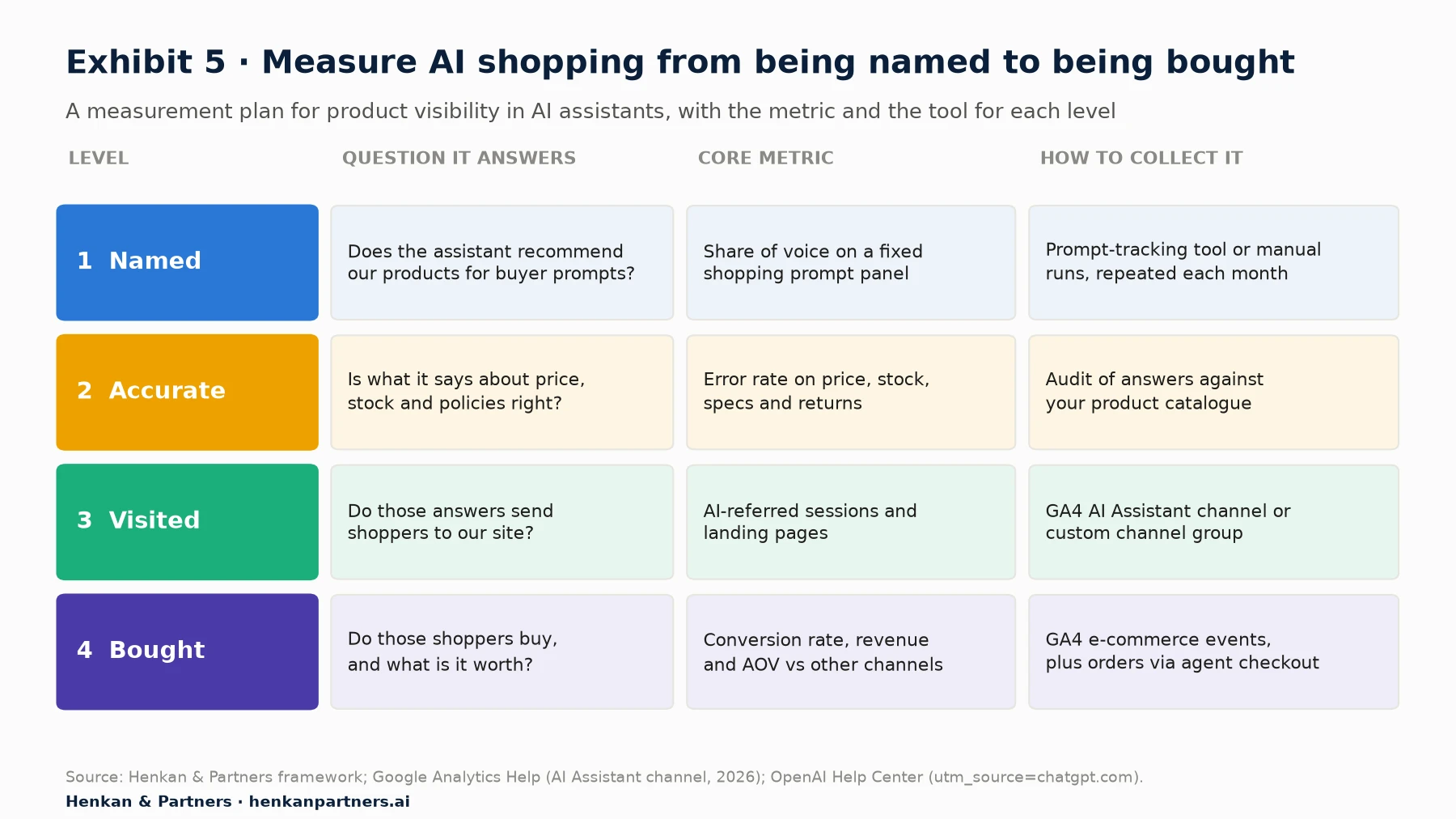
What this shows. Levels 1 and 2 happen inside the assistant, where your analytics cannot see; you need a prompt panel and an audit. Levels 3 and 4 happen on your site, where you already have the tools. In our experience, most teams measure only level 3. Adding level 2, accuracy, is the cheapest way to find problems that cost sales.
Tracking AI referrals in GA4
In May 2026 Google Analytics added an AI Assistant channel to the default channel group. Traffic whose referrer matches a recognised AI assistant, such as ChatGPT, Gemini or Claude, is given the medium `ai-assistant` and reported in its own channel. Before that, AI referrals typically landed in Referral, and some in Direct when the referrer was stripped. ChatGPT also adds `utm_source=chatgpt.com` to the links it shows, which makes its traffic easier to identify.
The default channel is a good start. For e-commerce reporting we usually add a custom channel group so that you control the definition and can split assistants. An illustrative rule, placed above Referral in the channel order because GA4 assigns the first matching channel:
Channel "AI assistants": Session source matches regex
(chatgpt|openai|perplexity|gemini\.google|copilot\.microsoft|claude\.ai|meta\.ai)
OR Session medium exactly matches ai-assistant
Three limits to keep in mind. First, clicks from Google's own AI features usually arrive with a google.com referrer, so they cannot be separated from organic search this way. Second, many AI-influenced journeys end in a branded search or a direct visit later, which last-click attribution credits elsewhere; look at new-customer share and branded search trends alongside. Third, orders placed through an agent checkout (Google UCP, Copilot Checkout, Perplexity Instant Buy) may reach you as orders without a normal session, so tag them with an order source in your back end. Our guides to web analytics and e-commerce custom dimensions show how to add a dimension such as `order_channel` or `agent_platform` so these orders appear in reports.
Once the traffic is labelled, look at what these visitors do. Session replay on AI-referred sessions is a quick way to see whether the page confirms or contradicts what the assistant promised.
Measuring share of voice in AI shopping answers
Build a prompt panel: 50 to 200 shopping questions that reflect how real buyers ask, by category, need and budget, in each market you sell in. Include generic prompts ("best cordless vacuum for pet hair"), comparison prompts ("Brand A vs Brand B") and branded prompts ("is Brand A true to size?"). Run the panel monthly on each assistant that matters to you, several times per prompt because answers vary, and record whether your products appear, in what position, with what description and which sources are cited.
AI shopping share of voice = answers that recommend at least one of your products ÷ all answers in the prompt panel
Accuracy rate = answers with correct price, stock and key specs for your products ÷ answers that mention your products
Tracking tools are covered in our GEO guide. For shopping, add one step most tools skip: compare the facts in each answer with your catalogue. That is where costly errors show up.
Section 9 · Agents as customers
Agentic checkout turns software into a customer segment, and CRO must serve it too
Agentic commerce is shopping in which an AI agent acts on a person's behalf: it searches, compares, fills a cart and, with permission, completes the purchase, either through a protocol the merchant supports or by using the merchant's website as a person would.
For conversion teams, this is the most important change in the article. Until now, conversion rate optimisation (CRO) meant designing pages and checkouts for people. When an agent does the browsing, the "visitor" is software. It does not see your hero banner or your urgency message. It reads data, follows links, fills forms and needs to know that the price it saw is the price it will pay. Our Essential Guide to Conversion Rate Optimization covers the human side; here is the machine side.
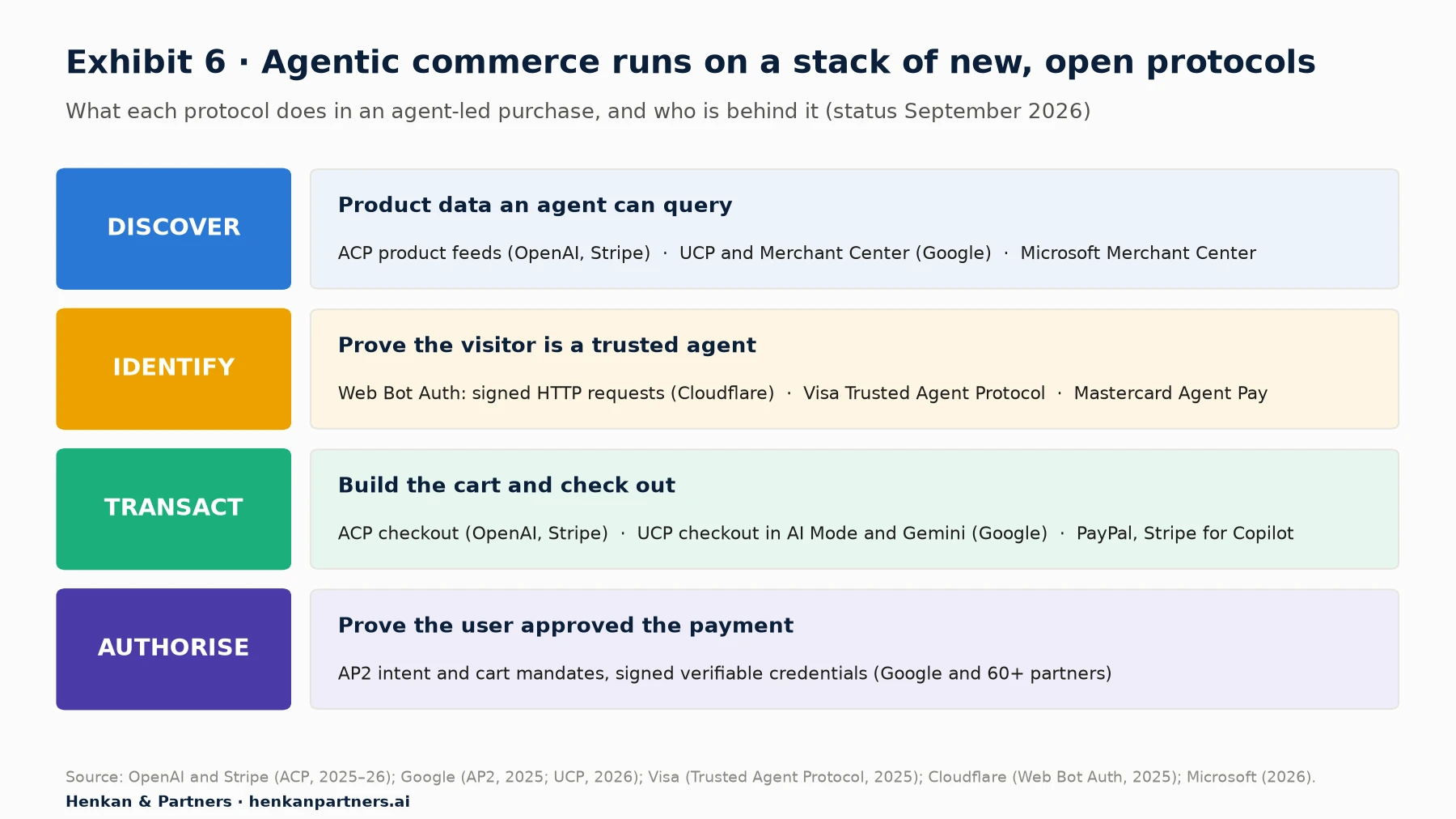
What this shows. No single standard has won, and several overlap. The layers are more stable than the names: an agent needs product data it can query, a way to prove it is trustworthy, a way to transact and proof that the human agreed. Most merchants will adopt these through their platform (Shopify, Salesforce, Stripe, PayPal, Google Merchant Center) rather than build them. Your job is to know which ones your stack supports and to keep the data behind them accurate.
The protocols in brief
- Agent Payments Protocol (AP2). Announced by Google Cloud on 16 September 2025 with more than 60 organisations, including Mastercard, PayPal and Adyen. It uses cryptographically signed mandates: an intent mandate records what the user asked for and the limits they set, and a cart mandate records the exact items and price the user approved. It can extend Google's Agent2Agent protocol (A2A) and the Model Context Protocol (MCP).
- UCP and ACP. Google's UCP (January 2026) is compatible with A2A, AP2 and MCP and powers checkout in AI Mode and Gemini. OpenAI's ACP now serves mainly to share product feeds with ChatGPT.
- Web Bot Auth, Visa Trusted Agent Protocol and Mastercard Agent Pay. In October 2025 Cloudflare, Visa and Mastercard described how agents can sign their HTTP requests with public-key cryptography, so merchants can verify a registered agent and tell browsing from purchasing, instead of guessing from the user agent or IP address.
Bot management: stop the bad bots without blocking good agents
Retailers have spent a decade blocking bots: scrapers, scalpers, credential stuffers. Many bot-management rules will now also block legitimate shopping agents. The legal picture is unsettled. Amazon sued Perplexity in November 2025, alleging its Comet browser agent disguised itself as Google Chrome while shopping on Amazon. A federal judge granted Amazon an injunction in March 2026; on 4 August 2026 the Ninth Circuit overturned it, reasoning that because Comet acts at a user's direction, it is the user who accesses Amazon. The underlying case continues.
A practical position for most merchants, as a Henkan & Partners framework:
- Inventory the agents that already visit. Look in server or CDN logs for known AI user agents. OpenAI, for example, documents OAI-SearchBot for search, GPTBot for training and ChatGPT-User for user-initiated visits, and warns that for user-initiated actions "robots.txt rules may not apply".
- Allow search and user-initiated agents on product and policy pages, and decide separately about training crawlers. Blocking OAI-SearchBot removes you from ChatGPT search answers.
- Prefer verification over user-agent strings. Where your CDN supports signed agents (Web Bot Auth), use it to allow verified agents and challenge the rest.
- Protect the sensitive paths. Keep rate limits and fraud checks on login, account, checkout and gift-card pages, where abuse is costly.
What agent-ready pages look like
Agent-ready pages are good pages with fewer tricks. Price, stock, delivery date and returns shown as text, not only in images. Variant choices as standard form controls with clear labels. No required interaction hidden behind hover states or custom widgets. Stable URLs for each variant. A guest checkout that does not force account creation. Error messages that say what is wrong. A useful test: if a change helps a screen-reader user, it probably helps an agent too.
For marketers. Add agents to your test plan. Before a redesign goes live, check that a product can be found, configured and added to the cart with JavaScript-heavy features disabled.
For leaders. Ask your platform and payment providers which agent protocols they support and on what timeline. Do not build a custom integration for a standard that may not last; do make sure your data is ready for the ones that do.
Section 10 · Risks
Wrong prices and invented details are the main risk, and you can only reduce them at the source
AI assistants still make mistakes about products, and in shopping those mistakes have a price. One of the most detailed public tests so far comes from a vendor, so treat it as indicative.
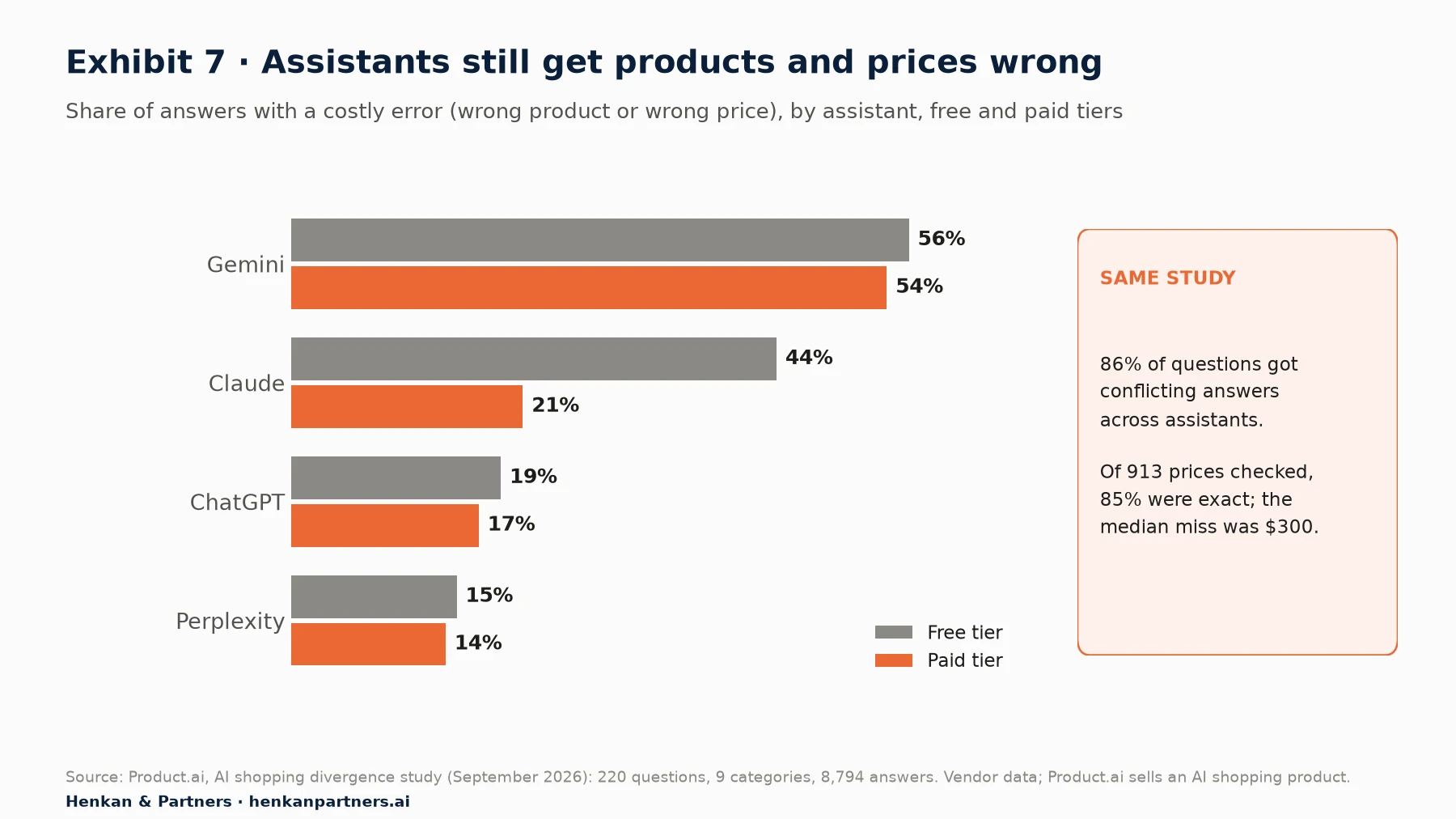
What this shows. Even the most accurate assistants in this test made a costly error in about one answer in seven, and the assistants disagreed with each other on 86% of questions. Most prices were right, but the misses were large. The study covers electronics, beauty, supplements and home categories, and results will change as models are updated. The lesson for brands is not which assistant is best, but that errors about your products are likely and need monitoring.
The main risks, and what you can do about each:
| Risk | What happens | What reduces it |
|---|---|---|
| Hallucinated or stale prices | The assistant quotes a price you no longer charge; the shopper arrives and feels misled | Frequent feed updates, consistent markup, clear sale start and end dates |
| Wrong availability | Out-of-stock items recommended, in-stock items skipped | Real-time stock in feeds; correct availability markup; remove discontinued pages or mark them clearly |
| Invented features or policies | The assistant claims a warranty, size or compatibility you do not offer | State specs and policies in plain text on the page; publish Q&A; correct third-party sources |
| Brand safety | Your product appears next to unsuitable content or is compared unfairly | Monitor answers on branded prompts; publish fair comparison pages; respond to reviews |
| Agent fraud and abuse | Bots posing as shopping agents scrape prices or test cards | Signed-agent verification, rate limits and fraud checks on sensitive paths |
| Loss of the customer relationship | The purchase happens in the assistant; you get the order but less data | Prefer integrations where you stay merchant of record; capture consent at fulfilment; track agent orders |
Accuracy is also a conversion issue. A shopper who expects €89 and sees €109 leaves. Message match between an ad and its landing page has long been a reliable conversion lever; AI answers make it harder, because you do not write the message. Your only control is the data the assistant reads.
Disclosure: Henkan & Partners is building an SEO and GEO service, and sells conversion optimisation and analytics services related to the topics in this article.
Section 11 · What to do next
Six steps to make your products visible, accurate and buyable in AI assistants
1. Take a baseline on your top products and prompts
Choose your top 20 to 50 products and 50 to 100 shopping prompts. Run them on ChatGPT, Google AI Mode, Gemini, Perplexity and Copilot, and on Amazon if you sell there. Record whether you appear, how you are described, which sources are cited and every factual error.
2. Fix the feeds and keep them in sync
Complete Merchant Center, including the conversational attributes; set up or check your ChatGPT and Microsoft Merchant Center feeds, directly or through your platform. Set a freshness target for price and stock, and alert when the site and the feeds disagree.
3. Make product pages readable and complete
Put specifications, reviews, Q&A and policies in the server-rendered HTML, add Product and Offer markup with shipping and return details, and rewrite descriptions to answer real buyer questions. Start with the products that generate most revenue.
4. Build the content and reputation assistants rely on
Publish buying guides by need, fair comparisons and at least one piece of original data per key category. Grow review volume and substance, and plan expert and creator coverage for the needs you want to own.
5. Measure named, accurate, visited and bought
Check the GA4 AI Assistant channel, add a custom channel group, tag agent-checkout orders, and report share of voice, accuracy rate, AI-referred sessions and revenue together every month.
6. Get ready for agents as customers
Review bot-management rules so verified shopping agents can reach product and policy pages, ask your platform and payment providers about ACP, UCP and AP2 support, and add an agent test to your release checklist. If you want help with a baseline, a feed and product-page audit or AI traffic measurement, Talk to us.
FAQ
Frequently asked questions about AI search optimization for e-commerce
Frequently asked questions
What is AI search optimization?
AI search optimization (or optimisation) is the work of making a brand, its content and its products more likely to be found, cited and recommended by AI assistants such as ChatGPT, Google AI Mode and Gemini, Perplexity and Microsoft Copilot. For e-commerce it focuses on product feeds, structured data, product pages, reviews and measurement, as well as readiness for AI agents that can buy on a shopper's behalf.
How is AI search optimization different from GEO?
Generative engine optimization (GEO) is the general practice of being cited in AI answers, mostly through content. AI search optimisation for e-commerce applies it to products, where answers are built from structured data such as prices, stock, reviews and return policies, and where accuracy and checkout matter as much as visibility.
How do I get my products to show up in ChatGPT shopping?
Make sure OAI-SearchBot can crawl your site, and share a product feed with ChatGPT through the Agentic Commerce Protocol, directly or through a provider. Shopify merchants appear automatically through Shopify Catalog. The feed needs at least item_id, title, description, url, brand, seller_name, image_url, availability and price, and should include reviews and return details where you have them.
Can shoppers buy directly inside ChatGPT?
Not through OpenAI's own checkout any more. OpenAI launched Instant Checkout in September 2025 and, in March 2026, moved purchases back to merchants' own sites and apps while keeping product discovery in ChatGPT. Some retailers, such as Walmart, run their own apps inside ChatGPT.
How does Google AI Mode choose which products to show?
It draws on the Shopping Graph, which Google says holds more than 50 billion listings, plus Merchant Center feeds and the web index. Complete, accurate Merchant Center data, including the new conversational attributes, and Product and Offer markup are the main inputs you control.
What is agentic commerce?
Agentic commerce is shopping in which an AI agent acts for a person: it searches, compares, fills a cart and, with permission, pays. Protocols such as ACP, UCP and AP2, and signed-agent standards from Cloudflare, Visa and Mastercard, aim to make these purchases safe and verifiable.
How do I track traffic from AI assistants in GA4?
Google Analytics added an AI Assistant channel to the default channel group in 2026, which labels traffic from recognised assistants with the medium ai-assistant. You can also build a custom channel group that matches sources such as chatgpt, perplexity, gemini.google, copilot.microsoft and claude.ai, placed above Referral. ChatGPT adds utm_source=chatgpt.com to its links.
Does AI traffic convert better than other traffic?
In Adobe's US retail data it now does: AI-referred visits converted 60% better than non-AI visits in July 2026, after converting 38% worse in March 2025, and generated 53% more revenue per visit. These are vendor figures, and AI referrals remain a small share of total visits for most retailers.
Should I block AI bots from my online shop?
Usually not all of them. Blocking search and user-initiated agents can remove your products from AI answers. Decide separately about training crawlers, and keep strong protection on login, checkout and account pages.
How accurate are AI shopping assistants?
Not reliably accurate yet. In a September 2026 test of 220 shopping questions by Product.ai, a vendor, answers with a costly product or price error ranged from 14% to 56% depending on the assistant and tier, and assistants disagreed on 86% of questions. Brands should monitor what assistants say about their products and fix the data sources behind errors.
Key terms
- AI search optimisation
- The practice of making products and content more likely to be found, described correctly and recommended by AI assistants. It matters because assistants increasingly shape which products shoppers consider.
- Agentic commerce
- Shopping in which an AI agent searches, compares and, with permission, buys for a person. It matters because the visitor to your site may be software, not a human.
- Agentic Commerce Protocol (ACP)
- An open standard from OpenAI and Stripe for sharing product feeds with ChatGPT and, originally, for in-chat checkout. It matters because it is how many merchants get products into ChatGPT.
- Agent Payments Protocol (AP2)
- Google's open protocol for agent-led payments using signed intent and cart mandates. It matters because it gives merchants and payment firms proof that a user approved a purchase.
- Universal Commerce Protocol (UCP)
- Google's open standard, launched in January 2026, for agentic commerce across the shopping journey, powering checkout in AI Mode and Gemini. It matters for merchants selling through Google's AI surfaces.
- Shopping Graph
- Google's dataset of product listings, prices, reviews and stock, with more than 50 billion listings. It matters because it feeds Google's shopping answers, including AI Mode.
- Merchant Center
- Google's tool (and Microsoft's equivalent) for submitting product feeds. It matters because feed quality directly affects eligibility and accuracy in AI shopping answers.
- Product structured data
- Schema.org markup (Product, Offer, AggregateRating, shipping and return policy) that states product facts in machine-readable form. It matters because it backs up the feed on your own pages.
- Share of voice (AI)
- The share of answers in a fixed prompt set that recommend your products. It matters because it measures visibility where analytics cannot see.
- AI Assistant channel
- A GA4 default channel, added in 2026, for traffic from recognised AI assistants. It matters because it separates AI referrals from ordinary referral traffic.
- Web Bot Auth
- A method for agents to sign HTTP requests with public-key cryptography so sites can verify them. It matters because it lets you admit good agents without opening the door to bad bots.
- Message match
- Consistency between what a shopper was told before arriving and what the landing page shows. It matters because AI answers set expectations you do not write.
Sources
All sources were checked in September 2026. Figures from Adobe, Salesforce, Microsoft, Peec AI and Product.ai are vendor data drawn from their own customers, networks or tests and were not independently audited; Amazon's and Microsoft's usage and sales figures are company-reported. McKinsey's figures are forecasts. Exhibit 1 is compiled by Henkan & Partners from the announcements listed. Exhibits 3, 5 and 6 and Exhibits A and D are Henkan & Partners frameworks; the product page checklist, bot-management steps and worked example reflect our project experience, and the worked example's figures are illustrative. Platform features and availability change often; check each provider's documentation before acting.
- OpenAI (2025). Buy it in ChatGPT: Instant Checkout and the Agentic Commerce Protocol.
- OpenAI (2026). Powering product discovery in ChatGPT.
- OpenAI Developers (2026). Agentic Commerce: product feed specification.
- OpenAI (2026). Overview of OpenAI crawlers.
- OpenAI Help Center (2026). Publishers and developers FAQ.
- Retail Dive (2025). ChatGPT launches shopping research feature.
- Google (2025). Shopping on Google: AI Mode and virtual try-on updates from I/O 2025.
- Google (2025). Google Shopping launches agentic checkout and more AI shopping tools.
- Google (2026). New tech and tools for retailers to succeed in an agentic shopping era.
- Google Merchant Center Help (2026). About the Universal Commerce Protocol and How to use conversational attributes.
- Google Search Central (2026). Merchant listing structured data.
- Google Cloud (2025). Announcing Agent Payments Protocol (AP2).
- Google Analytics Help (2026). What's new in Google Analytics: AI Assistant channel.
- PYMNTS (2024). Perplexity launches AI-powered shopping assistant that can research and purchase.
- PayPal (2025). PayPal and Perplexity launch Instant Buy; Engadget (2025). Perplexity announces its own take on an AI shopping assistant.
- Microsoft Advertising (2026). Conversations that convert: Copilot Checkout and Brand Agents. Company data.
- Amazon (2024). Amazon announces Rufus, a new generative AI-powered conversational shopping experience.
- Amazon (2026). Fourth quarter 2025 results. Company data.
- GeekWire (2026). Amazon unifies Alexa+ and Rufus as AI rivals move into online shopping.
- Payments Dive (2025). Amazon sues Perplexity over AI shopping agents; GeekWire (2026). Judge blocks Perplexity's AI bot from shopping on Amazon; Engadget (2026). Perplexity has successfully overturned Amazon's injunction on its AI shopping bot.
- Adobe (2026). AI traffic grows but retail sites lag in AI search visibility. Vendor data.
- Adobe (2026). Holiday shopping season results. Vendor data.
- Digital Commerce 360 (2026). Adobe: AI-referred traffic to retail sites doubles in a year. Vendor data.
- Adobe Digital Insights (2026). AI traffic trends report, August 2026. Vendor data.
- Salesforce (2026). 2025 holiday shopping data. Vendor data.
- McKinsey & Company (2025). The agentic commerce opportunity: how AI agents are ushering in a new era for consumers and merchants.
- Cloudflare (2025). Securing agentic commerce: helping AI agents transact with Visa and Mastercard.
- Product.ai (2026). AI shopping divergence study. Vendor data.
- Search Engine Land (2026). AI search engines cite Reddit, YouTube and LinkedIn most: study. Peec AI vendor data.
- Federal Trade Commission (2024). Federal Trade Commission announces final rule banning fake reviews and testimonials.
- Henkan & Partners. The Essential Guide to Generative Engine Optimization, The Essential Guide to Conversion Rate Optimization, The Essential Guide to E-commerce Acquisition and Retention Channels, Understanding the E-commerce Market Equation, The Essential Guide to Web Analytics, Which Custom Dimensions to Collect in Your E-commerce Analytics, Session Replay in 2026 and The Essential Guide to Voice of Customer.