Guide
The Essential Guide to Generative Engine Optimization (GEO)
Alexandre Suon · 2026-09-28
Generative engine optimization (GEO) is the work of getting your brand, pages and products named and cited in AI answers from Google AI Overviews and AI Mode, ChatGPT, Perplexity, Gemini, Copilot and Claude. This guide explains how those answers are built, what the research and the data say drives citations, and the technical, content and measurement steps that matter for e-commerce teams in 2026.
Executive summary
- GEO extends SEO from ranking in a list to being quoted in an answer. AI search features retrieve pages, ground a written answer in them and cite a few sources. The foundations are still classic SEO: Google says there are "no additional requirements" to appear in AI Overviews or AI Mode beyond being indexed and eligible for a snippet.
- AI answers now reach billions of people and take clicks. Google reports more than 1 billion monthly users of AI Mode, and ChatGPT reached 900 million weekly users in February 2026. When an AI Overview appears, Pew found Google users clicked a result in 8% of visits against 15% without one; Ahrefs measured a 58% lower click-through rate for the top result.
- Being cited is what limits the damage. In Seer Interactive's data, brands cited in an AI Overview earned about 2.2 times the organic clicks of brands that were not cited. AI referrals are still small (0.2% of visits in Contentsquare's benchmark) but convert well, 54% better than other traffic on US retail sites according to Adobe (vendor data).
- Evidence beats tricks. In the original GEO study (Princeton and IIT Delhi, KDD 2024), adding quotations, statistics and cited sources raised a page's visibility in generated answers by roughly 27% to 41%, while keyword stuffing lowered it. Industry studies add that brand mentions correlate more with AI visibility than backlinks, and that AI assistants favour fresher content.
- Technical access decides eligibility. Let search-oriented AI bots (OAI-SearchBot, PerplexityBot, Claude-SearchBot, Googlebot, Bingbot) reach your key pages, decide separately about training bots, and serve critical content in the HTML because most AI crawlers do not run JavaScript. llms.txt is not required by Google and is rarely requested by AI bots.
- Measure share of answer, not only rankings, and treat products as data. Track mentions and citations on a fixed prompt set, Google's new Search Console generative AI report (impressions only, since June 2026), AI-referred sessions and revenue. For e-commerce, product feeds now feed ChatGPT shopping and Google's AI Mode, where checkout is moving to open protocols (ACP, UCP).
Section 1 · The basics
What is generative engine optimization? Earning a place in the answer, not just on the results page
Generative engine optimization (GEO) is the practice of making your brand, content and products more likely to be retrieved, quoted, cited and recommended by AI systems that write answers, such as Google AI Overviews and AI Mode, ChatGPT search, Perplexity, Gemini, Microsoft Copilot and Claude.
The term comes from a 2023 research paper by Pranjal Aggarwal and colleagues at Princeton University and IIT Delhi, published at the KDD 2024 conference. They called systems that search the web and then write a synthesised answer generative engines, and showed that the way a page is written changes how visible it is inside those answers. The industry has since adopted a cluster of overlapping names: AI search optimisation, LLM SEO (after large language models, the technology behind the assistants), answer engine optimisation (AEO) and AI visibility. They describe the same shift from different angles.
The shift is simple to state. In classic search, success is a click from a list of ten blue links. In AI search, the engine reads the pages for you and writes the answer. Your page can be used without being visited, and your brand can be recommended, or left out, without the user ever seeing your site. GEO is the discipline of being the source the answer is built on and the name it recommends.
| SEO | AEO | GEO | |
|---|---|---|---|
| Goal | Rank pages in search results and win the click | Be the direct answer: featured snippets, voice assistants, "People also ask" | Be retrieved, quoted, cited and recommended inside AI-written answers |
| Where it shows | Google and Bing results pages | Answer boxes, voice results, AI answers | AI Overviews, AI Mode, ChatGPT, Perplexity, Gemini, Copilot, Claude |
| Unit of success | Ranking position, clicks | Snippet ownership | Share of answers that mention you, citations, AI-referred visits |
| Main levers | Crawlability, relevance, links, experience | Question-and-answer structure, concise definitions | SEO foundations plus brand mentions, quotable evidence, AI bot access, product data |
| Measured with | Search Console, rank trackers, analytics | SERP feature tracking | Prompt tracking tools, bot logs, Search Console and Bing AI reports, AI referral channel |
In practice, most of GEO is good SEO done thoroughly. Google's own guidance says that "the best practices for SEO remain relevant" for AI features. What changes is the emphasis: breadth of topic coverage matters more than one head keyword, being mentioned on other sites matters more than raw link counts, and the way facts are written on the page decides whether an AI can lift them. For the wider picture of how organic search fits among your channels, see our guide to e-commerce acquisition and retention channels.
Section 2 · Why it matters
AI answers now reach billions of people and take clicks from the classic results
AI answers moved from experiment to default in about two years. OpenAI launched ChatGPT search in October 2024 and announced 900 million weekly ChatGPT users in February 2026. Google made AI Overviews standard in its results and, on its July 2026 earnings call, said AI Mode had passed 1 billion monthly active users since its global expansion, that the Gemini app had 950 million monthly users, and that it had brought AI Overviews and AI Mode together into one experience. Pew Research Center's browsing panel found that 18% of US Google searches in March 2025 produced an AI summary, rising to 60% for searches phrased as questions.
The effect on clicks is now well documented, although each study measures it differently:
- Pew Research Center (2025). Among 900 US adults, users clicked a traditional result in 8% of visits when an AI summary appeared and in 15% when it did not. They clicked a link inside the summary in just 1% of visits, and ended their browsing session more often (26% against 16%).
- Ahrefs (vendor data). On 300,000 keywords, the top-ranking page's click-through rate was 34.5% lower when an AI Overview appeared in its April 2025 study, and 58% lower in its February 2026 update.
- Seer Interactive (vendor data). Across 53 brands and 2.43 billion impressions, informational queries earned about 33,500 organic clicks per million impressions without an AI Overview, about 20,743 when the brand was cited in one and about 9,445 when it was not.
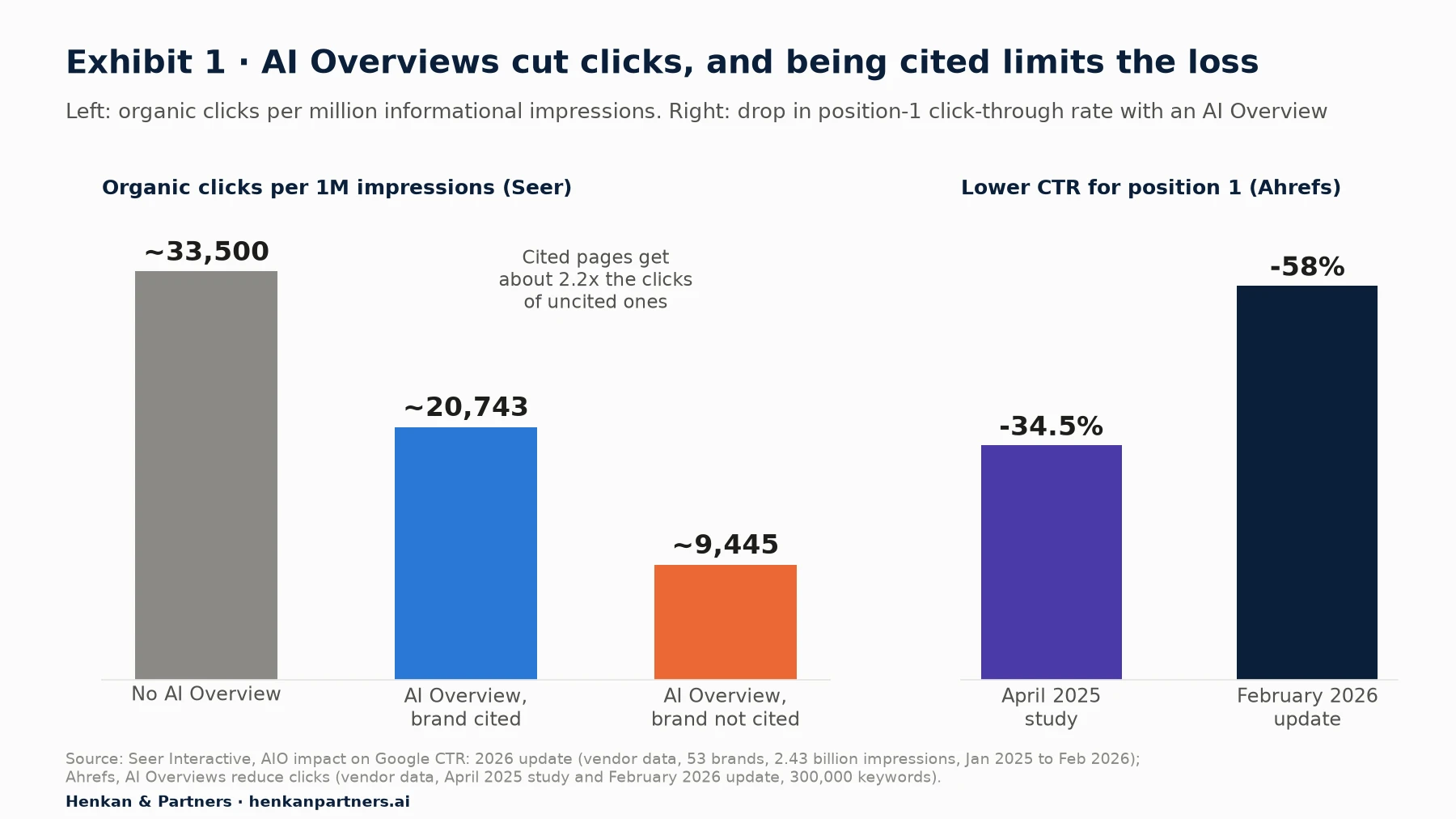
What this shows. Two independent datasets point the same way: when an AI answer sits above the results, fewer people click. The left panel is the more useful one for GEO. Being cited does not bring clicks back to the level of a page without an AI Overview, but it more than doubles them compared with not being cited. That gap is the business case for the rest of this guide.
Traffic that does arrive from AI assistants is small but valuable. Contentsquare's 2026 benchmark, built on 99 billion sessions, found AI-referred traffic grew 632% in a year but was still only 0.2% of visits, converting at 1.3%. Adobe, which analyses more than a trillion visits to US retail sites, reported that AI-referred retail traffic grew 138% year on year in May 2026 and converted 54% better than other traffic, with visitors spending 53% more time on site (vendor data). Ahrefs' 2026 AI search benchmark found Google still sends about 190 times more traffic than ChatGPT (vendor data). In short: search is not dead, but the answer layer now sits between your customer and your site.
Predictions deserve caution. Gartner predicted in February 2024 that traditional search engine volume would drop 25% by 2026. Google, for its part, reported record search usage in 2026 and says AI Mode drives an incremental increase in queries. Both can be partly true: people search more, but more of those searches end in an answer rather than a visit.
For marketers. Stop reporting organic traffic alone. Add two numbers to your monthly report: how often AI answers mention your brand on the questions that matter, and how much revenue comes from AI-referred sessions.
For leaders. Treat GEO as a visibility risk, not a new channel to budget from scratch. The first question is whether customers asking an AI about your category hear your name, and whether what they hear is accurate.
Section 3 · How AI answers work
AI answers are built by retrieving, grounding and citing, so you must be retrievable first
Every major AI search product follows the same broad pattern, known as retrieval-augmented generation. The model does not answer from memory alone. It searches, reads the most relevant passages and writes an answer grounded in them, usually with links to the sources. Google describes one important refinement: both AI Overviews and AI Mode may use a "query fan-out" technique, "issuing multiple related searches across subtopics and data sources" before writing a response.
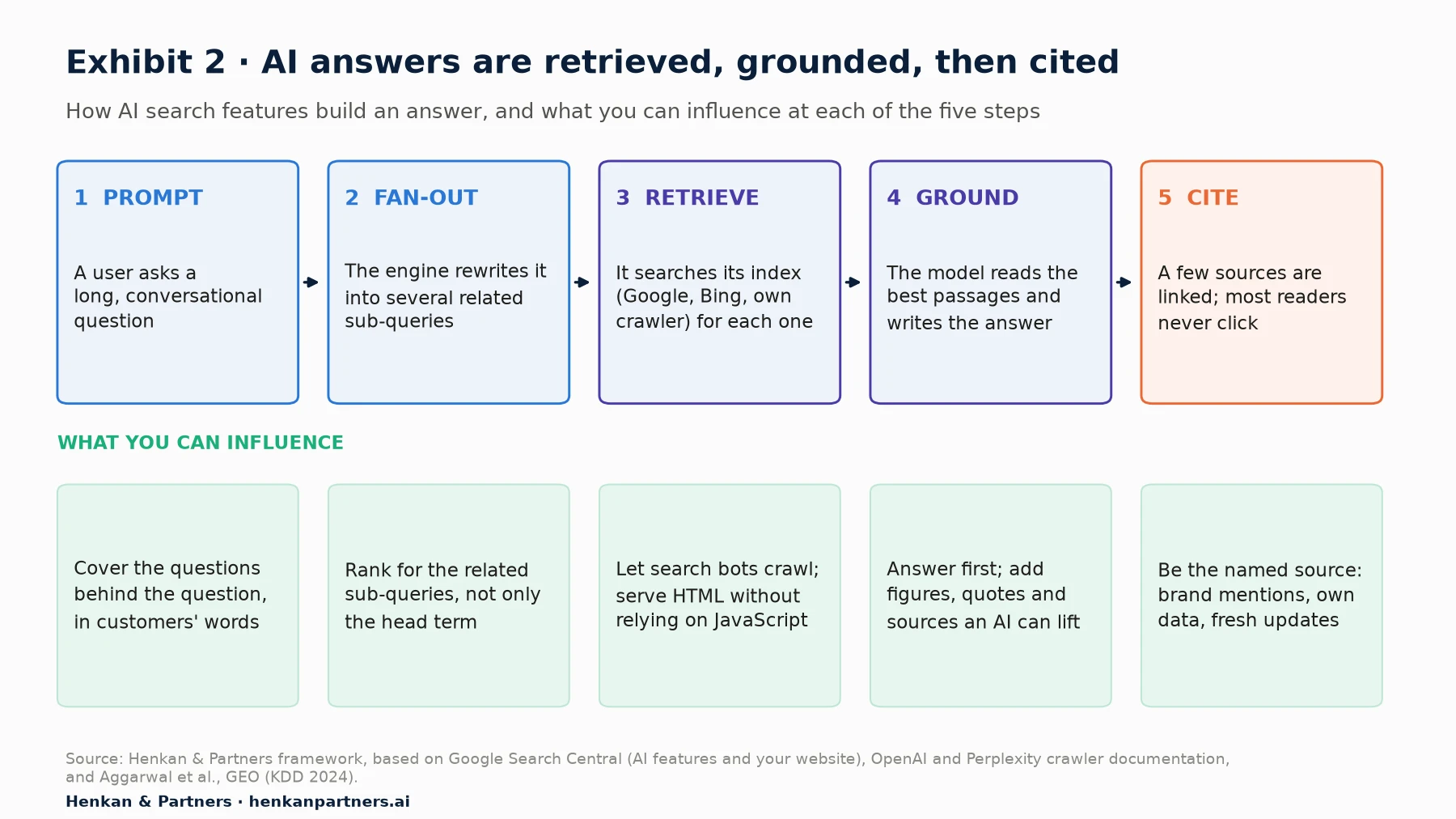
What this shows. Visibility is decided before the model writes a word. If your page is not in the index the engine searches, or does not rank for the sub-queries it generates, it cannot be cited, however well it is written. The writing levers (step 4) matter only once the retrieval levers (steps 2 and 3) are in place.
Two routes lead into an AI answer, and they are often confused. The first is training data: what a model absorbed when it was built, which shapes what it "knows" about your brand but is frozen at a cut-off date and hard to influence. The second is live retrieval: the pages the system fetches when a user asks a question. GEO works mainly on the second route, because it is current, it produces citations and you can control access to it.
| Engine | Where it retrieves from | Crawler to allow for visibility | What to know |
|---|---|---|---|
| Google AI Overviews and AI Mode | Google's search index, with query fan-out | Googlebot | No separate opt-in; same eligibility as a search snippet. Google-Extended does not affect Search; the Search generative AI control in Search Console opts a site out. |
| Gemini app | Grounding with Google Search | Googlebot; Google-Extended governs training and Gemini grounding | Blocking Google-Extended opts you out of Gemini training and grounding, not of Search. |
| ChatGPT search | Third-party search providers plus OpenAI's own crawler and partner content | OAI-SearchBot (and ChatGPT-User for user-triggered visits) | Sites that block OAI-SearchBot are not shown in ChatGPT search answers, except as navigational links. |
| Perplexity | Its own index and live fetches | PerplexityBot (and Perplexity-User) | Perplexity says PerplexityBot is not used to train foundation models. |
| Microsoft Copilot and Bing | Bing's index | Bingbot | Bing Webmaster Tools reports Copilot citations of your pages. |
| Claude | Web search and fetches by Anthropic's bots | Claude-SearchBot (and Claude-User) | Blocking either may reduce your visibility in Claude's answers. |
The practical consequence: for Google, GEO starts in Google's index; for Copilot, in Bing's; for ChatGPT, Perplexity and Claude, in a mix of third-party indexes and their own crawlers. A site that ranks well in Google but blocks the other bots, or has never been checked in Bing Webmaster Tools, is invisible in part of the AI landscape.
Section 4 · The research
The original GEO study found quotes, statistics and sources lift visibility by up to 40%, and keyword stuffing does not
The founding paper, GEO: Generative Engine Optimization (Aggarwal, Murahari, Rajpurohit, Kalyan, Narasimhan and Deshpande, KDD 2024), is still the most rigorous public test of what changes a page's visibility in AI answers. The authors built GEO-bench, 10,000 queries across 25 domains, mostly informational. For each query they took the top web results, rewrote one source with one of nine methods, and measured how much of the generated answer that source contributed, weighted by how early it was cited (position-adjusted word count), and a subjective impression score judged by a model.
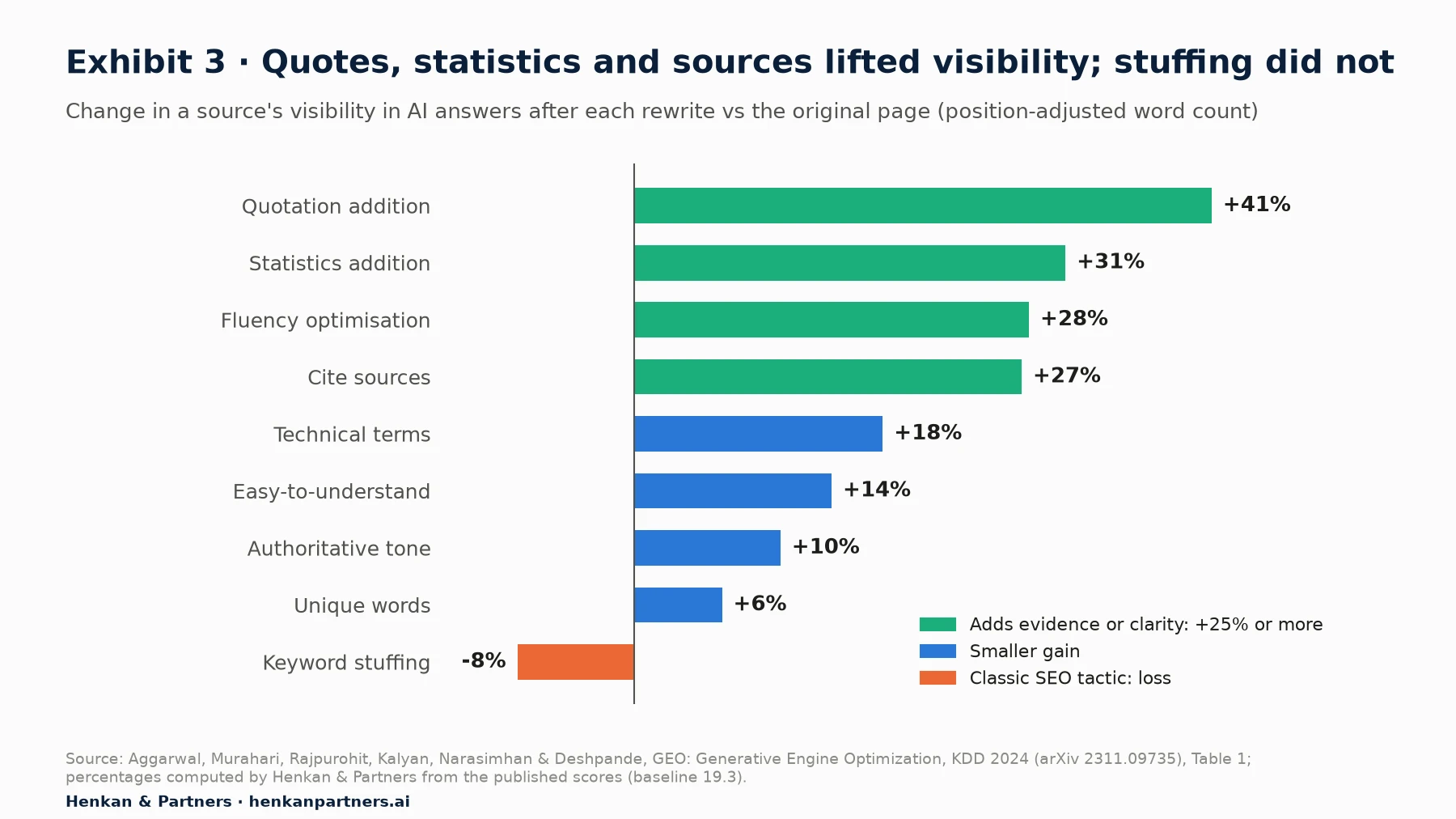
What this shows. The methods that worked add something an answer can use: a quotation from a credible person, a specific number, a cited source, or clearer and more fluent text. Methods borrowed from old-school SEO, such as repeating the keyword, made the page less visible than doing nothing. The lesson is to add evidence, not volume.
Four further findings matter for practitioners:
- The headline gain held on a live engine. On Perplexity.ai, the authors report visibility improvements of up to 37%. Quotation addition raised the position-adjusted score from 24.1 to 29.1; keyword stuffing lowered it to 21.9.
- Lower-ranked pages gain most. Adding cited sources increased visibility by 115.1% for pages ranked fifth in the classic results, while the top-ranked page lost 30.3% on average. GEO can partly level the field for smaller sites with better evidence.
- Combinations help a little. The best pair, fluency optimisation plus statistics addition, beat any single method by more than 5.5%.
- Results vary by domain. Quotations worked best for people and society, explanation and history queries; statistics for law and government and opinion questions; fluency for business, science and health. The authors conclude that optimisation must be domain-specific.
Our view. Read the study as direction, not as a promise of 40%. It was run in 2023, largely on a simulated engine built on GPT-3.5, on mostly informational queries, and it measures words in the answer rather than clicks or sales. Engines have changed a great deal since. But its central message has aged well: engines reward pages that give them verifiable, quotable substance, and punish padding.
Section 5 · What drives citations
Citations follow retrievability, brand authority, clear structure and fresh, original facts
No AI company publishes its ranking factors, so everything beyond the official documentation comes from correlation studies. Most are run by SEO tool vendors on their own data. Read them as signals of direction, not proof of cause. Five factors appear consistently.
1. Being retrieved across the whole topic, not just one keyword
Ranking still matters, but across a topic. Ahrefs found that in March 2026 only 38% of pages cited in Google AI Overviews ranked in the top 10 for the query, down from 76% in its study about a year earlier; 31.2% ranked from 11 to 100 and 31.0% beyond 100. Ahrefs attributes the change to query fan-out and to Google's upgrade to Gemini 3 in January 2026: the engine searches related sub-queries and cites pages that rank for those.
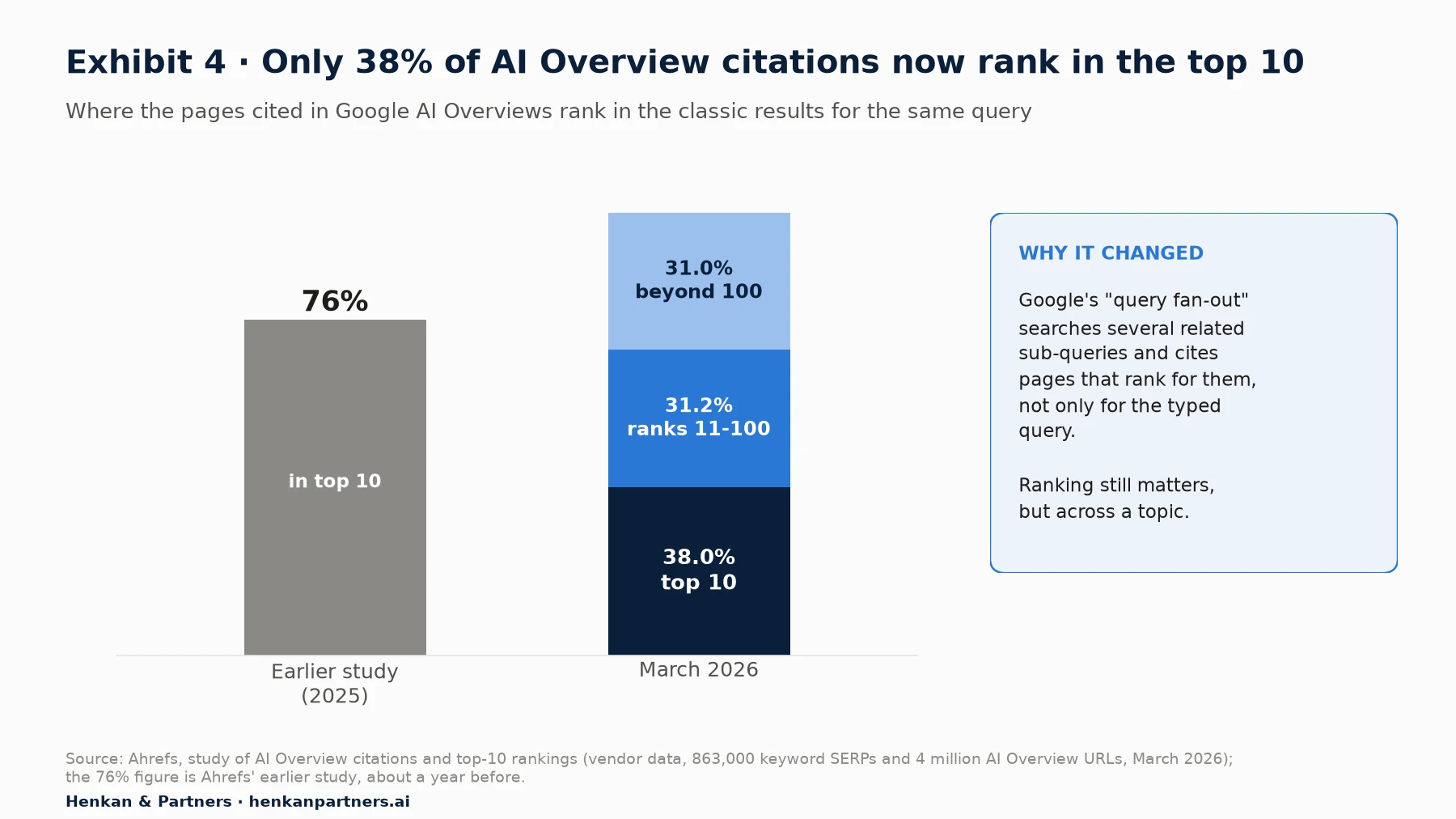
What this shows. A page can be cited without ranking for the typed query, because the engine is really answering several related questions. That rewards sites that cover a topic in depth, with pages that answer the follow-up questions a buyer would ask, over sites that chase a single head term.
2. Being talked about: brand mentions over backlinks
In Ahrefs' study of 75,000 brands (vendor data, updated April 2026), the factor most correlated with how often a brand appears in AI Overviews was branded web mentions (0.664), followed by branded anchors (0.527) and branded search volume (0.392). Classic link metrics correlated much less: Domain Rating 0.326, number of backlinks 0.218. About 26% of brands had no AI Overview mentions at all. A later Ahrefs report found YouTube mentions the strongest single signal of AI brand visibility, and YouTube was the most cited domain in AI Overviews, with 5.6% of all citations.
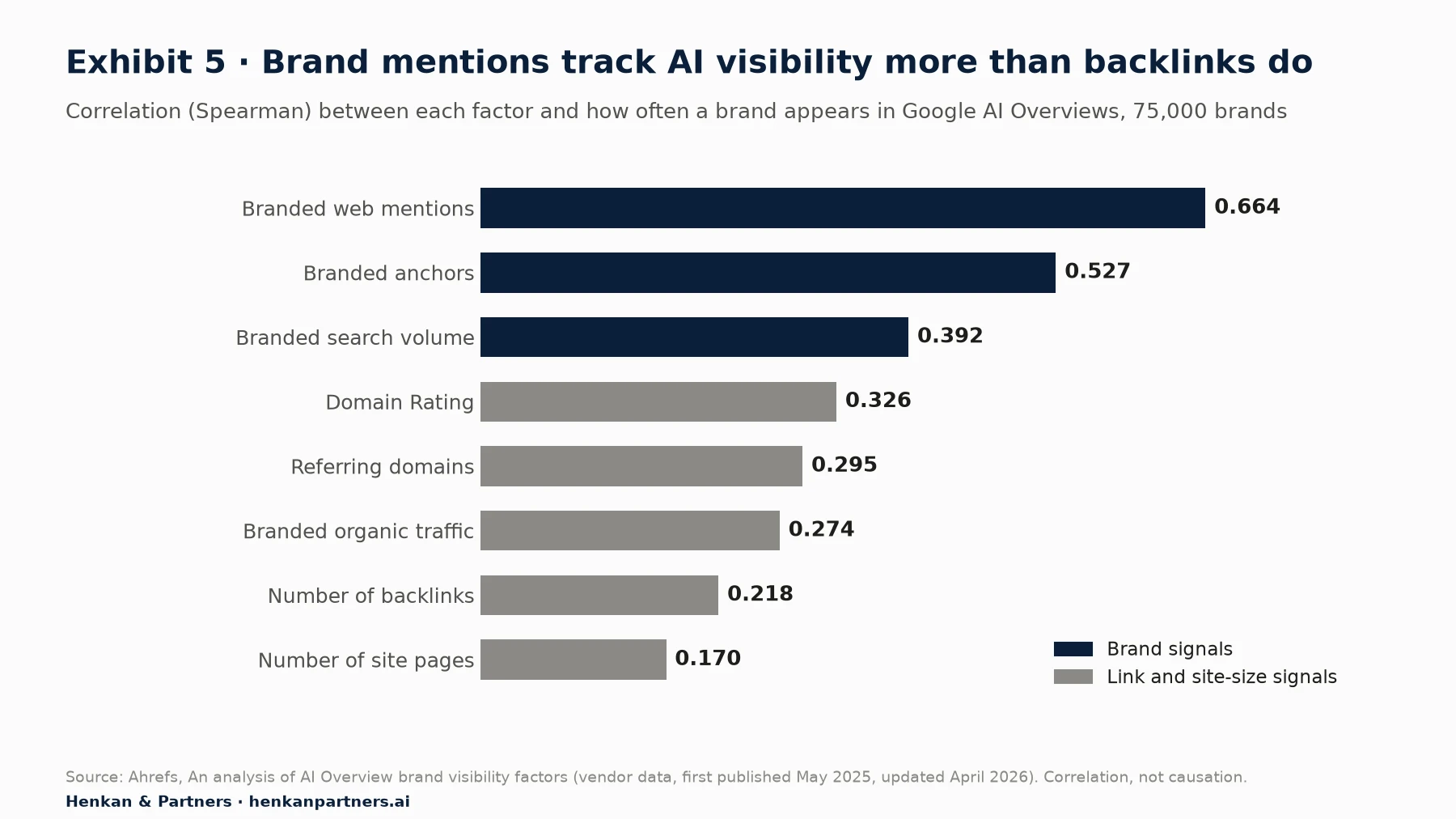
What this shows. Language models learn and retrieve associations between names and topics. A brand that is discussed on review sites, forums, videos, news and comparison articles is more likely to be named when someone asks for a recommendation. Correlation is not causation, since big brands have more of everything, but the ranking of factors is consistent with how these systems work.
3. Structure an AI can lift: answer first, one idea per passage
AI systems quote passages, not pages. Content that states the answer in the first sentence under a clear heading, defines terms plainly, and keeps each paragraph to one idea is easier to extract and attribute. This is also why the GEO study found fluency and "easy-to-understand" rewrites helped. Google notes that it does not require special markup for AI features, but accurate structured data still helps machines understand products, prices, reviews and organisations, and it powers shopping features.
4. Freshness, especially for ChatGPT
Ahrefs analysed nearly 17 million citations across seven AI platforms in 2025 and found AI assistants cite content about 26% fresher than Google's classic results. ChatGPT showed the strongest preference, citing pages 458 days newer on average than organic results; Google AI Overviews did not favour fresher content. Updating a key page with new facts, and showing a visible last-updated date, is a cheap way to stay in contention.
5. Original facts nobody else has
If ten pages say the same thing, the engine needs only one of them. Proprietary data, benchmarks, prices, specifications, test results and expert quotes give an AI a reason to cite you specifically. Pew found that Wikipedia, YouTube and Reddit together made up 15% of sources in Google's AI summaries: reference, video and first-hand discussion. Brands win citations when they are the primary source.
What about llms.txt?
llms.txt is a proposed file, first suggested in 2024, that lists a site's key content in Markdown for language models. It is harmless to publish, but do not expect it to move visibility. Google's documentation states: "You don't need to create new machine readable files, AI text files, or markup to appear in these features." A 2026 analysis by Originality.ai with server-log research from Ahrefs, reported by PPC Land, found llms.txt adoption grew 8.8 times in a year, yet 97% of the files received no requests in May 2026. As of September 2026, no major AI search engine has said it uses llms.txt to choose sources.
Section 6 · Technical GEO
Technical GEO: let the right bots in, serve content without JavaScript and keep your data accurate
Technical GEO decides whether you are eligible at all. It is also where the most expensive mistakes happen: a blanket block on "AI bots", added in 2023 to stop training, can quietly remove a site from ChatGPT or Claude answers in 2026.
Know which bot does what
AI companies now run separate bots for training, for search indexing and for fetching a page when a user asks. Blocking one does not block the others, and the choice has different consequences.
| Company | Training bot | Search / index bot | User-triggered fetch |
|---|---|---|---|
| OpenAI | GPTBot | OAI-SearchBot | ChatGPT-User (robots.txt "may not apply") |
| Anthropic | ClaudeBot | Claude-SearchBot | Claude-User |
| Perplexity | None declared (PerplexityBot is not used for training) | PerplexityBot | Perplexity-User (generally ignores robots.txt) |
| Google-Extended (a control token, not a separate crawler) | Googlebot (Search, AI Overviews, AI Mode) | Not covered here | |
| Microsoft | Not covered here | Bingbot (Bing, Copilot) | Not covered here |
The economics of those bots differ widely. Cloudflare's network data shows how many pages each platform crawls for every visitor it sends back.
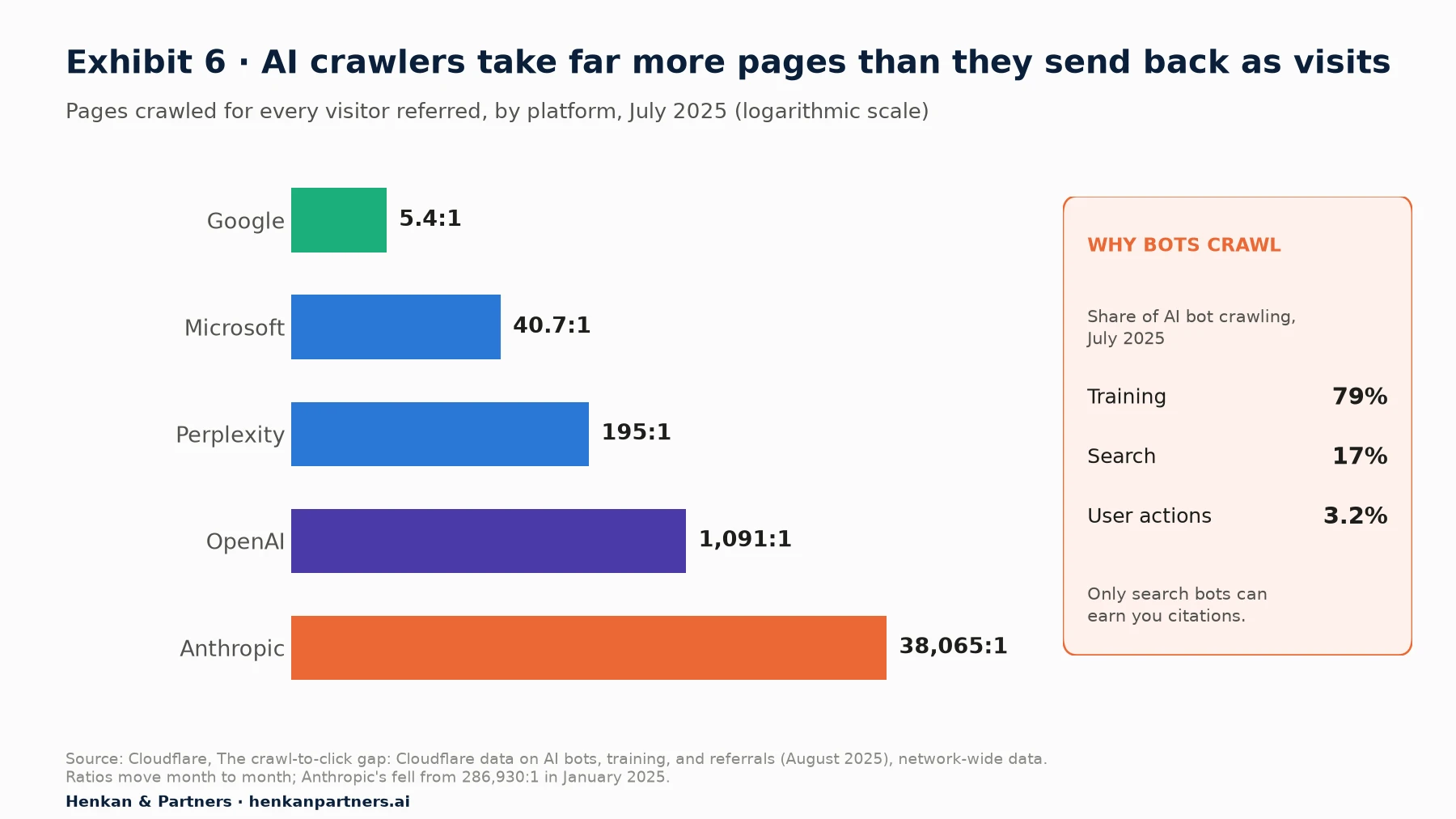
What this shows. Most AI crawling (79%) feeds model training, which earns you no citation and no visit. Search and user-triggered bots are the ones that can put you in an answer. That is the logic behind a split robots.txt policy: decide about training on principle, but let search bots in if you want to be recommended. Ratios move quickly; Anthropic's fell from 286,930 to 1 in January 2025 to 38,065 to 1 in July.
Choose a robots.txt policy deliberately
Most brands selling online should allow search bots and make a conscious decision about training bots. A typical "visible but not trained on" policy looks like this (illustrative; adapt paths and test before deploying):
User-agent: OAI-SearchBot
Allow: /

User-agent: Claude-SearchBot
Allow: /

User-agent: PerplexityBot
Allow: /

User-agent: GPTBot
Disallow: /

User-agent: ClaudeBot
Disallow: /

User-agent: Google-Extended
Disallow: /
Three cautions. First, blocking Google-Extended does not remove you from AI Overviews or AI Mode, which use Googlebot; to leave them, use the Search generative AI control in Search Console, rolled out to all sites by 31 August 2026, which excludes your content from AI Overviews, AI Mode and generative AI features in Discover without affecting other parts of Search. Snippet directives such as `nosnippet`, `data-nosnippet` or `max-snippet`, and `noindex`, also work but limit your classic results too. Second, many sites block AI bots at the CDN or firewall level, not in robots.txt, so check both. Third, OpenAI says robots.txt changes take about 24 hours to take effect in its systems.
Serve key content in the HTML
Vercel's analysis of crawler traffic found that OpenAI, Anthropic, Meta, ByteDance and Perplexity crawlers do not execute JavaScript: ChatGPT's and Claude's crawlers fetch JavaScript files but do not run them. Google's Gemini (through Google's infrastructure) and Applebot do render pages. If your product names, prices, descriptions, reviews or FAQs load only through client-side JavaScript, most AI bots see an empty template. Server-side rendering or static generation of core content is the fix.
Technical checklist
- Audit access. List every AI user agent in robots.txt, CDN and firewall rules; confirm that search bots reach product, category and guide pages.
- Check rendering. Fetch key pages with JavaScript disabled; everything you want quoted must be in the raw HTML.
- Cover both indexes. Verify the site in Google Search Console and Bing Webmaster Tools, submit sitemaps, fix indexing gaps in Bing, which serves Copilot, and check both tools' AI reports.
- Keep structured data accurate. Organization, Product, Offer, Review and FAQ markup should match what is visible on the page. It is not a ranking trick, but it removes ambiguity about who you are and what you sell.
- Log the bots. Separate AI bot traffic in server or CDN logs so you can see which pages each bot fetches, and keep bots out of your human analytics, as described in our session replay guide.
- Show freshness. Publish visible last-updated dates and keep sitemap `lastmod` values honest.
Section 7 · Content playbook
Write pages an AI can quote: answer first, add evidence, and own facts nobody else has
The content side of GEO is less about new formats than about discipline. In our experience, most pages fail to be cited for one of three reasons: they never state the answer plainly, they repeat what every competitor says, or they bury facts in marketing language. The playbook below is a Henkan & Partners framework built on the research above.
- Map the questions, not the keywords. List the questions buyers ask an assistant at each stage, in their own words: "best running shoes for flat feet under €150", "is brand X true to size", "X vs Y for sensitive skin". Use search data, site search, customer service logs and voice of customer research.
- Answer in the first two sentences. Under a heading phrased as the question, give the direct answer, then the nuance.
- Add evidence the GEO study rewards. A specific number, a named source, a short quote from an expert or a customer. Cite where each fact comes from.
- Publish something original. A size guide built from return data, a durability test, a price index, a survey. Original data is the most reliable path to citations and to brand mentions on other sites.
- Write one idea per passage. Short paragraphs, descriptive subheadings, tables for comparisons and specifications. Each passage should make sense if quoted alone.
- Be consistent about facts. Prices, availability, delivery and return terms must be identical on your site, your feeds, marketplaces and third-party profiles. Contradictions make an engine hedge or pick someone else.
- Earn mentions where the conversation happens. Reviews, comparison articles, forums such as Reddit, YouTube reviews and expert roundups. Do this through genuine product seeding and PR, not paid spam, which platforms remove and assistants learn to discount.
- Refresh what matters. Review top pages quarterly, add new facts and date the update.
Worked example: rewriting a product guide paragraph (illustrative)
Before: "Our premium merino socks are the ultimate choice for hikers who demand the very best in comfort and performance on every adventure."
After: "Merino wool socks suit multi-day hikes because they stay warm when damp and resist odour. Ours use 70% merino and 30% nylon for durability; in our 2026 wear test, 20 testers walked 300 km each and none reported holes. For summer hikes under 25°C, choose the lightweight version."
The second version answers a real question, gives numbers, names its own evidence and adds a condition. It is the kind of passage an assistant can quote when someone asks "are merino socks good for hiking?". The figures above are illustrative; use your own tested data.
For marketers. Pick your 20 most commercially important questions and check, by hand, what ChatGPT, Gemini, Perplexity and Google's AI Mode answer today. Note who is cited and why. That half-day exercise usually shows exactly which pages to rewrite first.
For leaders. The scarce asset in GEO is original evidence: data, tests, experts. Budget for producing facts, not for producing more pages.
Section 8 · Measurement
Measure GEO as share of answer, citations and AI-referred revenue, not rankings alone
AI answers change from one run to the next and from one user to another, so there is no single "position" to track. Measure GEO on a ladder, from whether bots can reach you to whether AI-influenced customers buy.
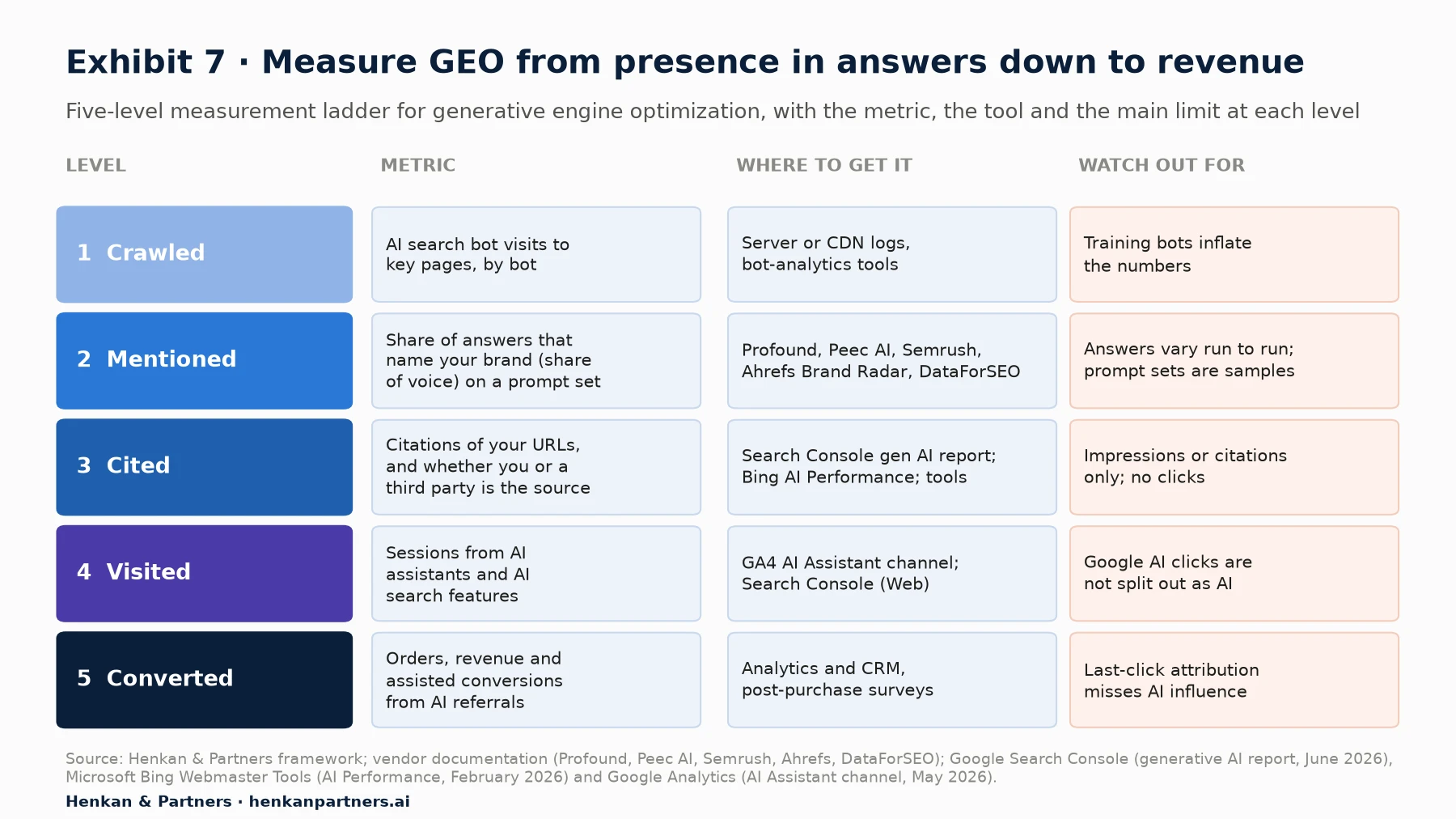
What this shows. Each level answers a different question and has a different blind spot. Mentions and citations tell you whether you are in the answer; sessions and revenue tell you whether it pays. No single tool covers all five levels, so most teams combine a prompt-tracking tool with their analytics and log data.
The core metric: share of voice in AI answers
Build a fixed set of prompts, typically 50 to 300, that reflect real buyer questions by category, stage and market. Run them regularly on each engine that matters and record whether your brand is mentioned, where, with what sentiment, and which URLs are cited. Share of voice is the percentage of answers that mention you, compared with competitors. Because answers vary, use enough prompts and repeated runs to see trends rather than reacting to single results.
AI share of voice = answers that mention your brand ÷ all answers tracked in the prompt set
Citation rate = answers that cite at least one of your URLs ÷ all answers tracked
Tools that exist today
| Tool | What it does | Engines covered (as documented) | Pricing signal |
|---|---|---|---|
| Profound | AI visibility monitoring, prompt volumes, agent analytics, ChatGPT shopping visibility | Major answer engines | Enterprise; not public |
| Peec AI | Visibility, position, sentiment and share of voice on tracked prompts | ChatGPT, Gemini, Perplexity, Copilot, AI Mode, more on Enterprise | Plans by number of prompts |
| Semrush AI Visibility Toolkit | AI visibility score, share of voice, sentiment, prompt tracking, AI site audit | Including Google AI Mode and ChatGPT | From $99 a month |
| Ahrefs Brand Radar | Brand mentions across AI answers from a large prompt database, plus custom prompts | AI Overviews, AI Mode, ChatGPT, Perplexity, Gemini, Copilot; Claude for custom prompts | Custom prompts from $50 a month |
| DataForSEO LLM Mentions API | Raw data on mentions, top domains and pages, AI search volume, for building your own dashboards | ChatGPT and Google AI Overviews | Pay as you go, per request |
| Google Search Console generative AI report | Impressions of your pages in AI features, by page, country and date (no clicks) | AI Overviews and AI Mode; a separate report covers Discover | Free |
| Bing Webmaster Tools AI Performance | Citations of your URLs and sample grounding queries | Copilot, Bing AI summaries, some partners | Free |
| Google Analytics 4 | "AI Assistant" default channel for referrals from assistants such as ChatGPT, Gemini and Claude (since May 2026) | Referral traffic only | Free |
Google closed part of the gap in 2026. Since 3 June 2026 (first in the UK, worldwide by 31 August), Search Console has a generative AI performance report showing how often links to your pages appeared in AI Overviews and AI Mode, by page, country and date. It shows impressions only: clicks from AI features are still counted in the Web performance report and cannot be separated. Two gaps therefore remain. You cannot yet see Google AI clicks on their own. And many AI-influenced journeys end in a branded search or a direct visit days later, which last-click attribution credits elsewhere. A simple "How did you hear about us?" question at checkout, with an AI assistant option, fills part of that gap. For the analytics foundations behind all of this, see our guide to web analytics and our history of the analytics market.
Section 9 · E-commerce
For e-commerce, product feeds and agentic checkout now decide whether an assistant can recommend and sell your products
For online retailers, GEO is not only about articles. When a shopper asks an assistant what to buy, the answer is built from product data: titles, attributes, prices, availability, reviews and return policies. The assistants are building shopping surfaces fed by merchant catalogues, and experimenting with buying on the shopper's behalf, called agentic commerce.
| Platform | How products get in | Checkout status (September 2026) |
|---|---|---|
| ChatGPT | Merchant product feeds through the Agentic Commerce Protocol (ACP) or providers such as Shopify, Salesforce and Stripe; Shopify and Etsy merchants integrated automatically, others apply | OpenAI launched Instant Checkout in September 2025, then in March 2026 refocused on product discovery. Customers now complete purchases on the merchant's site or app, and OpenAI says there are no fees on purchases that start in ChatGPT. |
| Google AI Mode and Gemini | Google Merchant Center feeds, with new conversational attributes such as product Q&A, compatible accessories and substitutes | UCP-powered checkout with Google Pay for select merchants in the US, Canada and Australia; the merchant remains seller of record. The Universal Commerce Protocol was announced in January 2026 with Shopify, Etsy, Wayfair, Target and Walmart. |
| Perplexity | Shopping answers that feature merchants, including retailers connected through PayPal | Instant Buy with PayPal launched for US users in November 2025; the retailer remains merchant of record. |
The direction is clear even if the details keep changing: assistants want structured, complete and current product data, and they want to hand the shopper to a checkout they trust. Adobe's 2026 analysis of retail sites found that only about half of pages were readable by AI, from 63% in cosmetics to 47% in furniture and home (vendor data). That is an opportunity for retailers who fix it first.
- Treat your feed as your most important GEO page. Complete every attribute, including materials, dimensions, compatibility, care and use cases, not just the required fields.
- Keep price and stock in sync across your site, Merchant Center, ChatGPT feeds and marketplaces. Stale data is the fastest way to be dropped.
- Publish reviews and Q&A on product pages in crawlable HTML. They answer the comparison questions shoppers put to assistants.
- Write category and comparison content that states who each product is for. Assistants recommend by fit ("best for wide feet"), so say it plainly.
- Get ready for agentic checkout by following ACP and UCP, and by making sure your own checkout converts the AI-referred shopper who arrives already decided. The e-commerce market equation shows why conversion and average order value matter as much as the traffic source.
Section 10 · Risks and myths
Most GEO myths promise shortcuts; the real risks are noise, inaccuracy and giving content away
Six myths to ignore
| Myth | Reality |
|---|---|
| "SEO is dead." | AI features retrieve from search indexes. Google says SEO best practices remain relevant, and it still sends far more traffic than any assistant. |
| "You need llms.txt." | Google says no AI text files are needed; server-log data shows almost no AI bots request them. |
| "Special schema gets you into AI Overviews." | Google says there is no special schema for AI features. Accurate structured data helps understanding, not eligibility. |
| "Repeat the keyword so the AI picks you." | In the GEO study, keyword stuffing reduced visibility by about 8%. |
| "GEO is a quick hack." | The strongest correlates, brand mentions and original data, take months to build. |
| "Block all AI bots to protect your content." | Blocking search bots removes you from answers. Decide separately for training and search. |
Five real risks
- Wrong answers about your brand. Assistants can state outdated prices, discontinued products or policies you never had. Monitor what they say and fix the source, often an old page or a third-party listing.
- Measurement noise. Answers are non-deterministic and personalised. Small prompt sets and single runs produce false trends; buy tools with that in mind.
- Manipulation and its backlash. Hidden instructions aimed at AI systems, fake reviews and paid mention networks may work briefly and create legal and reputational risk. Treat them like black-hat SEO.
- Giving value away. Letting bots read everything may help visibility while reducing visits. For publishers and content-led brands, the robots.txt decision is a commercial one; for most retailers, visibility usually wins.
- Chasing vanity metrics. A rising share of voice that does not show up in AI-referred revenue, or in brand search, is not a result. Tie GEO reporting to the business.
Disclosure: Henkan & Partners is building an SEO and GEO service, and uses DataForSEO data in its own work.
Section 11 · What to do next
Six steps to start generative engine optimization this quarter
1. Take a baseline of your AI visibility
Write 50 to 100 buyer questions for your main categories and markets. Run them on Google AI Mode, ChatGPT, Gemini, Perplexity and Copilot, by hand or with a tool, and record mentions, citations, competitors and errors. This is your starting share of voice.
2. Fix access and rendering
Review robots.txt, CDN and firewall rules for every AI user agent, decide your training policy, allow search bots, and check that key content is in the server-rendered HTML. Verify the site in Bing Webmaster Tools.
3. Make your product and brand data complete and consistent
Complete Merchant Center and ChatGPT-compatible feeds, align prices and policies everywhere, and correct third-party profiles that assistants cite about you.
4. Rewrite the pages that matter most
Start with the 20 questions where competitors are cited and you are not. Answer first, add sourced numbers and quotes, publish at least one piece of original data, and date every update.
5. Earn mentions beyond your site
Plan PR, reviews, creator content and expert contributions around the topics you want to own. Track which third-party pages assistants cite, and aim to be on them.
6. Measure, test and report monthly
Report share of voice, citations, AI-referred sessions and revenue together. Where possible, test content changes on comparable page groups before rolling them out. If you want help setting up a GEO baseline or measurement, Talk to us.
FAQ
Frequently asked questions about generative engine optimization
Frequently asked questions
What is generative engine optimization (GEO)?
Generative engine optimization is the practice of making your brand, pages and products more likely to be retrieved, quoted, cited and recommended in answers written by AI systems such as Google AI Overviews and AI Mode, ChatGPT, Perplexity, Gemini, Copilot and Claude. The term comes from a 2023 Princeton and IIT Delhi paper published at KDD 2024.
What is the difference between GEO and SEO?
SEO aims to rank pages in search results and win clicks. GEO aims to be included and cited in AI-written answers. GEO builds on SEO, because AI features retrieve from search indexes, but it puts more weight on topic coverage, brand mentions, quotable evidence, AI bot access and product data.
Is GEO the same as answer engine optimization (AEO)?
They overlap heavily. AEO started with featured snippets and voice assistants and focuses on being the direct answer. GEO focuses on AI systems that synthesise answers from several sources. Many practitioners now use AEO, GEO, AI search optimization and LLM SEO interchangeably.
How do I rank in ChatGPT?
There is no ranking list, but you can raise your chances of being cited: allow OAI-SearchBot in robots.txt, serve key content in HTML, be well indexed in the search engines ChatGPT draws on, publish clear pages with sourced facts, keep content fresh and earn mentions on sites ChatGPT cites. Retailers should also share product feeds with ChatGPT.
How do I appear in Google AI Overviews?
Google says there are no additional requirements: the page must be indexed and eligible to show a snippet. In practice, cover the related questions around a topic, since AI Overviews use query fan-out, write answers that can be quoted, and build your brand's authority. Blocking Google-Extended does not affect AI Overviews; the Search generative AI control in Search Console is the setting that excludes a site.
Does llms.txt help with AI search optimization?
Not today. Google states you do not need AI text files to appear in its AI features, and 2026 server-log research found 97% of llms.txt files received no requests. It does no harm, but it should not be a priority.
Should I block AI crawlers like GPTBot?
Decide separately for training and search. Blocking training bots such as GPTBot, ClaudeBot or Google-Extended keeps your content out of future model training without removing you from answers. Blocking search bots such as OAI-SearchBot, Claude-SearchBot or PerplexityBot can remove you from those assistants' answers.
How do you measure GEO?
Track a fixed set of buyer prompts across engines and measure share of voice (how often you are mentioned), citations of your URLs, AI-referred sessions (GA4 now has an AI Assistant channel) and the revenue they generate. Free sources include Google Search Console's generative AI report (impressions in AI Overviews and AI Mode) and Bing Webmaster Tools' AI Performance report; paid tools include Profound, Peec AI, Semrush, Ahrefs Brand Radar and DataForSEO.
How long does GEO take to show results?
Technical fixes such as unblocking search bots can take effect within days; OpenAI says robots.txt changes are processed in about 24 hours. In our experience, content rewrites show up in weeks, once pages are recrawled. Brand mentions and original data, the strongest correlates of AI visibility, take months.
Key terms
- Generative engine
- A system that searches for information and writes a synthesised answer with a language model, such as AI Overviews, ChatGPT search or Perplexity. It matters because it can use your content without sending a visit.
- Generative engine optimization (GEO)
- The practice of being retrieved, cited and recommended in AI-written answers. It matters because being cited is what limits the loss of clicks when an AI answer appears.
- Answer engine optimization (AEO)
- Optimising content to be the direct answer in snippets, voice assistants and AI answers. It matters because it overlaps with GEO and shares its question-first writing style.
- Retrieval-augmented generation (RAG)
- The technique of fetching relevant documents at question time and grounding a model's answer in them. It matters because it is why AI search can cite current pages, including yours.
- Grounding
- Basing an AI answer on specific retrieved sources rather than the model's memory. It matters because grounded answers are the ones that carry citations and links.
- Query fan-out
- Google's technique of issuing several related searches across subtopics before writing an AI answer. It matters because pages can be cited for sub-queries they rank for, not only the typed query.
- AI Overviews and AI Mode
- Google's AI summaries at the top of results and its conversational AI search experience. They matter because they reach more than a billion users and change how many people click through.
- Citation
- A link to a source shown with an AI answer. It matters because cited brands earn far more clicks than uncited ones on the same results page.
- Share of voice in AI answers
- The percentage of answers to a tracked prompt set that mention your brand, compared with competitors. It matters because it is the closest AI search equivalent to a ranking.
- Training crawler
- A bot that collects pages to train future models, such as GPTBot or ClaudeBot. It matters because blocking it protects content from training without removing you from AI answers.
- Search crawler (AI)
- A bot that indexes pages so an assistant can cite them, such as OAI-SearchBot, Claude-SearchBot or PerplexityBot. It matters because blocking it can remove you from that assistant's answers.
- Google-Extended
- A robots.txt token that controls whether Google may use your content for Gemini training and Gemini grounding. It matters because it does not affect Google Search or AI Overviews, a common misunderstanding.
- Search Console generative AI report
- A Google Search Console report, launched in June 2026, showing impressions of your pages in AI Overviews and AI Mode. It matters because it is Google's first first-party view of AI visibility, although it does not show clicks.
- llms.txt
- A proposed Markdown file that lists a site's key content for language models. It matters because it is widely promoted but not required or, so far, widely used by AI search engines.
- Agentic commerce
- Shopping in which an AI assistant finds, compares and sometimes buys products for the user. It matters because product feeds and checkout protocols such as ACP and UCP decide which retailers the assistant can sell.
Sources
All sources were checked in September 2026. Figures from Ahrefs, Seer Interactive, Adobe, Contentsquare, Cloudflare and Originality.ai are vendor data drawn from their own customers, tools or networks and were not independently audited; we flag them where used. Percentages in Exhibit 3 are computed by Henkan & Partners from the scores published in Table 1 of the GEO paper. Exhibits 2 and 7 and Exhibits A and F are Henkan & Partners frameworks; the content playbook and worked example reflect our project experience, and the worked example's figures are illustrative. Tool features and prices change often.
- Aggarwal, Murahari, Rajpurohit, Kalyan, Narasimhan and Deshpande (2024). GEO: Generative Engine Optimization, KDD 2024, arXiv 2311.09735.
- Google Search Central (2026). AI features and your website.
- Google Search Central (2026). Google's common crawlers (Google-Extended).
- Alphabet (2026). Q2 2026 earnings call: remarks from Sundar Pichai.
- TechCrunch (2026). ChatGPT reaches 900M weekly active users.
- OpenAI (2024). Introducing ChatGPT search.
- Pew Research Center (2025). Google users are less likely to click on links when an AI summary appears in the results.
- Ahrefs (2026). AI Overviews reduce clicks: 2026 update and April 2025 study. Vendor data.
- Seer Interactive (2026). AIO impact on Google CTR: 2026 update. Vendor data.
- Contentsquare (2026). What is AI-referred traffic? 2026 benchmarks. Vendor data.
- Adobe (2026). Holiday shopping season results, vendor data; and Digital Commerce 360 (2026). Adobe: AI-referred traffic to retail sites doubles in a year.
- Ahrefs via Business Wire (2026). Across 75,000 brands, YouTube mentions are the strongest signal of AI visibility. Vendor data.
- Gartner (2024). Gartner predicts search engine volume will drop 25% by 2026.
- Ahrefs (2026). AI Overview citations and the top 10. Vendor data.
- Ahrefs (2026). An analysis of AI Overview brand visibility factors (75K brands studied). Vendor data.
- Ahrefs (2025). Do AI assistants prefer to cite fresh content?. Vendor data.
- PPC Land (2026). llms.txt adoption rises 8.8x but 97% of files get zero AI requests.
- OpenAI (2026). Overview of OpenAI crawlers.
- Anthropic (2026). Does Anthropic crawl data from the web, and how can site owners block the crawler?.
- Perplexity (2026). Perplexity crawlers.
- Cloudflare (2025). The crawl-to-click gap: Cloudflare data on AI bots, training, and referrals. Network data.
- Vercel (2024). The rise of the AI crawler.
- Google (2026). New opportunities, control and insights for website owners.
- Google Search Console Help (2026). Generative AI performance report (Search) and Search generative AI control.
- Search Engine Land (2026). Bing Webmaster Tools officially adds AI Performance report.
- Google (2026). What's new in Google Analytics: AI Assistant channel.
- Ahrefs (2026). Brand Radar; Semrush (2026). AI Visibility Toolkit; Peec AI (2026). Pricing; Profound (2026). Platform overview; DataForSEO (2026). LLM Mentions API.
- OpenAI (2026). Powering product discovery in ChatGPT and ChatGPT for merchants.
- OpenAI (2025). Buy it in ChatGPT: Instant Checkout and the Agentic Commerce Protocol.
- Forbes (2026). Why OpenAI's checkout retreat spells trouble for its commerce strategy.
- Google (2026). New tech and tools for retailers to succeed in an agentic shopping era and Merchant Center Help, About the Universal Commerce Protocol.
- PayPal (2025). PayPal and Perplexity launch Instant Buy.
- Henkan & Partners. The Essential Guide to E-commerce Acquisition and Retention Channels, Understanding the E-commerce Market Equation, The Essential Guide to Web Analytics, Session Replay in 2026 and The Digital Analytics Market, 1995–2026.