Focus
Where to Start: Finding Champions, Securing a Sponsor and Setting the Rituals of an Experimentation Programme
Alexandre Suon · 2026-10-01
You do not need a company-wide mandate to start an experimentation programme. You need one executive sponsor, four to six champions and a few short rituals that make testing a habit. This deep dive shows how to find those people, where to run your first tests, and gives you ritual agendas, a one-page charter template and a 90-day plan you can copy.
Executive summary
- Start small and deliberate: one sponsor, one owner, a handful of champions. A programme is not a tool licence. It is a group of people who agree to let evidence decide, plus a rhythm that keeps them doing it.
- Secure the sponsor before the first test. In Prosci's change-management research, 73% of projects with an extremely effective sponsor met or exceeded their objectives, against 29% with a very ineffective one. Ask your sponsor for four specific things, not for general support.
- Choose champions for credibility, not job title. Look for respected early adopters in product, design, engineering, marketing, analytics and trading. Rogers' diffusion research puts early adopters at about 13.5% of a population; they are the people peers copy.
- Run your first tests where traffic, appetite and low politics overlap. A team with enough traffic to conclude tests in two to four weeks, a manager who wants answers and no turf war will give you clean early results.
- Install five short rituals and give each one a single output. A weekly stand-up, a fortnightly idea intake, a monthly show-and-tell, a monthly results digest and a quarterly roadmap review. That is about four hours a month for a champion. Microsoft's experimentation platform team describes similar results reviews and company-wide "Best Experiments Talks".
- Write it down on one page and plan 90 days in four phases. In Ascend2's 2025 survey of 402 marketing decision-makers who run A/B tests, only 46% had a comprehensive, regularly updated documented testing strategy. A one-page charter and a phased 90-day plan with exit tests close that gap.
Section 1 · Where to start
You do not need a mandate to start, you need a sponsor, a few champions and a habit
An experimentation programme is the people, rules and routines that let an organisation decide changes with controlled experiments (A/B tests) as a matter of course, rather than one test at a time. It has an owner, a sponsor, a backlog, agreed metrics, a quality standard and a regular rhythm for sharing results.
Most programmes start because one person, often a CRO lead, product manager or analyst, runs a few tests and wants more. The question is how to make that survive a reorganisation or its founder leaving.
The answer is less about tools and more about people and routines. You need someone senior who protects the work (the sponsor), a few respected people in other teams who carry it into their own work (the champions), and a set of short meetings and documents that keep everyone moving (the rituals). Write those down in a one-page charter and you have a programme.
This article is the second step in our learning path Build a culture of experimentation. If you need the big picture first, read how to build a culture of experimentation and see how Booking.com, Microsoft and others experiment at scale. If you have just been hired into a CRO role, our guide to your first 90 days in a new CRO role covers your personal plan; this article covers the programme's plan.
| Building block | What it is | Minimum to start |
|---|---|---|
| Sponsor | A senior leader who owns a roadmap and protects the programme | One named person who attends two meetings a quarter |
| Owner | The person who runs the backlog, rituals, QA and reporting | One named person, at least half their time |
| Champions | Respected practitioners who bring testing into their teams | Four to six people, about half a day a week |
| Rituals | Recurring meetings and documents with fixed agendas | Five rituals, each with one output |
| Charter | A one-page agreement on purpose, rights and rules | Version 0 signed by the sponsor in week two |
Section 2 · The sponsor
Secure one executive sponsor first, because sponsorship predicts success more than anything else
Experimentation changes who gets to decide. A test can overrule a director's favourite idea, and that is uncomfortable. Without someone senior saying "we decide this way now", the first awkward result tends to end the programme.
The evidence from change management is consistent. Prosci has run benchmarking studies on change projects since 1998, and "active and visible sponsorship" has ranked as the top contributor to success in all eleven editions, beating the second factor by a 4:1 margin. The same research found that half of participants said their sponsors had a less than adequate understanding of the role. So you are not only finding a sponsor, you are teaching them what to do.
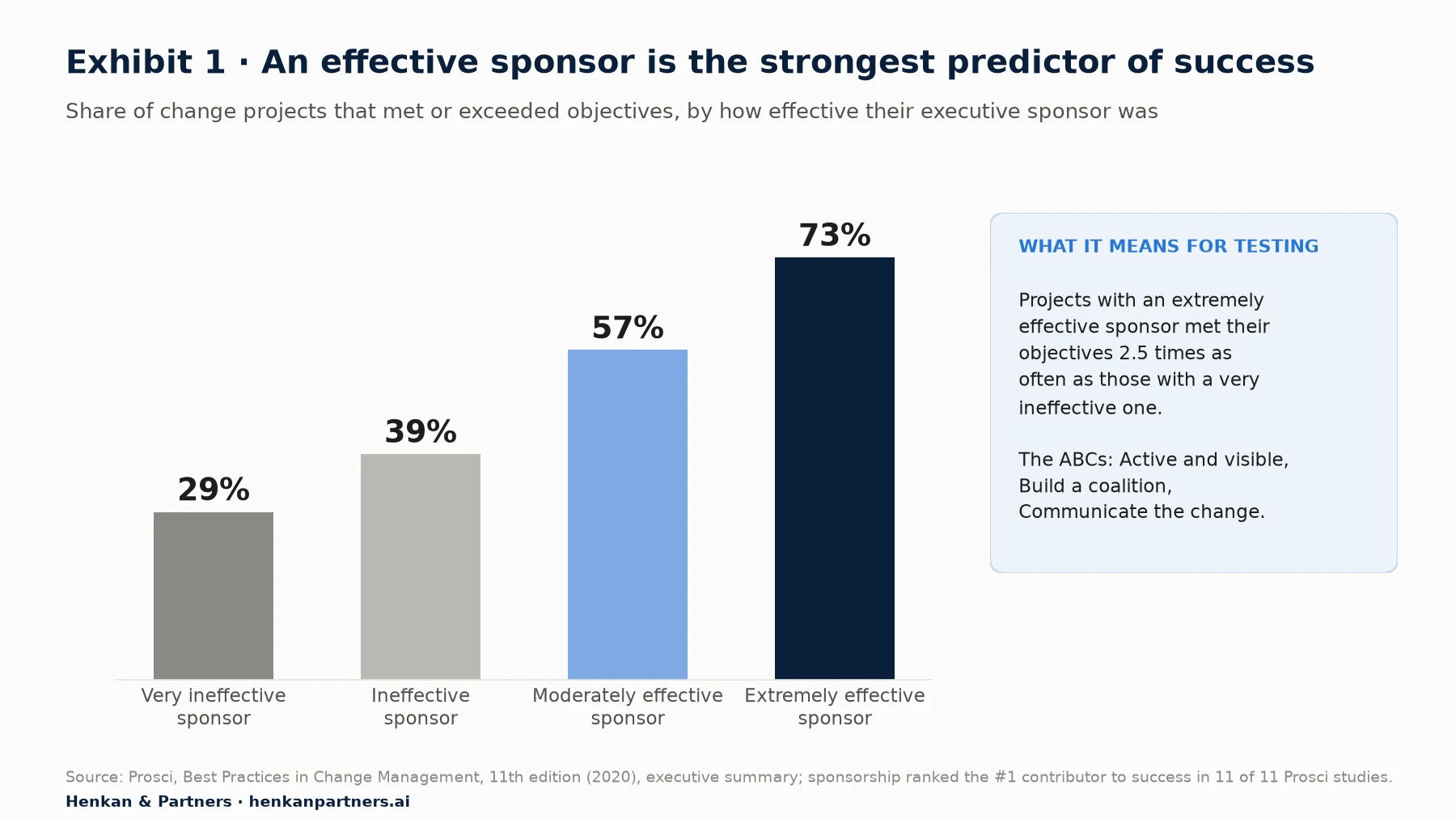
What this shows. The data comes from change projects in general, not experimentation programmes specifically, so treat it as directional. But the pattern matches what we see: programmes with an engaged sponsor survive their first losing tests, and programmes without one fade. Prosci summarises the job as the ABCs: be active and visible, build a coalition of other sponsors, and communicate the change.
How to choose your sponsor
The best sponsor is not always the most senior person who likes data. Look for these five traits:
- Owns a roadmap you can test. A head of e-commerce, product or digital whose decisions tests can inform. A sponsor with no roadmap gives approval but no work.
- Cares about a metric testing can move. Conversion, average order value, sign-ups, retention. If their bonus depends on it, even better.
- Will show up. Thirty minutes at the monthly show-and-tell and 90 minutes at the quarterly review. Ask directly; a sponsor who cannot commit this time is a name, not a sponsor.
- Can be wrong in public. The sponsor's own idea will lose a test one day. How they react sets the culture. Ask them how they would feel if the test of their favourite idea failed.
- Is staying. Avoid someone who is likely to move within a year. A programme that loses its sponsor in month four rarely recovers.
The sponsor ask: four specific commitments
Vague support ("I'm a big fan of testing") is worth little. Go into the meeting with a written ask. In our experience these four commitments matter most:
| Commitment | What it looks like in practice | Why it matters |
|---|---|---|
| 1. Name it publicly | An email or all-hands mention announcing the programme, its owner and its first area | Gives champions permission to spend time on it |
| 2. Protect capacity | For example, one developer day a week and part of one analyst, ring-fenced for 90 days | Capacity is the first thing to disappear when deadlines hit |
| 3. Agree a decision rule | "Changes in the test area ship when a test supports them, or by a documented exception" | Without it, results are optional and people stop caring |
| 4. Protect losing tests | Opens the show-and-tell, celebrates a test that stopped a bad change | Teams only report honestly when failure is safe |
For leaders. If someone asks you to sponsor an experimentation programme, the most useful thing you can do costs no budget: let one of your own ideas be tested first, and talk about the result whatever it is.
For practitioners. Bring a one-paragraph business case to the sponsor meeting. Our article on building the business case for experimentation shows how to size it without promising uplifts you cannot guarantee.
Section 3 · Champions
Recruit four to six champions for their credibility with peers, not their job title
A champion (some companies say ambassador) is a practitioner in another team who spends part of their time bringing testing into that team's work. They submit ideas, help colleagues write hypotheses, sit in on reviews and talk about results in their own meetings. They are how the programme spreads beyond the owner's calendar.
This is not a new idea. Kotter's classic analysis of failed transformations names "not creating a powerful enough guiding coalition" as the second of eight errors, and notes that in large organisations the coalition "needs to grow to the 20 to 50 range before much progress can be made". Experimentation teams use the same idea. At Vista, Lukas Vermeer and Flavio De Souza describe Experimentation Ambassadors as "the first line of support for any experiment in a domain", with second-line support from experimentation consultants in a central Centre of Excellence. A large company may eventually need dozens of champions. To start, you need four to six good ones.
Where to look: early adopters, not only enthusiasts
Everett Rogers' research on how new practices spread splits any population into five groups by how early they adopt. The innovators (about 2.5%) will try anything, but peers often see them as outliers. The early adopters (about 13.5%) are the opinion leaders: respected, curious, and watched by colleagues. They are your champion pool.
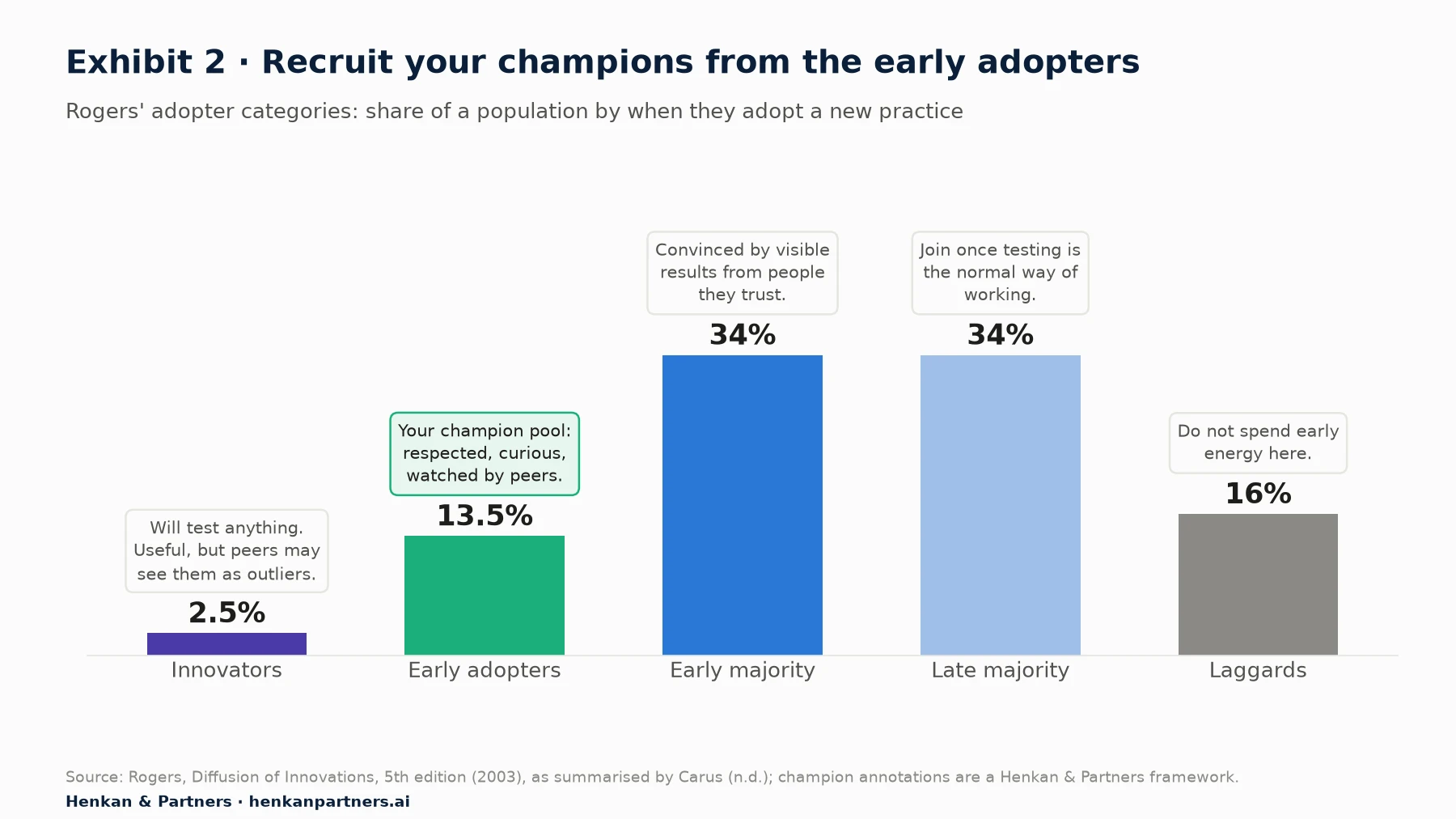
What this shows. The early majority, a third of your organisation, will follow once they see results from people they trust. That is why credibility matters more than enthusiasm when you pick champions. A respected senior designer who is curious about testing will move more colleagues than a junior analyst who loves statistics.
What a champion looks like in each function
| Function | What they bring | Signal to look for | What to offer them |
|---|---|---|---|
| Product | Roadmap questions worth testing; turns features into experiments | Already asks "how will we know it worked?" | Faster, safer launch decisions |
| Design / UX | Research insight and variant design | Runs user research and shares it | Evidence to settle design debates |
| Engineering | Feature flags, test builds, QA, performance | Cares about release quality | Fewer rollbacks, cleaner releases |
| Marketing / CRM | Offers, messages, landing pages, emails | Already A/B tests emails or ads | Proof of what drives revenue |
| Analytics | Metric definitions, tracking, trust checks | Questions dashboards before using them | A seat at the decision table |
| Trading / merchandising | Ranking, promotions, ranges, pricing displays | Asks why a promotion worked | Tested playbooks for peak periods |
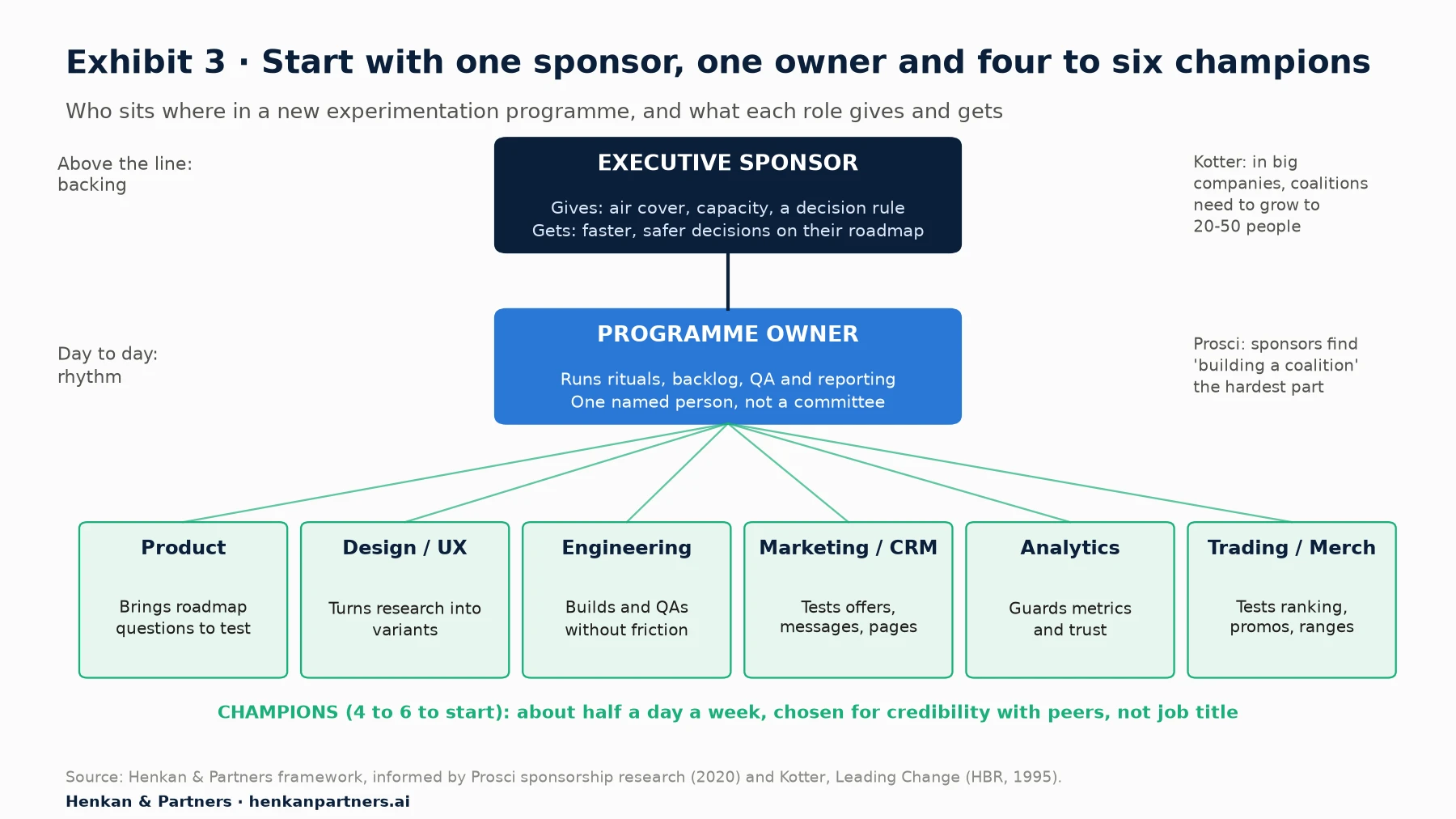
What this shows. The owner is the hub. The sponsor provides cover from above; champions carry the work sideways into their teams. You do not need every function on day one. Pick the four to six that matter most for your first area, and add the rest as the programme widens.
How to select champions and keep them engaged
Score each candidate from 1 to 3 on five criteria, and pick those with 11 points or more (Henkan & Partners framework):
- Credibility. Do peers ask this person for advice?
- Curiosity. Do they ask "why" and "how do we know"?
- Access to a test surface. Do they work on pages, features or campaigns with enough traffic?
- Manager support. Will their manager release about half a day a week? Get this in writing.
- Comfort with being wrong. Have they ever changed their mind publicly because of data?
Then make it worth their while. Microsoft's guidance for Microsoft Teams champion programmes recommends being clear about requirements, training champions "early and often", holding regular monthly meetings and visibly rewarding them, noting that employees often are not looking for monetary gain but appreciate recognition. For experimentation champions, in our experience, the rewards that work are: their name on results in the digest, first access to the analyst and developer, a short training path (our sibling article on hiring and training an experimentation team covers it), and a line in their performance review agreed with their manager.
Our view. Do not appoint champions by email. Invite them personally, explain the time commitment and what they get, and let them say no. Volunteers who said yes to something specific stay; conscripts drift away by week six.
Section 4 · The first area
Start where traffic, appetite and low politics overlap
Your first area is the page, product, journey or team where the programme runs its first tests. Choose it carefully. Early tests need to conclude cleanly and quickly, and their results need to be used. Three filters help:
- Traffic. Enough users and conversions to reach a decision in two to four weeks. Our guide to A/B test sample size and duration shows how to check.
- Appetite. A manager in that area who wants answers and has open questions on their roadmap. Testing in an area whose owner does not care produces results nobody acts on.
- Low politics. No ongoing turf war, redesign or re-platforming. A checkout owned by three teams, or a homepage the brand team guards, is a poor first choice.
First-area score = Traffic (1-5) + Appetite (1-5) + Politics (1-5, where 5 = least contested) + Test-ability (1-5)
Shortlist areas scoring 15 or more; pick the one whose owner will join the sponsor review.
| Candidate area (illustrative) | Traffic | Appetite | Politics | Test-ability | Total |
|---|---|---|---|---|---|
| Product listing pages | 5 | 4 | 4 | 4 | 17 |
| Checkout | 4 | 3 | 2 | 3 | 12 |
| Homepage hero | 5 | 2 | 1 | 5 | 13 |
| Account sign-up flow | 3 | 5 | 4 | 4 | 16 |
| B2B quote form | 1 | 5 | 5 | 3 | 14 |
In this illustrative example, the product listing pages win: traffic, a merchandising team that wants answers, and no ownership dispute. The homepage has traffic but is contested. The B2B quote form has keen owners but too little traffic for classic A/B tests. If your traffic is limited everywhere, read our article on A/B testing mistakes before you start, because low-traffic programmes are where false positives breed.
Section 5 · Rituals
Five short rituals turn a few tests into a habit
Rituals sound soft. They are not. They are the mechanism that moves tests from idea to decision without the owner chasing everyone. Each ritual below has a fixed cadence, a fixed agenda and one output. If a ritual has no output, cancel it.
The largest programmes use the same patterns. Microsoft's Experimentation Platform team describes how some teams "hold regular reviews where experimenters bring in their A/B test results" to validate or negate hypotheses, how results are included in "ship" emails, and how Microsoft organises company-wide "Best Experiments Talks" where tests with valuable learnings are presented to spark interest in data-driven decisions.
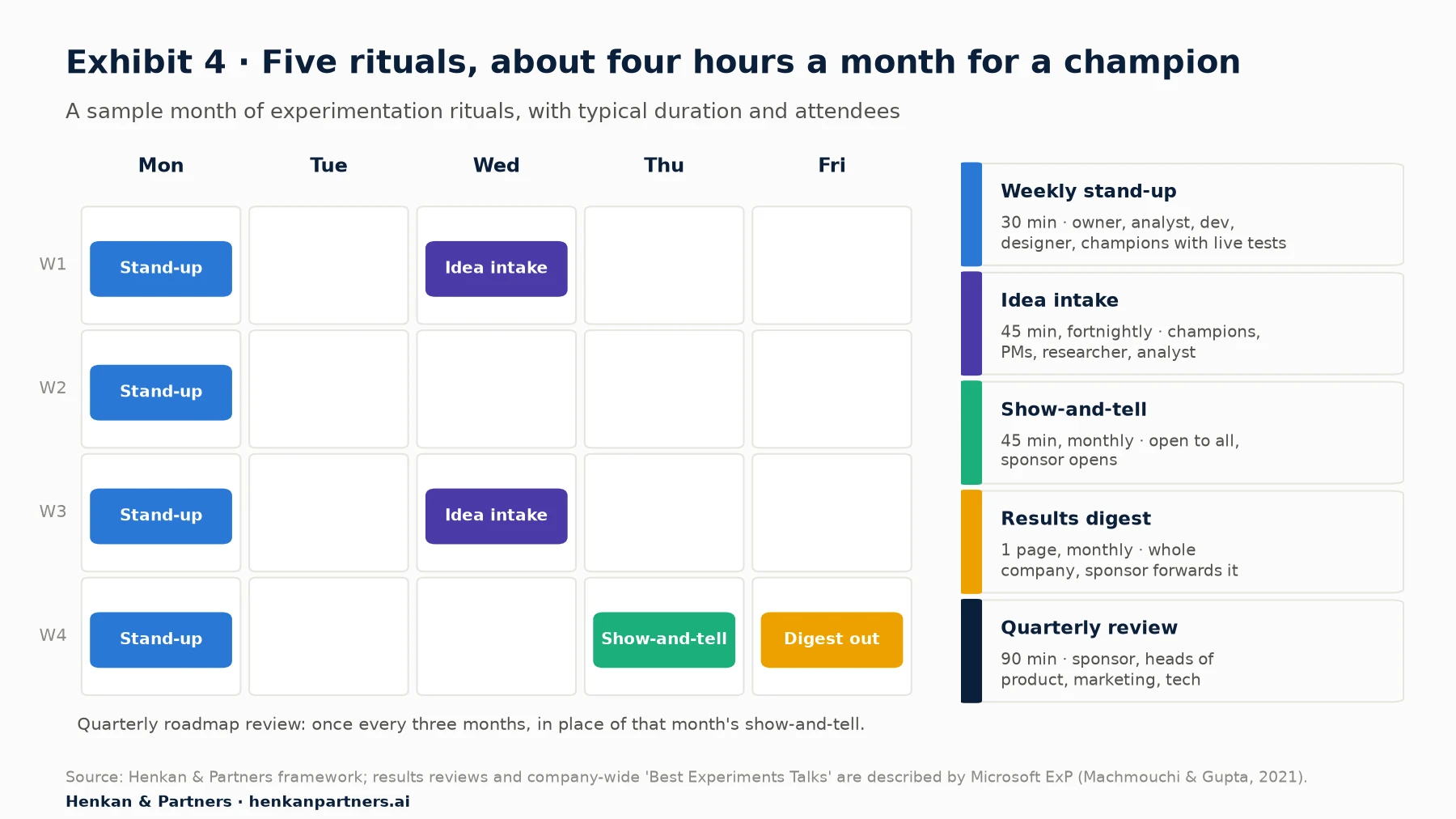
What this shows. For a champion, the whole rhythm costs about four hours a month: four 30-minute stand-ups, two 45-minute intake sessions and one 45-minute show-and-tell. For most other people it is 45 minutes a month plus reading a one-page digest. Keep it that light, or attendance will fall.
| Ritual | Cadence | Duration | Attendees | Single output |
|---|---|---|---|---|
| Experiment stand-up | Weekly | 30 min | Owner, analyst, developer, designer, champions with live tests | Updated test board and a named owner for every blocker |
| Idea intake and prioritisation | Fortnightly | 45 min | Owner, champions, product managers, researcher, analyst | Ranked backlog and the next two to three tests committed |
| "What we learned" show-and-tell | Monthly | 45 min | Open to all; sponsor opens | Learnings logged and one decision announced |
| Results digest | Monthly | 1 page | Whole company; sponsor forwards it | A written record people can search later |
| Quarterly roadmap review | Quarterly | 90 min | Sponsor, heads of product, marketing, tech; finance optional | Next quarter's areas, targets and capacity agreed |
Section 6 · Ritual agendas
Copy these agendas and keep every ritual short, timed and tied to one output
The agendas below are the ones we use when we set up programmes. Copy them into your calendar invites. Timings add up to the slot length, so the meeting ends on time.
1. Weekly experiment stand-up (30 minutes)
Purpose: keep live and upcoming tests healthy and unblocked. Chair: programme owner. Board: one card per test, with status (idea, design, build, QA, live, analysing, decided).
- Live test health (8 min). For each live test: traffic split as expected (no sample ratio mismatch), guardrail metrics normal, any bugs reported. Our article on guardrail metrics explains what to watch.
- Launching this week (8 min). QA status against the launch QA checklist, sign-offs needed, planned start date.
- Ready to decide (8 min). Tests that reached their planned duration: who writes the result, when it goes to the decision owner.
- Blockers and asks (6 min). Each blocker gets a named owner and a date. Escalations to the sponsor are noted here.
Anti-pattern: discussing results in depth. Park those for the show-and-tell or a separate analysis session.
2. Idea intake and prioritisation (45 minutes, fortnightly)
Purpose: turn ideas into a ranked, evidence-backed backlog. Chair: owner, with champions presenting their teams' ideas. Rule: no idea is discussed unless it was submitted in the intake form 48 hours before, with the problem, the evidence and the hypothesis.
- New submissions (10 min). Each submitter has one minute: the problem, the evidence (analytics, research, survey, support tickets), the proposed change.
- Scoring (15 min). Score with one agreed framework. Our guide on writing and prioritising test hypotheses compares the common ones.
- Feasibility and sizing (10 min). Developer and analyst flag build effort and whether traffic can support the test.
- Commit (10 min). Agree the next two or three tests to design, and retire ideas older than three months that never ranked.
Anti-pattern: the most senior person's idea goes first. Score it like any other; that is the point.
3. Monthly "what we learned" show-and-tell (45 minutes)
Purpose: make results visible and safe to share, including losses. Chair: sponsor opens, owner hosts. Audience: open invitation; record it.
- Sponsor opening (3 min). Why this matters, and one decision the sponsor made because of a test.
- Guess the winner (5 min). Show control and variant of the first test; the audience votes before the reveal. It is the fastest way to show that intuition is unreliable.
- Three test stories (24 min). Eight minutes each, told by the champion who ran it: question, what we changed, what happened, what we decided. At least one must be a loss or a flat result.
- What we will test next (5 min). Top of the backlog, and how people can submit ideas.
- Questions (8 min).
Anti-pattern: a slide deck of uplift percentages. Tell stories about decisions. Our sibling article on building momentum covers how to tell a result story and celebrate losses.
4. Monthly results digest (one page)
Purpose: create a written record and reach people who never attend meetings. Owner: programme owner writes it; sponsor forwards it with one line of their own. Template:
- Headline: the single most useful thing we learned this month, in one sentence.
- Tests concluded: for each, the question, the result (win, loss, flat, inconclusive), and the decision taken.
- Learning of the month: one insight about customers that holds beyond the single test.
- Programme pulse: tests launched, tests concluded, average days from idea to decision.
- Coming next: two or three tests about to launch, and who to contact.
- Ask: one thing you need (an idea for a page, a developer, a decision).
Store every digest and every test write-up in one searchable place. According to Speero's 2024 benchmark report, half of the experimentation teams it surveyed did not have a centralised repository or knowledge base for test documents (agency data; sample size not published). Our sibling article on measuring an experimentation culture covers how to build that learning library.
5. Quarterly roadmap review (90 minutes)
Purpose: renew the sponsor's commitment, agree next quarter's focus and capacity. Chair: sponsor. Attendees: heads of product, marketing and technology for the areas in scope, the owner, two champions; finance optional.
- Programme scorecard (15 min). Tests launched and concluded, time to decision, share of tests passing QA and trust checks, decisions taken.
- Learning themes (20 min). Three or four patterns from the quarter, with the decisions they changed.
- Value and cost (15 min). Decisions with estimated impact, bad changes avoided, and the capacity used. Keep estimates honest and ranged.
- Next quarter's areas and targets (25 min). Which areas to keep, which to add, what to stop.
- Capacity and asks (15 min). Developer, analyst and design time needed; any tool or training needs.
Section 7 · The charter
Write a one-page charter so decisions do not depend on who is in the room
A charter is a one-page agreement on why you test, what is in scope, who decides what and which rules every test follows. It prevents the same argument from being re-run every time a result is inconvenient. It also makes the programme portable: when a sponsor or owner leaves, the rules stay.
Most organisations do not have one that is current. In Ascend2's 2025 survey of 402 marketing decision-makers who run A/B tests (fielded April 2025, published June 2025), 46% said their documented A/B testing strategy was comprehensive and regularly updated, 29% said it was outdated or infrequently updated, 18% were developing one, 5% had no formal strategy and 2% were unsure.
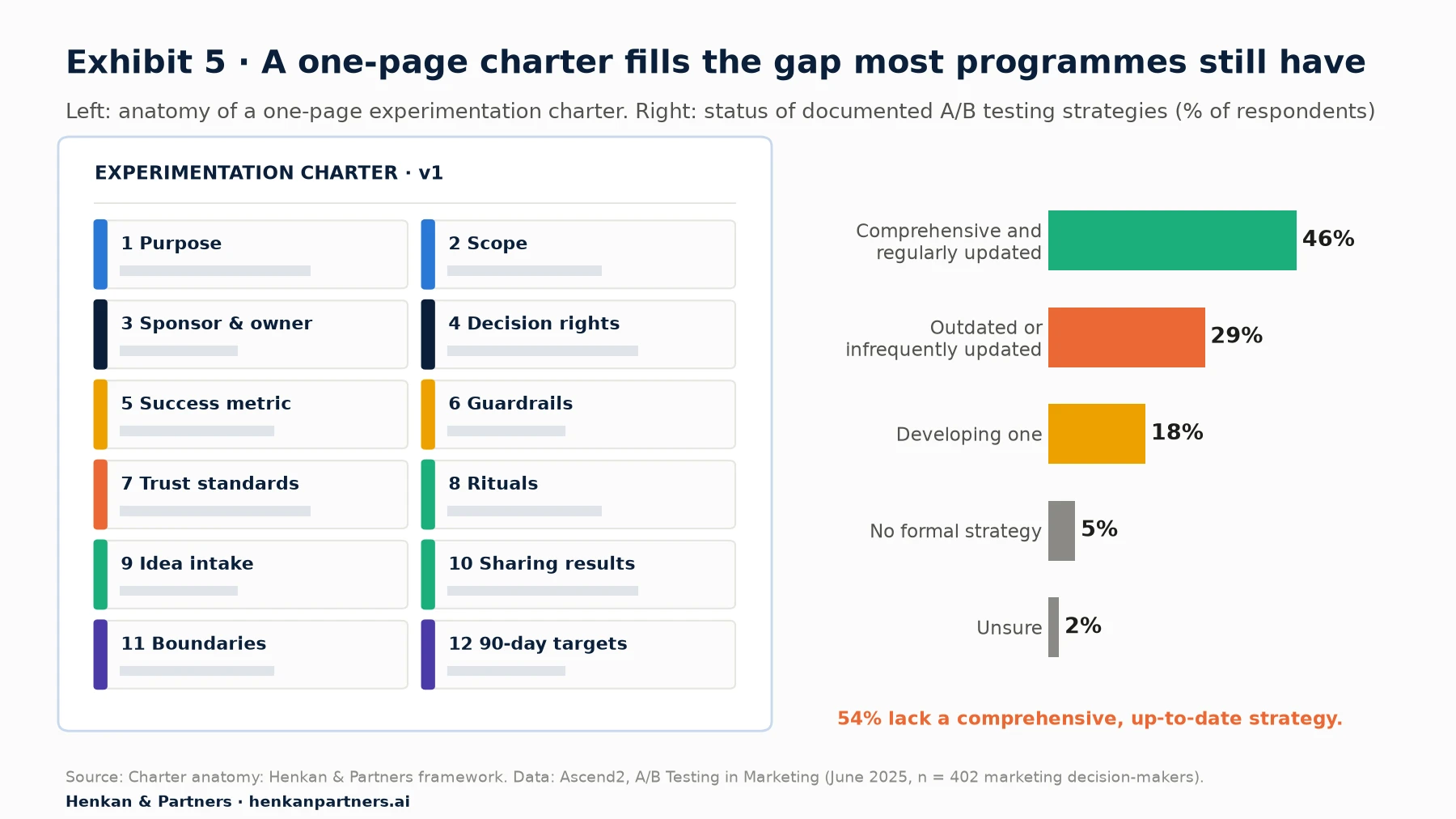
What this shows. More than half of respondents (54%) do not have a comprehensive, up-to-date strategy. A charter is a lighter starting point than a full strategy document: it fits on one page, the sponsor can sign it in week two, and you update it each quarter.
The one-page charter template
Copy this table into a document and fill in the right-hand column. The example text is illustrative.
| Section | What to write | Example (illustrative) |
|---|---|---|
| 1. Purpose | Why we test, in one or two sentences | We test to make product and marketing decisions with evidence, and to stop changes that hurt customers |
| 2. Scope | Which areas, channels and change types are in and out | In: product listing and product pages, web and app. Out: pricing levels, legal text |
| 3. Sponsor and owner | Names and roles | Sponsor: Head of E-commerce. Owner: Experimentation Lead |
| 4. Decision rights | Who can propose, launch, stop and ship | Champions propose; owner approves launch; analyst can stop on guardrail breach; area owner ships |
| 5. Success metric | The primary metric tests are judged on | Revenue per visitor, with conversion rate as a secondary |
| 6. Guardrails | Metrics that must not degrade | Page load time, return rate, error rate, unsubscribe rate |
| 7. Trust standards | Minimum quality every test meets | QA checklist, sample ratio check, pre-set duration, no peeking-based stops |
| 8. Rituals | Cadence of each ritual | Weekly stand-up, fortnightly intake, monthly show-and-tell and digest, quarterly review |
| 9. Idea intake | How anyone submits an idea | Intake form with problem, evidence and hypothesis |
| 10. Sharing results | Where results live and who sees them | All tests, including losses, in the test library; digest to all staff |
| 11. Boundaries | Brand, legal, ethical and customer limits | No dark patterns; legal review for claims and pricing displays |
| 12. 90-day targets | What success looks like by the first review | Six tests concluded, all five rituals running, second area chosen |
Decision rights (section 4) deserve the most care, because they shape your operating model. Who may launch a test without asking is the question our sibling article on choosing an operating model answers in depth. For values to put in section 1, our experimentation manifesto offers three values and 16 principles you can borrow.
Section 8 · The first 90 days
Run the programme's first 90 days in four phases, each with an exit test
The first quarter decides whether the programme becomes a habit. Kotter warned that most people "won't go on the long march unless they see compelling evidence in 12 to 24 months" that the journey is working, and that planning short-term wins is essential. In experimentation, your short-term win is not a big uplift. It is a trustworthy process that has produced decisions people used.
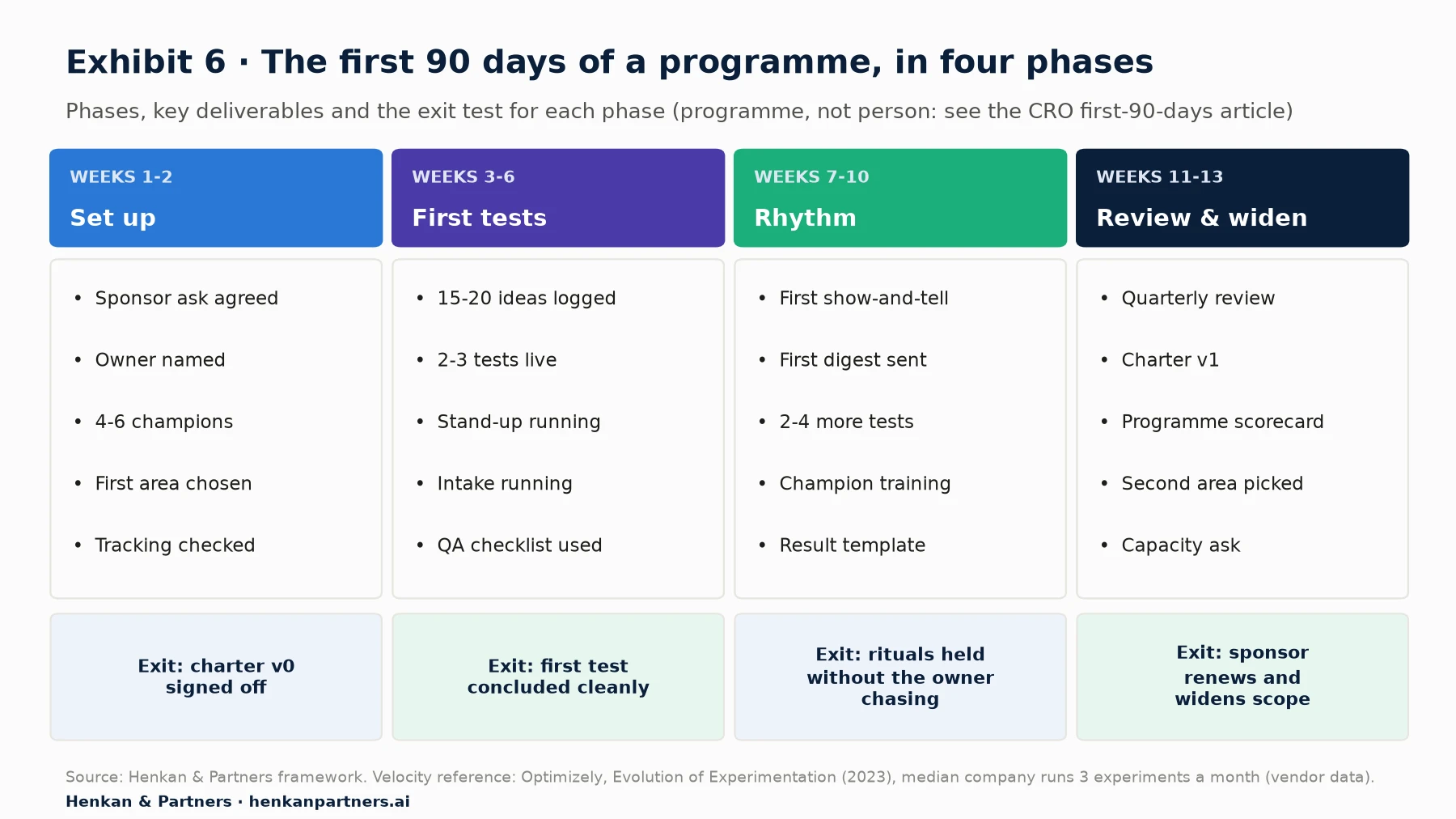
What this shows. Each phase ends with an exit test, not a date. If the first test has not concluded cleanly by week six, do not move on to building rhythm; fix the build, QA or traffic problem first. Moving on with a broken foundation is how programmes lose trust.
| Phase | Weeks | Deliverables | Exit test |
|---|---|---|---|
| Set up | 1-2 | Sponsor ask agreed; owner named; four to six champions recruited; first area chosen; tracking and testing tool checked; charter version 0 | Sponsor has signed charter v0 |
| First tests | 3-6 | Intake form live; 15 to 20 ideas logged and scored; two or three tests designed, QA'd and launched; weekly stand-up running | First test concluded with no data-quality issues |
| Rhythm | 7-10 | First show-and-tell and first digest; two to four more tests; champion training; result write-up template in use | Rituals happen without the owner chasing attendance |
| Review and widen | 11-13 | Quarterly review; charter v1; programme scorecard; second area chosen; capacity plan for next quarter | Sponsor renews commitment and agrees the next area |
Set realistic targets for the first quarter
Be careful with targets. Optimizely's analysis of over 127,000 experiments run on its platforms between 2018 and 2023 found the median company runs about three experiments a month, while reaching the top 10% requires 16 or more a month (vendor data, Optimizely customers who already pay for a testing platform). A new programme with modest developer capacity should aim for the lower end. In our experience, four to eight concluded tests in the first 90 days is a good result for a mid-sized e-commerce site. Promise a number of decisions and a working rhythm, never an uplift figure.
Our view. Measure the first quarter on three things: tests concluded cleanly, decisions taken because of a test, and rituals held on schedule. Win rate is noise at this volume; most tests do not win, even at the best testing companies.
Section 9 · AI
Use AI to lower the admin cost of rituals, but keep humans on evidence and decisions
Much of a new programme's workload is administration: summarising ideas, drafting write-ups, preparing the digest. Large language models (LLMs) and AI agents are good at this, and they make a small team's rhythm easier to sustain. Our article on AI agents in experimentation covers what vendors ship at each step.
- Idea intake. An LLM can cluster submitted ideas, flag duplicates and draft hypotheses in your standard format for the intake session.
- Results digest. An assistant can draft the digest from test records, which the owner then checks and edits.
- Charter drafting. AI can produce a first draft of the charter from your notes; the sponsor and owner must still own every decision right in it.
- Searching past tests. Assistants connected to your test library, for example through the Model Context Protocol (MCP), an open standard for connecting AI tools to data, can answer "have we tested this before?" during intake.
The risks are real. AI summaries can overstate a result or present an inconclusive test as a win, so a human must check every result line against the data. And keep the rituals human: the show-and-tell works because people change their minds in front of colleagues.
Section 10 · Pitfalls
New programmes stall for predictable reasons, and each one shows an early warning sign
Not every programme survives its first year. These are the failure modes we see most often.
| Failure mode | Early warning sign | Fix |
|---|---|---|
| Sponsor in name only | Sponsor skips the first show-and-tell | Ask for 30 minutes and a specific role; if refused, find a second sponsor before scaling |
| Champion fatigue | Champions stop submitting ideas by week six | Check that their manager released the time; recognise their work in the digest |
| Ritual theatre | Meetings happen but produce no decisions | Enforce one output per ritual; cancel any ritual without one |
| Wrong first area | Tests run for months without concluding | Re-score areas; move to higher traffic or test bigger changes |
| Results ignored | Losing variants ship anyway | Escalate to the sponsor's decision rule in the charter |
| Trust incident | A result is reversed after a tracking bug | Pause, publish what happened, add the check to the QA list |
Most of these are people problems. When the conversation gets hard, for example with a director whose idea lost, our sibling article on how to talk about experimentation to every stakeholder gives the words for each audience.
Disclosure: Henkan & Partners helps companies set up and run experimentation programmes, including fractional experimentation teams. The frameworks in this article are ours; the data comes from the third-party sources listed below.
Section 11 · What to do next
What to do next
1. This week: write your sponsor ask
Draft the four commitments in Table 2 for your most likely sponsor and book 30 minutes with them. Bring a one-paragraph business case and your proposed first area.
2. Next week: shortlist and invite champions
List ten candidates across functions, score them on the five criteria, and invite the top four to six personally. Agree half a day a week with each of their managers.
3. Score your first area
Score three to five candidate areas on traffic, appetite, politics and test-ability. Check traffic with a sample size calculator before you commit.
4. Book the rituals and sign the charter
Put all five rituals in calendars for the next 90 days, using the agendas above, and get charter version 0 signed. To save time, download the Experimentation Culture Kit: it includes a one-page charter, ritual agendas, a stakeholder map, objection cards, a RACI, a health scorecard and a maturity self-assessment.
5. Get a second opinion before you scale
If you want help choosing your first area, running the first rituals or setting up QA and reporting, our team sets up programmes like this every quarter. Talk to us.
FAQ
Frequently asked questions about starting an experimentation program
Frequently asked questions
What is an experimentation program?
An experimentation program (programme in British English) is the set of people, rules and routines that lets an organisation make decisions with controlled experiments such as A/B tests as a matter of course. It has an owner, an executive sponsor, a backlog, agreed metrics, quality standards and a regular rhythm for sharing results.
How do you start an experimentation program?
Secure one executive sponsor with four specific commitments, name one owner, recruit four to six champions across functions, pick a first area with enough traffic and an owner who wants answers, install five short rituals and write a one-page charter. Then run the first 90 days in four phases, each with an exit test.
What does an executive sponsor do in an experimentation programme?
The sponsor names the programme publicly, protects developer and analyst capacity, agrees a decision rule (tested changes ship on evidence) and protects losing tests, ideally by opening the monthly show-and-tell. Prosci's research ranks active and visible sponsorship as the top contributor to change success.
What is an experimentation champion?
A champion, sometimes called an ambassador, is a respected practitioner in a team outside the core programme who spends part of their time bringing testing into their team's work: submitting ideas, helping write hypotheses, sharing results. Vista, for example, describes its Experimentation Ambassadors as the first line of support for experiments in their domain.
How many champions do you need to start?
Four to six is enough for a first area, covering the functions that matter most, such as product, design, engineering, marketing, analytics and trading. Each needs about half a day a week, agreed with their manager. Add more as the programme spreads to new areas.
What meetings does an experimentation programme need?
Five rituals cover most needs: a weekly 30-minute experiment stand-up, a fortnightly 45-minute idea intake and prioritisation session, a monthly 45-minute show-and-tell, a monthly one-page results digest and a quarterly 90-minute roadmap review with the sponsor. Each should produce one clear output.
What should an experimentation charter include?
Purpose, scope, sponsor and owner, decision rights, success metric, guardrail metrics, trust standards, rituals, idea intake, how results are shared, brand and legal boundaries, and 90-day targets. Keep it to one page and update it each quarter.
How many tests should a new programme run in its first 90 days?
Optimizely reports that the median company on its platform runs about three experiments a month (vendor data, 2023). For a new programme with limited capacity, four to eight concluded tests in the first quarter is a good result in our experience. Measure clean conclusions and decisions taken, not uplift.
Key terms
- Experimentation programme
- The people, rules and routines that make controlled experiments the normal way to decide changes. It matters because single tests without a programme rarely change how decisions are made.
- Executive sponsor
- A senior leader who backs the programme publicly and protects its capacity. It matters because sponsorship is the strongest predictor of success in change projects.
- Programme owner
- The one person who runs the backlog, rituals, QA and reporting. It matters because shared ownership usually means no ownership.
- Champion (ambassador)
- A respected practitioner who brings testing into their own team part-time. It matters because champions spread the practice faster than a central team can.
- Guiding coalition
- Kotter's term for the group of influential people who lead a change together. It matters because no single person can change how a company decides.
- Early adopters
- In Rogers' diffusion model, the roughly 13.5% of people who adopt new practices early and influence peers. They matter because they are the best pool for champions.
- Ritual
- A recurring meeting or document with a fixed cadence, agenda and output. Rituals matter because they turn occasional tests into a habit.
- Experimentation charter
- A one-page agreement on purpose, scope, decision rights, metrics and rules. It matters because it stops the rules being renegotiated after each inconvenient result.
- Decision rights
- Who can propose, launch, stop and ship tested changes. They matter because unclear rights cause delays and disputes.
- Primary success metric
- The metric a test is judged on, such as revenue per visitor. It matters because changing the metric after the test is a common way to fake a win.
- Guardrail metric
- A metric that must not get worse, such as page speed or return rate. It matters because a variant can win on its main metric while hurting the business elsewhere.
- Sample ratio mismatch (SRM)
- When the observed split of users between variants differs from the planned split. It matters because it signals a bug that can invalidate the result.
- Results digest
- A short, regular written summary of concluded tests and decisions. It matters because it reaches people who never attend meetings and builds institutional memory.
- Test velocity
- The number of experiments launched or concluded per period. It matters as a sign of programme health, but only when tests are trustworthy and lead to decisions.
Sources
All sources checked in October 2026. Optimizely and Speero figures are vendor or agency data from their own customers or surveys and are labelled as such; Speero does not publish the sample size for the figure we cite. Rogers' adopter percentages are taken from a secondary summary of his book. Prosci data covers change projects in general, not experimentation programmes specifically. Exhibits 3, 4 and 6, the charter anatomy in Exhibit 5, the annotations in Exhibit 2, and Tables 1 to 8 are Henkan & Partners frameworks; Table 4 is an illustrative example, not client data.
- Prosci (2020). Best Practices in Change Management, 11th edition: executive summary.
- Prosci (n.d.). Primary Sponsor's Role and Importance.
- Kotter, J. P. (1995, HBR classic reprint). Leading Change: Why Transformation Efforts Fail. Harvard Business Review.
- Carus (n.d.). Summary of Diffusion Theory (Rogers, Diffusion of Innovations, 5th edition, 2003).
- Vermeer, L. & De Souza, F. (2022). Organising for scaled experimentation.
- Microsoft Learn (n.d.). Create your champions program for Microsoft Teams.
- Machmouchi, W. & Gupta, S. (2021). Patterns of Trustworthy Experimentation: Post-Experiment Stage. Microsoft Research, Experimentation Platform.
- Ascend2 (2025). A/B Testing in Marketing research report (n = 402, fielded April 2025).
- Optimizely (2023). The Evolution of Experimentation. Vendor data.
- Optimizely via PR Newswire (2023). Optimizely Debuts New Report Revealing Increased Rates of Experimentation. Vendor data.
- Speero (2024). Why Mature Programs Grow Faster: Speero + Kameleoon Original Research. Agency and vendor data.